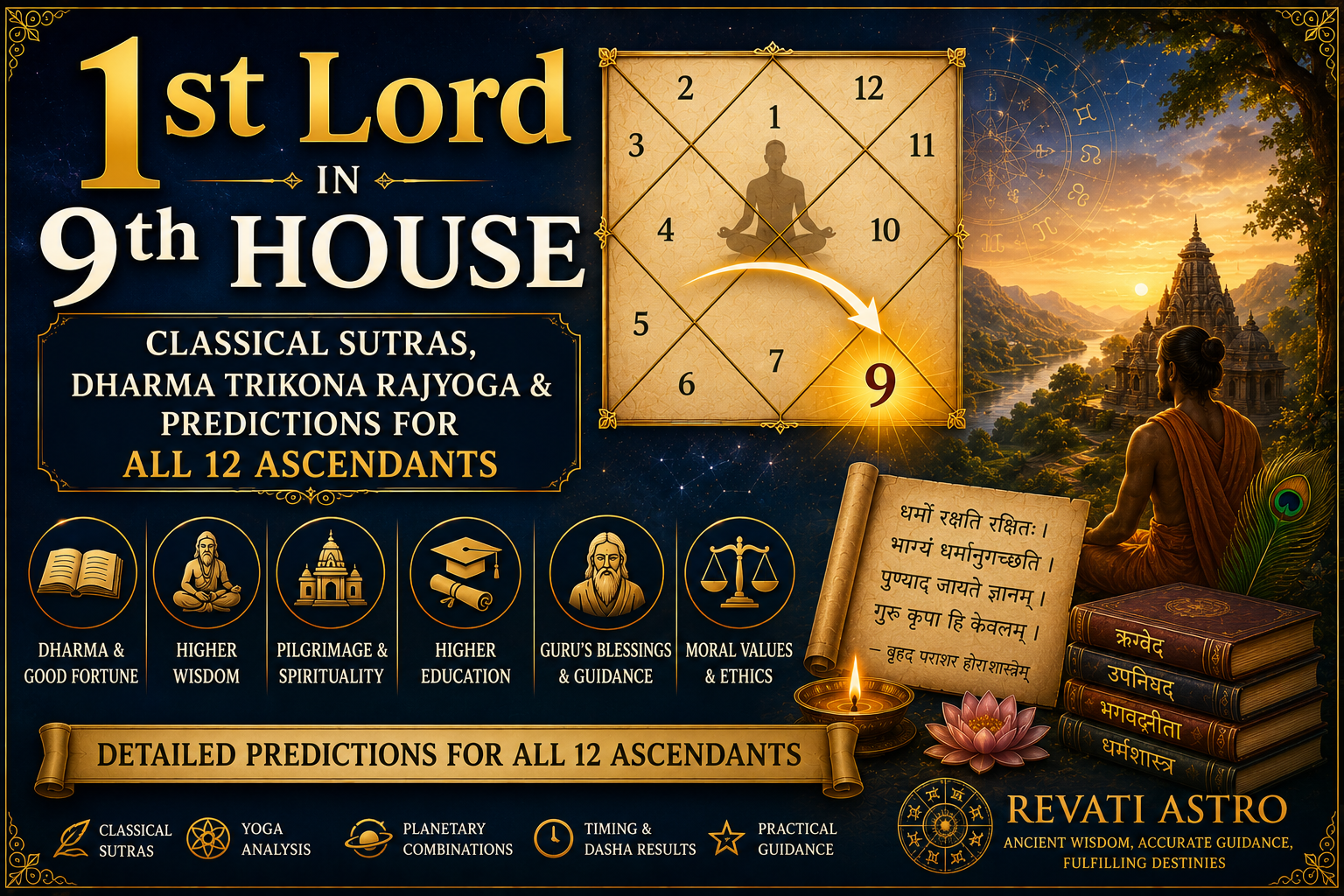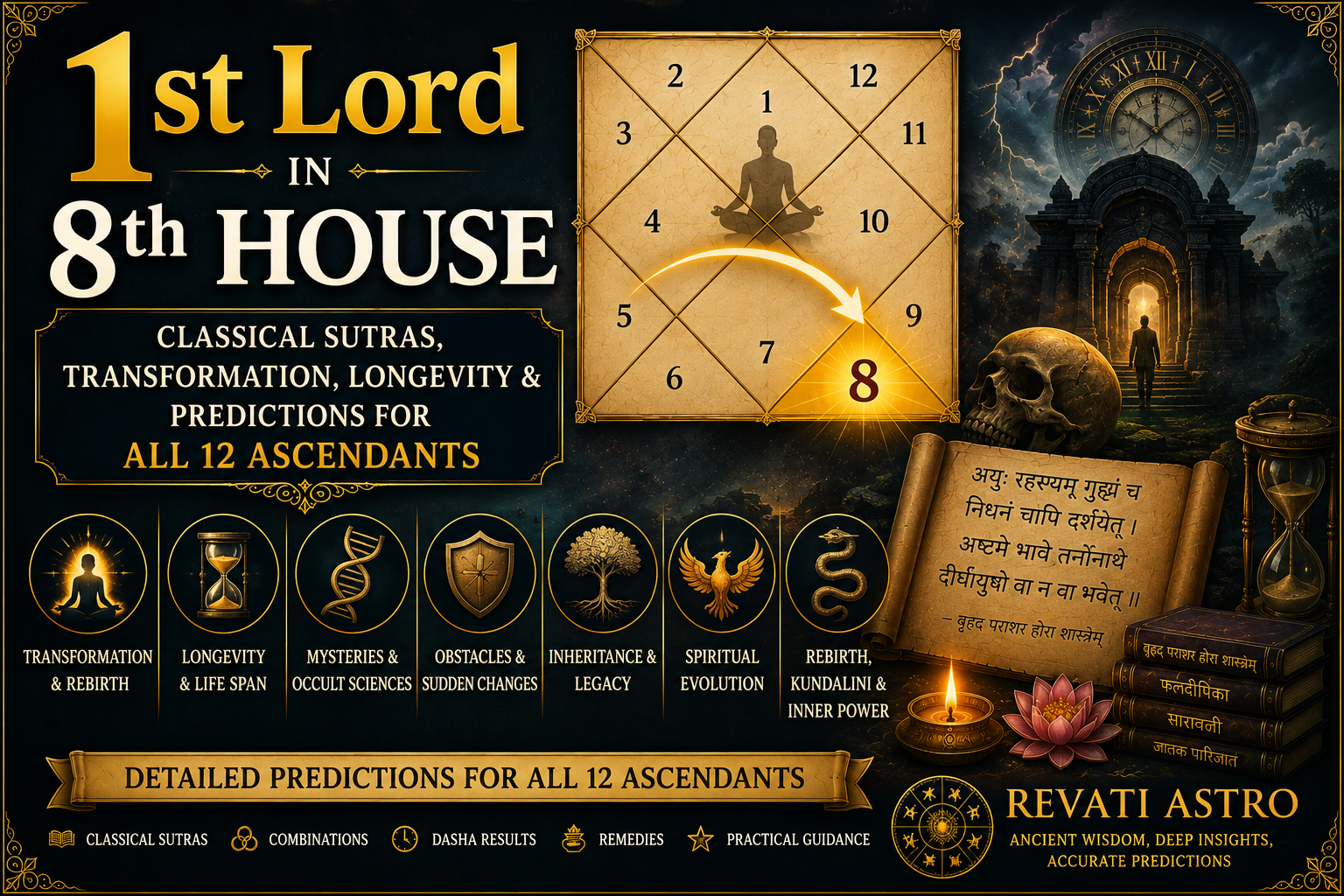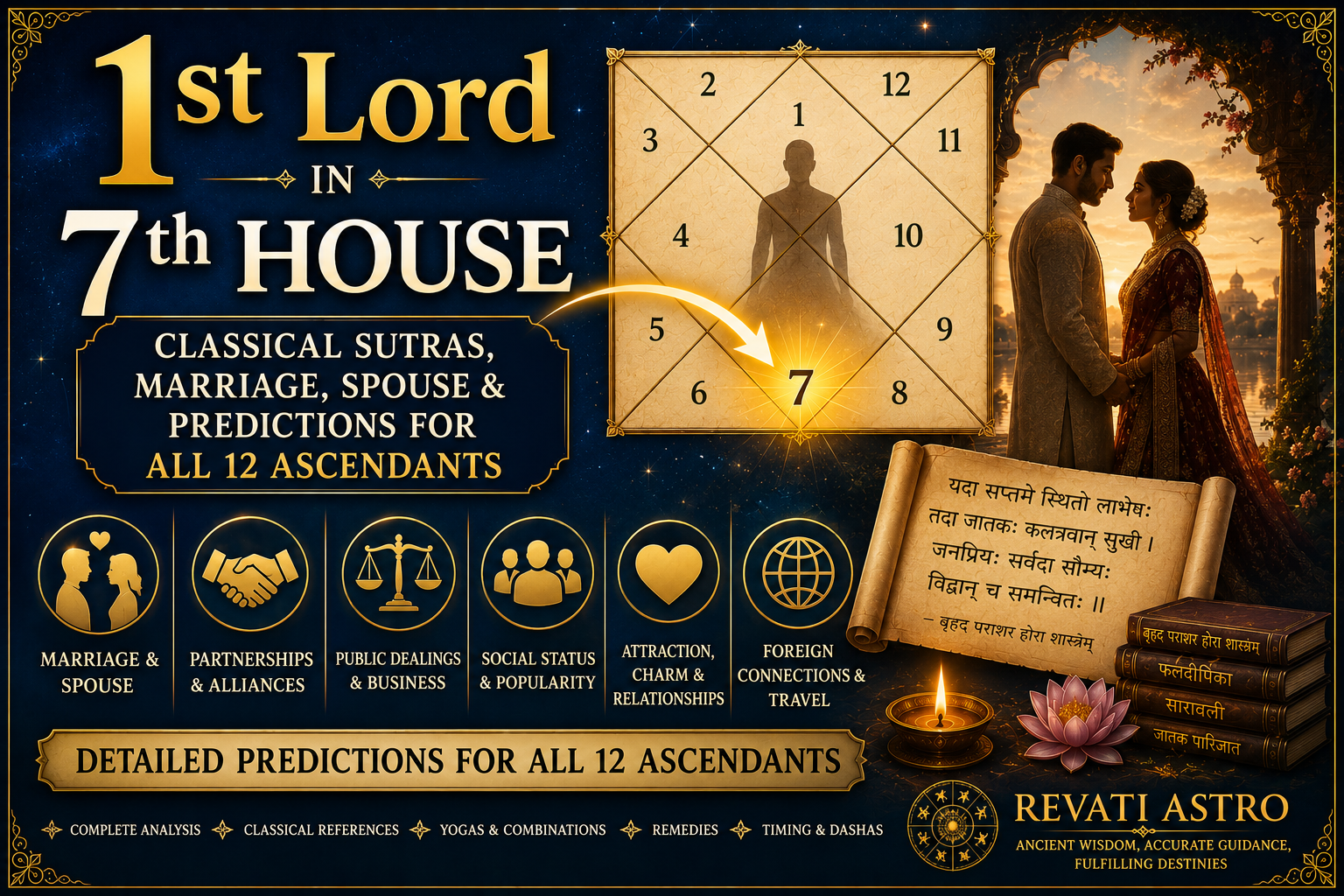



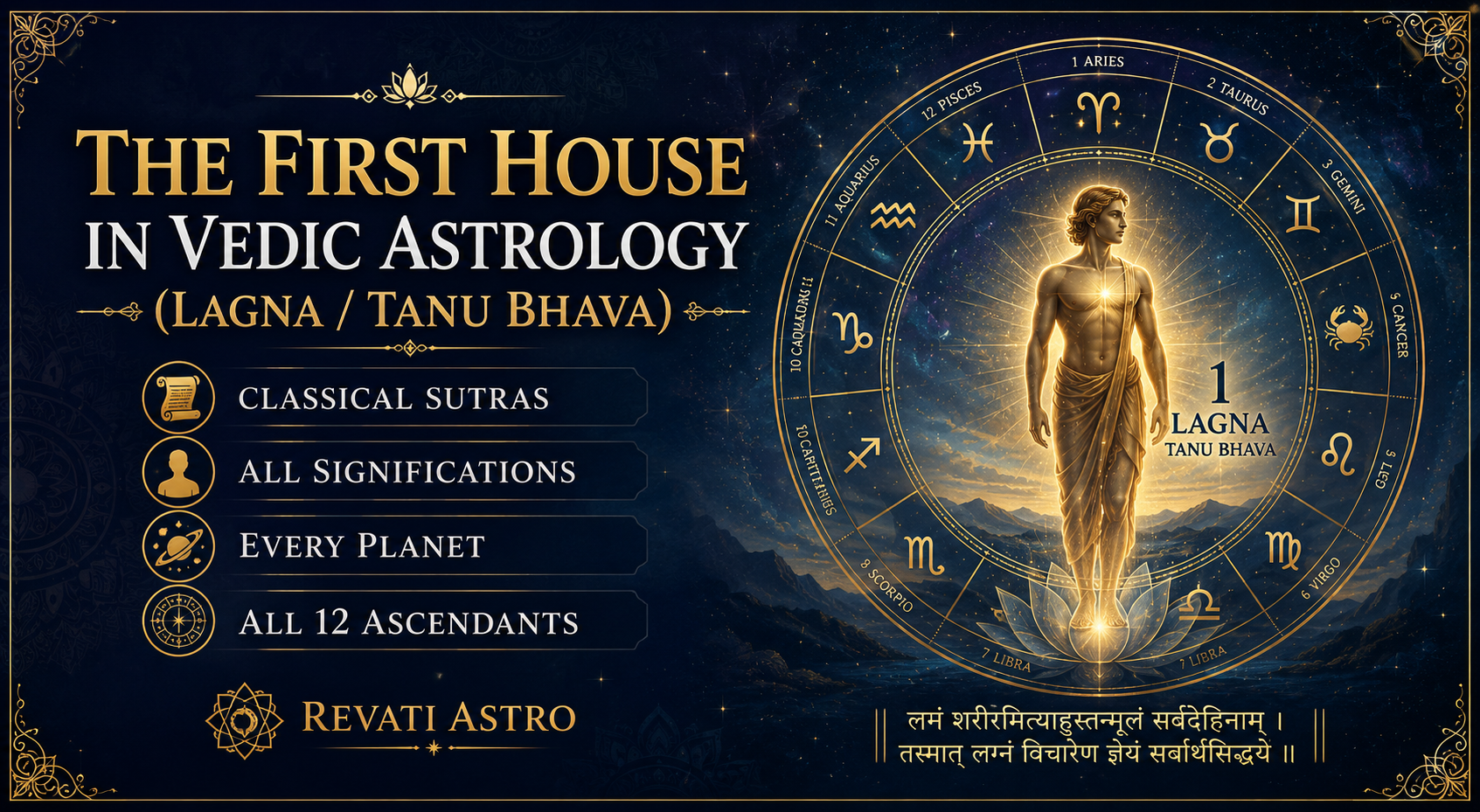
Everything in astrology begins here. Before the ancient sages examined wealth, marriage, career, or children in any horoscope, they examined one thing first: the First House. Not because it is simply the starting point of the chart wheel — but because every planetary promise, every yoga, every fortune or affliction written in the horoscope is delivered through the instrument of the self.
A lame messenger cannot carry the king’s order. A damaged vessel cannot carry its cargo through rough waters. The First House is that vessel — and every house in the chart depends on its strength to deliver its promise. This is the house of you — your body, your breath, your personality, your courage, your vitality, and the story your soul chose for this incarnation.
In this definitive guide, we cover the First House with the depth it deserves: the original Sanskrit sutras of Parashara, Varahamihira, Kalyana Varma, Mantreswara, Kalidasa, and Vaidyanatha Dikshita; what each classical text adds that the others do not; the effect of all nine planets in the First House with classical shlokas; complete predictions for all 12 ascendants including personality, appearance, health, and life path; special yogas, Dasha timing, and divisional chart analysis. No surface-level content. Everything from the source.
📜 Table of Contents
- What is the First House? Foundation & Three Layers
- Classical Names & Their Meanings
- The Parashara Sutra — Root of All First House Analysis
- Significations Across All Major Classical Texts
- Body Parts, Constitution & Physical Indicators
- The Lagna Lord — Role, Importance & Five Tests of Strength
- Judging First House Strength — Classical Method
- Every Planet in the First House — Sutras & Full Predictions
- All 12 Ascendants — Personality, Appearance, Health & Life Path
- Special Yogas & Combinations Involving the First House
- Transits & Dashas Through the First House
- First House in Divisional Charts
- Health, Body & Disease Patterns
- FAQ — Questions Every Student Asks
1. What is the First House? Foundation & Three Layers
The zodiac wheel contains twelve houses (Bhavas), each governing a specific domain of human life. The First House — called Lagna, Tanu Bhava, or the Ascendant — is the most critical of all twelve. It is the zodiac sign that was rising on the eastern horizon at the exact moment of your birth. Because the Earth rotates every 24 hours, the rising sign changes approximately every two hours, making the First House the most time-sensitive and personally specific point in any horoscope.
Ancient Vedic astrologers called the Lagna the Jeeva — the life force itself. Without the body, no experience of this incarnation is possible. Without a strong First House, no planetary promise in the chart can be fully realised.
Three Layers Define the First House in Every Chart
Layer 1 — The Lagna Rashi (Rising Sign): The zodiac sign that is rising at birth. This sign’s nature, element, quality, and natural ruler shape the fundamental personality, physical constitution, and the native’s entire approach to life.
Layer 2 — Planets in the First House (Lagna Sthita Grahas): Any planet occupying the First House modifies and colours its results deeply. Some strengthen the First House; others challenge and test it. The planet merges its energy directly with the native’s personality and physical form.
Layer 3 — The Lagna Lord (Lagnesh): The planetary ruler of the rising sign. Where this planet is placed in the chart — in what house, what sign, with what aspects and conjunctions — determines the overall direction, health, and fortune of the native’s entire life.
⭐ Why the First House Holds a Unique Position in Classical Classification
The First House holds a position in classical Vedic astrology that no other house can claim. It is simultaneously a Kendra (quadrant — houses 1, 4, 7, 10) AND a Trikona (trine — houses 1, 5, 9). These are the two most powerful classifications in Jyotisha:
- Kendra houses = houses of tangible worldly manifestation, action, and structural strength
- Trikona houses = houses of dharma, fortune, divine grace, and spiritual merit
No other house in the chart carries both designations simultaneously. A planet placed in the First House or ruling it gains both Kendra and Trikona strength at once — making the Lagna Lord the single most important planet in any horoscope.
2. Classical Names & Their Meanings
The First House carries multiple Sanskrit names in the classical literature. Each name is not ceremonial — it reveals a distinct dimension of what this house governs. Understanding all the names is understanding the full scope of the house.
| Sanskrit Name | Literal Meaning | Astrological Significance |
|---|---|---|
| Lagna (लग्न) | “That which is attached” or “that which has risen” | The moment of the soul’s attachment to the body at birth — the karmic contract of this lifetime made visible in the chart |
| Tanu Bhava (तनु भाव) | The house of the physical body (Tanu = body/form) | Physical constitution, form, and the body as the primary vehicle of experience in this incarnation |
| Udaya Lagna (उदय लग्न) | “Rising Lagna” — the sign physically rising at birth | The most time-sensitive coordinate in the chart, changing every ~2 hours; the foundation of the entire house structure |
| Atma Bhava (आत्म भाव) | The house of the Atma (individual soul) | Used in Jataka Parijata: not just the body but the soul’s chosen instrument for this incarnation |
| Deha Bhava (देह भाव) | The house of the physical form (Deha = form) | The entire physical existence — not merely appearance, but the whole somatic experience of being alive in this body |
| Horoskopos (ὡροσκόπος) | “Hour-marker” — the sign that marks the hour of birth | Hellenistic term; the etymological origin of the English word “horoscope” — East and West both agreed this is where everything begins |
3. The Parashara Sutra — Root of All First House Analysis
The foundational classical verse on the First House from the Brihat Parashara Hora Shastra defines the entire scope of First House analysis. This single shloka has been the starting point for every commentator and practitioner in Jyotisha for centuries:
तनुं रूपं च ज्ञानं च वर्णं चैव बलाबलम् ।
प्रकृतिं सुखदुःखं च तनुभावाद्विचिन्तयेत् ॥Tanum rūpam ca jñānam ca varnam caiva balābalam |
Prakrtim sukhaduḥkham ca tanubhāvādvicintayet ||
Translation: “From the Tanu Bhava (First House), examine the body, its form, knowledge, complexion, strength and weakness, natural temperament, and the joys and sorrows of life.”
Word-by-word: Tanum = the physical body | Rupam = appearance, outer form | Jnanam = knowledge, intelligence | Varnam = complexion, colour, character | Balabalam = “strength-weakness” — the ratio of fortitude to frailty | Prakritim = natural temperament, inherent constitution | Sukham = happiness, capacity for joy | Duhkham = sorrow, degree of suffering | Tanubhavad = from the First House | Vicintayet = should carefully examine.
The hidden depth of this sutra: Notice what Parashara includes beyond the physical body — knowledge (jnanam), natural temperament (prakritim), and the fundamental ratio of happiness to sorrow (sukha-duhkham) in a person’s life. The First House is not merely a physical descriptor. It is the lens through which all of life’s experience is filtered. A damaged First House does not just mean health problems — it means the native’s entire experience of life, from joy to sorrow, is coloured by that damage.
लग्नं बलवद् भवेत् तदा सर्वभावफलानि प्राप्नोति ।
लग्नं दुर्बलं चेत् सर्वफलेषु विघ्नो भवेत् ॥Lagnam balavad bhavet tadā sarvabhāvaphalāni prāpnoti |
Lagnam durbalaṃ cet sarvaphaleṣu vighno bhavet ||
Translation: “When the First House is strong, the native attains the results of all houses. When the First House is weak, there is obstruction in obtaining results from all houses.”
This is the single most important principle in classical Jyotisha: The First House is the delivery mechanism for every other house’s promise. A powerful Raja Yoga in a chart with a severely afflicted First House may deliver its results weakened, delayed, or only partially realised. A strong First House amplifies every positive configuration in the horoscope.
लग्नं तनुभवं चैव आयुष्यभवं सह विचिन्तयेत् ।Lagnam tanubhavam caiva āyuṣyabhavam saha vicintayet |
Translation: “The First House and the Eighth House (Ayushya Bhava) must always be examined together.”
The First House represents the life force given at birth. The Eighth House represents the forces that consume or extend it. For any longevity assessment, classical astrology requires both to be examined — one without the other is incomplete diagnosis.
आद्यभावे विचार्याणि — शरीरं, सुखदुःखे, स्वभावः,
आयुः, वर्णः, बलाबलम्, ज्ञानम्, बाल्यावस्था च ।Ādyabhāve vicāryāṇi — śarīraṃ, sukhaduḥkhe, svabhāvaḥ,
āyuḥ, varṇaḥ, balābalam, jñānam, bālyāvasthā ca |
Translation: “From the First House, examine: the body; happiness and sorrow; natural character; longevity; complexion; strength and weakness; knowledge; and the experiences of childhood.”
Kalidasa adds two dimensions Parashara does not explicitly name: longevity (Ayushya) and childhood experiences (Balyavastha). The quality of early life — the formative environment and relationships of childhood — is a First House matter in the full classical framework.
4. Significations Across All Major Classical Texts
No single text tells the complete story. Each major classical source adds unique dimensions to our understanding of the First House. Here is what each contributes that the others do not:
Brihat Parashara Hora Shastra (Parashara)
- Physical body (Tanu), its constitution and form
- Personality, character, and natural temperament (Prakriti)
- Complexion and physical appearance (Rupa, Varna)
- General wellbeing and overall health
- Life force (Prana Shakti) and vitality
- Happiness-sorrow ratio throughout life
- Courage and natural inner strength
- The head and brain as the primary body part governed
- Childhood experiences and early life environment
- Unique dual classification: both Kendra AND Trikona
Uttara Kalamrita (Kalidasa)
- Strength, vitality, and raw energy levels
- Head, brain, forehead, and all facial features
- Overall lifespan and longevity (Ayushya)
- Early childhood experiences and their lifelong impact
- The native’s paternal grandmother (as the 4th from the 10th house)
- Gains of siblings (as the 11th from the 3rd house)
- Self-respect, dignity, and personal honour
- The first impression the native makes on the world
Phaladeepika (Mantreswara)
- Outward behaviour — how the native acts versus their inner reality
- The approach to life — confidence, hesitation, aggression, or grace
- Health and its fluctuations across the lifespan
- Dignity, honour, and reputation in society
- Natural abilities and effortless talents
- The behavioural signature — the native’s personal operating style immediately recognisable to everyone they meet
Saravali (Kalyana Varma)
- Physical features and their quality, proportion, and distinctiveness
- How the native is perceived by strangers at first encounter
- Fame — or its absence — in the world
- Quality of the physical frame: robust or frail, well-formed or otherwise
- Fortitude and endurance — capacity to withstand physical and mental hardship
- Arishtas (misfortunes, obstacles) in early life and how they shape character
- Sign-specific First House effects — most detailed physical descriptions of any classical text
Brihat Jataka (Varahamihira)
- The First House as the primary seat of Ayus (life duration)
- Physical attractiveness as a social and karmic indicator
- Longevity directly linked to First House strength
- The native’s capacity to project their personality into the external world
Jataka Parijata (Vaidyanatha Dikshita)
- The Atma Bhava — house of the individual soul (Jivatma)
- The quality of the native’s mind and its natural inclinations
- How past-life karmas express through the physical constitution and temperament
- The native’s relationship with their own physical form
5. Body Parts, Constitution & Physical Indicators
In the classical Kalpurusha (cosmic body) framework, the twelve signs correspond to twelve parts of the cosmic person. Since the First House always maps to the Aries/head position in this framework, it governs specific body parts consistently across all classical texts:
Primary Body Parts — First House
- Head and brain — skull, cranium, neurological health
- Face, forehead, and all facial features
- Eyes (particularly the right eye in several traditions)
- Hair and scalp — density, quality, scalp conditions
- Overall body structure and constitutional type
- Complexion and skin quality
- General vitality and immune strength
Medical Conditions from First House Afflictions
- Saturn afflicting: Joint, bone, tooth, skin; chronic disorders
- Mars afflicting: Injuries, scars, head wounds; fevers; inflammation
- Rahu afflicting: Mysterious conditions; neurological sensitivity
- Ketu afflicting: Sudden health events; unexplained conditions
- Sun afflicted: Eye weakness; vitality depletion; head conditions
- Moon afflicted: Mental health; respiratory; psychosomatic
First House Element & Body Constitution
| Element | Rising Signs | Ayurvedic Type | Physical Pattern |
|---|---|---|---|
| Fire 🔥 | Aries, Leo, Sagittarius | Pitta | Athletic, medium build; prominent features; bright eyes; high immediate energy |
| Earth 🌍 | Taurus, Virgo, Capricorn | Kapha/Vata | Sturdy, well-built frame; good bone structure; steady sustained energy |
| Air 💨 | Gemini, Libra, Aquarius | Vata | Lean, agile; quick movements; expressive face; variable energy |
| Water 💧 | Cancer, Scorpio, Pisces | Kapha | Rounded, soft features; large expressive eyes; emotion-linked vitality |
6. The Lagna Lord — Role, Importance & Five Tests of Strength
The Lagna Lord (Lagnesh) is the planetary ruler of the rising sign. This planet is the ambassador of the First House — wherever it is placed in the chart, it carries the native’s personal energy, purpose, and vitality into that house’s domain. The Lagna Lord’s condition is the single most important analytical step after identifying the rising sign itself.
लग्नाधिपे लग्ने स्थिते तनु बलं परं मतम् ।Lagnādhipe lagne sthite tanu balaṃ paraṃ matam |
Translation: “When the First Lord is placed in the First House itself, the strength of the body is considered supreme.”
This is the best possible First House configuration — the Lagna Lord at home in its own house, maximum First House expression in every dimension.
Five Classical Tests for Lagna Lord Strength
Test 1 — House Placement: Kendra placements (1, 4, 7, 10) give strength and worldly manifestation. Trikona placements (1, 5, 9) give fortune and dharmic support. Dusthana placements (6, 8, 12) weaken the Lagna Lord’s ability to deliver easy results — though the 8th carries complex longevity implications.
Test 2 — Sign Condition: Exaltation, Moolatrikona, or own sign = maximum strength. Debilitation, enemy sign, or combust = weakened. Neechabhanga (cancellation of debilitation) restores functional strength and often produces extraordinary results.
Test 3 — Conjunctions & Aspects: Natural benefics (Jupiter, Venus, strong Mercury, waxing Moon) strengthen. Natural malefics (Saturn, Mars, Sun, Rahu, Ketu) require analysis of their house lordship for the specific chart — a Yogakaraka malefic is a strengthening force even while appearing to be a malefic.
Test 4 — Retrograde Motion: A retrograde Lagna Lord intensifies First House themes but adds unconventional or delayed expression. The native’s identity and self-expression are themes they must consciously develop rather than ones that operate automatically.
Test 5 — Navamsha and Vargottama Status: A Vargottama Lagna Lord — occupying the same sign in D1 and D9 — is exceptionally powerful and expresses its qualities with unusual purity and directness. The soul-level and personality-level align completely.
Lagna Lord Quick Reference
| Ascendant | Sanskrit Name | Lagna Lord | Natural Character |
|---|---|---|---|
| ♈ Aries | Mesha Lagna | Mars (Mangal) | Warrior · Initiator · Fire-ruled |
| ♉ Taurus | Vrishabha Lagna | Venus (Shukra) | Builder · Aesthete · Earth-ruled |
| ♊ Gemini | Mithuna Lagna | Mercury (Budha) | Communicator · Analyst · Air-ruled |
| ♋ Cancer | Karka Lagna | Moon (Chandra) | Nurturer · Empath · Water-ruled |
| ♌ Leo | Simha Lagna | Sun (Surya) | Leader · Creator · Fire-ruled |
| ♍ Virgo | Kanya Lagna | Mercury (Budha) | Perfectionist · Healer · Earth-ruled |
| ♎ Libra | Tula Lagna | Venus (Shukra) | Diplomat · Artist · Air-ruled |
| ♏ Scorpio | Vrishchika Lagna | Mars (Mangal) | Transformer · Researcher · Water-ruled |
| ♐ Sagittarius | Dhanu Lagna | Jupiter (Guru) | Philosopher · Teacher · Fire-ruled |
| ♑ Capricorn | Makara Lagna | Saturn (Shani) | Builder · Executive · Earth-ruled |
| ♒ Aquarius | Kumbha Lagna | Saturn (Shani) | Reformer · Visionary · Air-ruled |
| ♓ Pisces | Meena Lagna | Jupiter (Guru) | Mystic · Healer · Water-ruled |
7. Judging First House Strength — The Classical Method
✅ Signs of a Strong First House
- Lagna Lord in Kendra or Trikona from Lagna
- Natural benefics occupy or aspect the First House
- Lagna Lord in exaltation, Moolatrikona, or own sign
- No malefics in First House — or malefics present are Yogakarakas for that chart
- Lagna Nakshatra’s ruling planet is strong and well-placed
- First House is Vargottama (same sign in D1 and D9)
- The Sun (Atma Karaka of the First House) is well-placed and unafflicted
⚠️ Signs of a Weak First House
- Lagna Lord in 6th, 8th, or 12th under heavy malefic affliction
- Two or more natural malefics in First House without benefic protection
- Lagna Lord debilitated without Neechabhanga
- Rahu or Ketu conjunct the Lagna Lord in a dusthana house
- Saturn and Sun both simultaneously afflict the First House
- Lagna Lord combust within 3° of the Sun without redeeming placements
- First House afflicted in both D1 and D9 — no Vargottama strength
8. Every Planet in the First House — Classical Sutras & Full Predictions
When a planet occupies the First House, it merges its energy directly with the native’s personality, appearance, and life force. Every section below leads with the actual classical shloka — the original Sanskrit, transliteration, and translation — followed by the complete predictive synthesis.
☉ Sun (Surya) in the First House
सूर्यः लग्ने — अल्पकेशः क्रोधी क्रूरः नेत्ररोगी,
प्रसिद्धः बलवान् क्षमाहीनो दीप्तकायः ।Sūryaḥ lagne — alpakeśaḥ krodhī krūraḥ netrarogi,
prasiddhaḥ balavān kṣamāhīno dīptakāyaḥ |
Translation: “The Sun in the Ascendant: the native has sparse hair, is given to anger, is somewhat harsh in nature, suffers from eye weakness, possesses a prominent and distinguished personality, is strong-willed, is impatient, and has a radiant physique.”
यदि लग्ने कर्के सूर्यः — शोफनेत्रः ।
मेषे — दुर्बलदृष्टिः । सिंहे — रात्रान्धः ।Yadi lagne karke Sūryaḥ — śophanayanaḥ |
Meṣe — durbaladr̥ṣṭiḥ | Siṃhe — rātrāndhaḥ |
Translation: “If the Sun is in the Ascendant in Cancer — the native will have swollen eyes. In Aries — the sight will be weak. In Leo — the Sun makes the person night-blind.”
Predictive Synthesis: The Sun in the First House is the signature of a deeply identity-conscious personality. These natives are built for leadership, visibility, and command. Their sense of self is inseparable from how they are seen and respected by the world — they dominate any room without necessarily intending to. For Leo Ascendant — where the Sun is also the Lagna Lord — this doubles the solar signature. The native is unmistakably regal and powerful, but must guard against ego-rigidity that alienates allies.
Physical signature: Sparse hair (consistent classical note), radiant bearing, strong constitution. Eyes may be sensitive — the sign-specific warnings from Saravali apply directly. Health: Eye conditions (especially Cancer or Leo Lagna), head-related issues. Career pattern: Natural leaders, politicians, public figures. The need to be seen and respected is the core motivational engine — when channelled into genuine service, extraordinary results follow.
☽ Moon (Chandra) in the First House
चन्द्रः लग्ने — सुन्दरकायः सुखी भोगी,
चपलमनाः स्त्रीप्रियः मधुराहारी ।Candraḥ lagne — sundarakāyaḥ sukhī bhogī,
capalamānasaḥ strīpriyaḥ madhurāhārī |
Translation: “The Moon in the Ascendant: the native has a beautiful and attractive body, is inclined toward happiness and sensory enjoyment, has a restless mind, is fond of the company of women, and loves sweet foods.”
पूर्णचन्द्रः लग्ने शुभः, क्षीणचन्द्रः लग्ने मानसिकचापल्यम् ।Pūrṇacandraḥ lagne śubhaḥ, kṣīṇacandraḥ lagne mānasikacāpalyam |
Translation: “A Full (Waxing) Moon in the Ascendant is auspicious. A Waning Moon in Lagna creates mental restlessness and emotional fluctuation.”
Predictive Synthesis: The Moon in the First House creates the most emotionally transparent personality in astrology. These natives wear their inner world on the outside — their face reflects their emotional state immediately and directly. They absorb the moods and energies of spaces and people like a sponge: a gift (empathy, intuition) and a vulnerability (emotional overwhelm, boundary challenges).
The Moon’s phase at birth is the most critical modifier. A Waxing Moon (Shukla Paksha) in Lagna amplifies vitality, optimism, and attractiveness. A Waning Moon (Krishna Paksha) — particularly the last quarter — creates emotional fluctuation and a less robust constitution, exactly as BPHS states. Cancer Ascendant with Moon as Lagna Lord in the First: maximum lunar expression — deep empathy, psychic sensitivity, powerful nurturing capacity. Health: Chest, stomach, digestive system. Emotional states directly trigger physical symptoms with clockwork consistency.
♂ Mars (Mangal) in the First House
मङ्गलः लग्ने — ह्रस्वकायः साहसी युद्धप्रियः,
क्रोधी क्षतचिह्नयुक्तः शस्त्रकुशलः ।Maṅgalaḥ lagne — hrasvakāyaḥ sāhasī yuddhapriyaḥ,
krodhī kṣatacihna-yuktaḥ śastrakuśalaḥ |
Translation: “Mars in the Ascendant: the native is of compact stature, courageous, fond of battles and conflict, quick to anger, bears a wound-mark or scar on the body, and is skilled in weapons and martial arts.”
लग्ने मङ्गलः — क्षतं देहे विशेषतो मुखे शिरसि वा ।Lagne Maṅgalaḥ — kṣataṃ dehe viśeṣato mukhe śirasi vā |
Translation: “Mars in the Ascendant produces a mark, wound, or scar on the body — particularly on the face or head.”
This physical indicator appears with striking consistency across verified charts. Saravali, BPHS, and Phaladeepika all note it independently — one of the most reliably observable physical signatures in all of classical Jyotisha.
Predictive Synthesis: Mars in the First House is one of the most recognisable physical and personality signatures in Jyotisha. The lean or athletic build, the direct unflinching gaze, the quality of barely-contained energy — all are Mars in Lagna hallmarks. These natives are built for action, competition, and challenge. Fear is not their default mode — action is. Temper is quick but passes equally quickly; Mars people process conflict through confrontation, not suppression, and rarely hold grudges.
For Aries and Scorpio Ascendants with Mars as Lagna Lord in the First — the most action-oriented, self-directed Mars-saturated personality in the zodiac. Natural athletes, surgeons, military, police, entrepreneurs. Jataka Parijata note: Mars in Lagna in a Fire sign needs Jupiter’s moderating aspect for wisdom; in a Water sign, the martial energy combined with emotional depth can produce volatility. Health: Injuries and accidents (especially head and face), fevers, inflammatory conditions. Fast recovery — Mars heals quickly.
☿ Mercury (Budha) in the First House
बुधः लग्ने — विद्वान् बुद्धिमान् वाक्पटुः,
बहुविद्याकुशलः यौवनसम्पन्नः सर्वकलावित् ।Budhaḥ lagne — vidvān buddhimān vākpaṭuḥ,
bahuvidyākuśalaḥ yauvanasampannaḥ sarvakalaāvit |
Translation: “Mercury in the Ascendant: the native is learned, intelligent, eloquent, skilled in many branches of knowledge, possessed of a youthful appearance throughout life, and versed in all the arts.”
Predictive Synthesis: Mercury in the First House produces the most intellectually vivid and verbally gifted personality in astrology. These natives live in their minds. Information, ideas, and communication are not just tools — they are the primary way this person experiences reality. They are the most well-read, verbally agile, and intellectually versatile of any rising sign group.
The classical emphasis on Yauvanasampanna (possessed of youth) is borne out with remarkable consistency — Mercury in Lagna natives typically appear younger than their biological age throughout life, both physically and in their energy and curiosity. Gemini and Virgo Ascendants with Mercury in Lagna: double Mercury energy, outstanding intellect, but must guard against overthinking and nervous exhaustion. Health: Nervous system — anxiety, nervous exhaustion, skin conditions, respiratory issues. The mind’s relentless activity takes a physical toll.
♃ Jupiter (Guru) in the First House
गुरुः लग्ने — सुज्ञानी सच्चरित्रो विशालकायः,
सर्वैः पूजितः धार्मिको दीर्घायुः सम्पन्नः ।Guruḥ lagne — sujñānī saccaritro viśālakāyaḥ,
sarvaiḥ pūjitaḥ dhārmiko dīrghāyuḥ sampannaḥ |
Translation: “Jupiter in the Ascendant: the native is blessed with excellent wisdom, noble character, a large and distinguished physique, is honoured by all, is righteous, long-lived, and prosperous.”
गुरुः लग्ने यदि — सर्वभावेषु शुभफलं भवति ।
लग्नस्थो गुरुः सर्वदोषहरः ।Guruḥ lagne yadi — sarvabhāveṣu śubhaphalaṃ bhavati |
Lagnastho guruḥ sarvadoṣaharaḥ |
Translation: “When Jupiter is in the Ascendant, auspicious results flow from all houses. Jupiter placed in the First House is said to remove (neutralise) all doshas (afflictions) of the chart.”
This is the strongest endorsement in all of classical literature for any single planetary placement. No other planet in any house receives a comparable statement across the major texts.
Predictive Synthesis: Jupiter in the First House is the single most protective and beneficially expansive placement in all of Jyotisha. Physically, Jupiter produces a larger-than-average presence — not always in height, but in warmth, authority, and the sense of substance that others immediately register. These natives attract people who seek guidance, counsel, and blessing without even trying.
Critical distinction: Jupiter in Lagna is most powerful for Sagittarius, Pisces, Cancer, and Aries Ascendants. For Capricorn or Taurus, Jupiter may rule dusthana houses — results become more nuanced. One shadow: overconfidence, overindulgence in food and comfort, generosity tipping into financial carelessness. Jupiter’s gifts always carry the responsibility of moderation. For Sagittarius and Pisces Ascendants with Jupiter as Lagna Lord in the First — the natural teachers, gurus, and wisdom-keepers of the zodiac.
♀ Venus (Shukra) in the First House
शुक्रः लग्ने — रूपवान् मनोहरः कलासक्तः,
प्रेमी सुखी वस्त्राभूषणप्रियः जनप्रियः ।Śukraḥ lagne — rūpavān manoharaḥ kalāsaktaḥ,
premī sukhī vastrābhūṣaṇapriyaḥ janapriyaḥ |
Translation: “Venus in the Ascendant: the native is beautiful, charming, devoted to the arts, romantic, happy, fond of fine clothing and ornaments, and loved by all people.”
Predictive Synthesis: Venus in the First House is the signature of natural charm, aesthetic refinement, and physical beauty. These natives have an easy magnetic quality — people are drawn to them without knowing exactly why. They make things beautiful wherever they go and have an extraordinary gift for bringing harmony to difficult situations. For Taurus and Libra Ascendants with Venus as Lagna Lord in the First — the natural diplomats, artists, designers, and social architects of the zodiac.
Classical caution: Venus in Lagna can produce excessive focus on pleasure, beauty, and sensory indulgence. If afflicted by Mars or Rahu, the native may be prone to relationship complications or an excessive need for external validation of their attractiveness. Health: Generally favourable. Overindulgence in later years can create kidney, skin, and hormonal conditions.
♄ Saturn (Shani) in the First House
शनिः लग्ने — कृशकायः श्यामवर्णः स्थूलशिरा,
आलसी दीर्घायुः बाधाग्रस्तः श्रमनिष्ठः ।Śaniḥ lagne — kṛśakāyaḥ śyāmavarṇaḥ sthūlaśirā,
ālasī dīrghāyuḥ bādhāgrastaḥ śrāmaniṣṭhaḥ |
Translation: “Saturn in the Ascendant: the native has a lean body, dark complexion, prominent veins, is slow in manner, is long-lived, faces obstacles, but is devoted to hard work and ultimately builds lasting success.”
“Śaniḥ lagne — kṛśakāyaḥ gabhīrasvabhāvaḥ ekāntapriyaḥ,
sarvakaryeṣu dhairyavān uttarārdhe sthirasampannaḥ |”
Translation: “Saturn in the Ascendant: a lean body, serious and reserved nature, a love of solitude, persistent in all tasks. Early life is marked by obstacles but the second half of life brings stability and lasting authority.”
Predictive Synthesis: Saturn in the First House is the most misunderstood placement in classical Jyotisha. The texts do not describe it as simply negative — they describe it as demanding. Saturn here is the mark of a karmic curriculum around identity and self-expression. These natives carry a quality of weight and responsibility from childhood — they mature early, feel older than their years, and carry a gravity that others sometimes mistake for coldness but is actually depth.
The karmic principle of Saturn in Lagna: Saturn tests self-respect before it rewards it. Early life brings limitation, self-doubt, and obstacle — not as punishment but as the forging process through which Saturn builds its most durable structures. When that threshold is crossed in the second half of life, Saturn delivers remarkable, lasting authority and recognition. The classical reverse-aging effect is consistently observable: Saturn in Lagna natives appear more youthful as they age — discipline of body and mind keeps them well-preserved while peers age rapidly. For Capricorn and Aquarius Ascendants — the arc from early difficulty to mature mastery is the defining life narrative.
☊ Rahu (North Node) in the First House
राहुः लग्ने — कुटिलस्वभावः तेजस्वी साहसी,
विचित्रवेषः अपसव्यमार्गी जन्मस्थानत्यागी ।Rāhuḥ lagne — kuṭilasvabhāvaḥ tejasvī sāhasī,
vicitravēṣaḥ apasavyamārgī janmasthānatyāgī |
Translation: “Rahu in the Ascendant: the native has a cunning nature, is bold and powerful in personality, dresses in unusual ways, follows unconventional paths, and often leaves their birthplace.”
Predictive Synthesis: Rahu in the First House is the placement of the outsider who craves to be an insider — the person who does not feel they fully belong to their native environment and spends life searching for a world that truly fits. There is typically something unusual, striking, or exotic about the appearance — an ambiguous quality that makes people ask “Where are you from?” even when the native is entirely local.
The critical Rahu principle for First House: Rahu magnifies whatever sign it occupies. Rahu in Aries amplifies Mars-warrior energy to extreme intensity. Rahu in Cancer amplifies emotional intensity and desire for belonging. The sign is as important as the planet — always read both together. Health: Mysterious or hard-to-diagnose conditions, neurological sensitivity, skin conditions, and when afflicted, addictive tendencies. Key note: Rahu in Lagna with Ketu in 7th — the native projects their Rahu-hunger for identity onto partners, seeking through relationships what they cannot find within themselves.
☋ Ketu (South Node) in the First House
केतुः लग्ने — वैराग्यशीलः घातप्रवणः देहक्षतः,
सांसारिकसुखविमुखः आध्यात्मिकप्रवृत्तिः ।Ketuḥ lagne — vairāgyaśīlaḥ ghātapravṇaḥ dehakṣataḥ,
sāṃsārikasukhavimukkhaḥ ādhyātmikapravṛttiḥ |
Translation: “Ketu in the Ascendant: the native is inclined toward renunciation and detachment, is prone to injury or wound to the body, is indifferent to worldly pleasures, and has strong spiritual inclinations.”
“Ketuḥ lagne — atīndriyajñānaprāptaḥ, lokavyavahārāt virāgī, gūḍhaśaktisampannaḥ |”
Translation: “Ketu in the Ascendant: the native gains knowledge beyond the ordinary senses, becomes detached from worldly dealings, and is endowed with hidden powers.”
Predictive Synthesis: Ketu in the First House produces the classic old soul — a person who seems to have already been here before, who carries past-life wisdom in their constitution, and who has a quality of detachment from conventional identity that others find mysterious. These natives are spiritually deep, intuitively gifted, and deeply intolerant of superficiality.
The central challenge: Ketu detaches from what it touches. Applied to the First House — the house of the self, identity, and the will to achieve — this creates a native who may struggle with sustained worldly ambition. They simply do not cling to identity with the force that others do. The counter-intuitive solution: honour the detachment. When the native stops fighting their Ketu nature and surrenders to spiritual purpose or service, surprising worldly success often arrives precisely through non-attachment. Many Ketu in Lagna natives become exceptional healers precisely because of their unusual bodily sensitivity and intuitive perception of others’ health.
9. All 12 Ascendants — Personality, Appearance, Health & Life Path
The rising sign is not just an astrological label — it is the lens through which every life experience is processed and expressed. Here is the complete picture for all twelve ascendants through the First House.
♈ MarsAries Ascendant (Mesha Lagna) — Lagna Lord: Mars | Fire | Cardinal
The Warrior · The Pioneer · The Front-Runner
Personality: The Aries Lagna native enters the world as a warrior. Bold, impulsive, and fiercely independent — they act first and ask later. Natural leaders who operate from the front lines, not behind a desk. Driven by competition, courage, and the desire to conquer new territory. The temper is quick and fierce but passes equally quickly — Mars people process conflict through confrontation, not suppression.
Physical Appearance: Athletic, well-built body with sharp, prominent facial features. Strong brow and direct unflinching gaze. A scar or mark on the head or face is the single most consistent classical physical signature (noted across BPHS, Saravali, and Phaladeepika independently). Medium to athletic height. High visible energy in the bearing.
Health: Prone to head injuries, accidents, inflammatory conditions, and fevers. Robust vitality and fast recovery overall. Must guard against burnout from overexertion and the tendency to ignore pain until it demands attention.
Life Path: The hero’s journey — a life of action, competition, and the constant testing of courage. Thrives in environments that reward initiative and boldness: military, athletics, surgery, entrepreneurship, engineering. The native’s greatest growth comes not from conquering external challenges but from developing the inner wisdom to choose which battles are worth fighting.
♉ VenusTaurus Ascendant (Vrishabha Lagna) — Lagna Lord: Venus | Earth | Fixed
The Builder · The Artist · The Pleasure-Seeker
Personality: Patient, sensory-loving, and deeply determined. What appears as stubbornness is actually profound loyalty to values and a resistance to being moved from what they know to be good. Once committed, these natives are unshakeable. The builders, artists, gourmets, and lovers of all things beautiful and durable. Their relationship with the material world is deeply intimate — they experience it through all five senses.
Physical Appearance: Stocky or well-built frame, rounded and pleasant facial features, large often dark eyes, good complexion. Venus as Lagna Lord classically produces physical attractiveness — women with Taurus Ascendant are frequently considered classically beautiful. A refined, elegant bearing that conveys both solidity and grace.
Health: Throat, thyroid, and neck conditions are the primary health areas (Taurus rules the throat in the Kalpurusha framework). Tendency toward overindulgence in food and pleasure creates weight management challenges in later life, particularly after Venus or Jupiter Mahadasha.
Life Path: Slow, steady accumulation of beauty, security, skills, and lasting material structures. Rarely overnight successes but they build something that outlives them. Financial security and material comfort are genuine needs, not mere luxuries — and there is no shame in this for Venus’s rising sign.
♊ MercuryGemini Ascendant (Mithuna Lagna) — Lagna Lord: Mercury | Air | Mutable
The Communicator · The Connector · The Perpetual Student
Personality: Quick, curious, verbally agile, and perpetually engaged with ideas, information, and people. The connectors of the zodiac — they know everyone and can talk to anyone about anything with genuine interest. The shadow: superficiality when mental energy lacks direction, and inconsistency when multiple interests compete for attention simultaneously.
Physical Appearance: Lean, agile body with fine and expressive features, quick and bright eyes, and an animated face that conveys thought in motion. Often appears younger than their biological age throughout life — Mercury’s most consistently observed physical gift. Quick, light movements.
Health: The nervous system is the primary health concern. Anxiety, nervous exhaustion, respiratory issues, shoulder and arm conditions. The mind’s relentless activity overworks the nervous system — meditation and adequate rest are physiologically necessary, not merely desirable.
Life Path: Learning, communicating, and connecting. Multiple careers, interests, and relocations are the pattern. The life path is intentionally non-linear — this is not a flaw, it is the nature of Mercury’s mutable Air energy. The native’s deepest value is delivered through teaching, writing, or any medium that allows ideas to connect people.
♋ MoonCancer Ascendant (Karka Lagna) — Lagna Lord: Moon | Water | Cardinal
The Nurturer · The Empath · The Guardian of Memory
Personality: Nurturing, deeply sensitive, and emotionally intelligent beyond almost all other ascendants. For Cancer Lagna, the emotional body and physical body are inseparable — these natives feel everything in their physical form. They navigate life through feeling, intuition, and emotional memory rather than logic alone. Long memories, deep attachments, powerful loyalty to home, family, and the past.
Physical Appearance: Round, soft face with large, expressive, and emotionally readable eyes. Complexion visibly reflects emotional state. Body tends toward curves and fullness. A memorable, distinctly empathetic quality in the face — strangers instinctively sense this person will listen and understand.
Health: Chest, stomach, and digestive system are the primary health areas (Cancer rules the stomach in the Kalpurusha framework). Emotional stress directly triggers physical digestive symptoms with remarkable consistency. Learning to distinguish emotional hunger from physical hunger is a significant health insight for this ascendant.
Life Path: Nurturing, protecting, and creating emotional security — first for themselves, then increasingly for others. Healers, caregivers, therapists, writers, historians, home-builders, and guardians of tradition and memory are the classic Cancer Lagna expressions.
♌ SunLeo Ascendant (Simha Lagna) — Lagna Lord: Sun | Fire | Fixed
The Sovereign · The Creator · The Inspirer
Personality: The most naturally regal of all twelve ascendants. Governed by the Sun itself, Leo Lagna carries solar energy directly in the personality. Charismatic, creative, generous, and deeply conscious of dignity and respect. Must be seen — not from vanity alone, but because visibility is how the Leo native confirms their existence and impact. When a Leo native finds their genuine creative mission, they become some of the most inspiring forces in any field.
Physical Appearance: Commanding bearing, often above-average height or at least ability to fill space beyond physical size. Abundant hair is a consistent classical note for Leo Lagna. An authoritative, striking face with warmth and vitality. Large-hearted quality — both emotionally and often in terms of the chest and upper body.
Health: Heart and cardiovascular system are primary health areas. High blood pressure, energy depletion from over-giving, and cardiac conditions are classically noted. Leo Lagna natives give generously from their vital reserves — and must learn to restore those reserves with the same commitment they give to others.
Life Path: Discovering authentic self-expression and learning the difference between the ego’s need for applause and the soul’s deeper call to create and inspire. The great Leo Lagna risk: performing for external approval rather than creating from internal truth. When the shift is made, the performance becomes art.
♍ MercuryVirgo Ascendant (Kanya Lagna) — Lagna Lord: Mercury | Earth | Mutable
The Perfectionist · The Healer · The Master of Detail
Personality: Precise, analytical, health-conscious, and deeply committed to service and improvement. The most self-critical of all twelve ascendants — their high standards apply first and most rigorously to themselves. The healers, editors, analysts, and perfectionists of the zodiac. A quality of wanting to make things better that runs through every area of life.
Physical Appearance: Refined, clean-featured appearance with an alert, precise quality to the eyes. Body tends to be lean and well-maintained — Virgo ascendants are health-conscious and this consistently shows. Often younger-looking than their biological age (both Mercury-ruled ascendants share this quality).
Health: Digestive system, intestines, and skin are primary health areas (Virgo rules the intestines in the Kalpurusha framework). Stress and overthinking manifest as digestive issues with great regularity. Classical Vata constitution: anxiety, dryness, nervous tension, digestive sensitivity.
Life Path: Mastery through service — finding deep meaning in the precision of their craft, the refinement of their skills, and the improvement of their environment. The greatest Virgo Lagna risk: paralysis by perfectionism rather than channelling it toward genuine excellence.
♎ VenusLibra Ascendant (Tula Lagna) — Lagna Lord: Venus | Air | Cardinal
The Diplomat · The Aesthete · The Peacemaker
Personality: The diplomat, aesthete, and peacemaker. Processes life through the lens of relationship, fairness, beauty, and social harmony. Beneath the charm is a surprisingly analytical mind constantly weighing and evaluating every situation. Libra ascendants are among the most pleasant and socially gifted of all twelve — but must guard against chronic indecision and people-pleasing at the expense of authentic self-expression. Note: The Sun is debilitated in Libra, creating a complex relationship with authority figures and a natural tendency to avoid direct confrontation even when it would be healthy.
Physical Appearance: Symmetrical face, graceful proportions, elegant poise. Classically attractive in a way that ages particularly well. A refined bearing that conveys both social grace and intellectual awareness.
Health: Lower back, kidneys, and skin are key health areas (Libra rules the kidneys in the Kalpurusha framework). Imbalance — in diet, relationships, or lifestyle — manifests physically with remarkable speed. Regular routine and balanced diet are physical health imperatives for this ascendant.
Life Path: Learning to hold themselves in balance while relating deeply to others — ultimately discovering that the inner balance they seek cannot be provided by any partner, only by themselves. The great Libra gift: holding multiple perspectives simultaneously. The great challenge: acting decisively from that place of multiple truths.
♏ MarsScorpio Ascendant (Vrishchika Lagna) — Lagna Lord: Mars | Water | Fixed
The Alchemist · The Investigator · The Transformer
Personality: The most psychologically complex of all twelve ascendants. Intense, perceptive, deeply private, and utterly unafraid of the depths of human experience. Natural ability to read between the lines, sense what others hide, and transform themselves through every challenge. The alchemists of the zodiac — they go into the darkness and come back with gold. Power, transformation, and depth are their primary orientations.
Physical Appearance: Magnetic, piercing eyes — often hypnotic or unusually intense — this is the single most consistent Scorpio Lagna physical signature. Compact, powerful body with an air of controlled, contained force. An unmistakable quality of depth and mystery in the bearing that communicates this person knows more than they are saying.
Health: Reproductive system, urinary tract, and elimination organs are primary health areas. Unexpressed emotions create intense physical symptoms with extraordinary consistency — psychosomatic sensitivity is the highest of all twelve ascendants. Healthy emotional processing is a physiological necessity, not a psychological luxury.
Life Path: The most profound transformation story in all of astrology. These natives go through the equivalent of multiple lifetimes of experience in a single incarnation. Their deepest purpose is to emerge from each cycle more whole, more powerful, and more authentic. The shadow: accumulating and holding rather than transforming and releasing.
♐ JupiterSagittarius Ascendant (Dhanu Lagna) — Lagna Lord: Jupiter | Fire | Mutable
The Philosopher · The Teacher · The Seeker
Personality: The philosopher, wanderer, teacher, and seeker of higher truth. Governed by Jupiter in a Fire sign, these natives live for meaning, expansion, and the adventures of pursuing a larger vision. Natural teachers and visionaries who see the bigger picture when everyone else is lost in detail. They inspire others through genuine faith in possibility and enthusiasm for the range of what is possible.
Physical Appearance: Tall or large-framed body; open, jovial, and immediately welcoming face; naturally warm and generous presence. Often athletic in youth, particularly in the hips and thighs (Sagittarius’ Kalpurusha body area). An air of optimistic authority that draws people naturally.
Health: Thighs, hips, and liver are primary health areas (Sagittarius rules the thighs and liver in the Kalpurusha framework). Jupiter’s benevolent influence generally protects the constitution — Sagittarius Lagna is typically among the healthiest in youth. Overindulgence in rich food and lifestyle creates liver and weight conditions in later life.
Life Path: Perpetual expansion — of mind, experience, geography, and wisdom. Here to discover, teach, and inspire. The greatest challenge: learning commitment and depth alongside their natural breadth. The shadow of Sagittarius is a mile wide and an inch deep — beautiful on the surface but lacking roots that sustain when storms arrive.
♑ SaturnCapricorn Ascendant (Makara Lagna) — Lagna Lord: Saturn | Earth | Cardinal
The Builder · The Achiever · The Endurer
Personality: The builder, achiever, and disciplined survivor. Defined above all others by their relationship with time, effort, and slow accumulation of success. Capricorn ascendants understand better than any other sign that great things are built slowly — that patience is not passive waiting but active sustained effort. Not flashy. But lasting. What they build outlives them.
Physical Appearance: Lean, angular, and often serious face with strong, well-defined features. The Saturn reverse-aging effect is most pronounced here — Capricorn Lagna natives frequently look distinctly younger in their 40s and 50s than they did in their 20s. A quiet authority that grows more pronounced with every decade.
Health: Knees, joints, skeletal system, teeth, and skin are primary health areas (Capricorn rules the knees in the Kalpurusha framework). Chronic rather than acute conditions are the characteristic pattern. Classical texts associate Saturn-ruled Lagna with exceptional longevity.
Life Path: The classic slow rise — from difficulty and limitation to enduring authority and legacy. Saturn rewards perseverance with a depth and durability that no other chart configuration can match. The first half of life often feels unfairly hard. The second half reveals why the forge was necessary.
♒ SaturnAquarius Ascendant (Kumbha Lagna) — Lagna Lord: Saturn | Air | Fixed
The Reformer · The Visionary · The Humanitarian
Personality: Humanitarian, intellectually unconventional, independent, and genuinely ahead of their time. Aquarius ascendants perceive a different social reality than those around them and cannot pretend otherwise. Reformers, scientists, social innovators, and visionaries oriented toward collective good rather than personal gain. The most group-conscious and future-oriented of all twelve ascendants.
Physical Appearance: Distinctive, often unusual quality to the appearance — something about Aquarius Lagna natives that is hard to categorise. Well-defined, thoughtful features with a quality of simultaneous presence and intellectual distance. An unconventional attractiveness that defies easy categorisation.
Health: Circulatory system, ankles, and calves are primary health areas (Aquarius rules the ankles in the Kalpurusha framework). Circulation conditions and blood flow issues classically noted. Like all Saturn-ruled ascendants, chronic conditions are more likely than acute ones.
Life Path: Reconciling the profound desire for human connection with the equally profound need for individual intellectual freedom. The native is here to contribute to collective evolution — but must first learn to live confidently in their own unconventional mind, without requiring the world to validate what they can see that it cannot yet.
♓ JupiterPisces Ascendant (Meena Lagna) — Lagna Lord: Jupiter | Water | Mutable
The Mystic · The Healer · The Bridge Between Worlds
Personality: The most spiritually attuned, imaginatively rich, and compassionately open of all twelve ascendants. Governed by Jupiter in the deepest Water sign, Pisces Lagna navigates life through feeling, intuition, and a porous connection to the invisible dimensions of existence. Their greatest strength — sensitivity — is also their primary vulnerability. The line between spiritual gift and emotional overwhelm must be consciously navigated throughout life.
Physical Appearance: Soft, open, and often luminous quality to the face. Large, gentle, and unusually expressive eyes — the eyes of Pisces Lagna are one of astrology’s most consistently observed physical signatures. Body tends toward softness. An otherworldly quality that is ineffable but immediately felt by those in their presence.
Health: Feet and lymphatic system are primary health areas (Pisces rules the feet in the Kalpurusha framework). Pisces Lagna natives are the most susceptible of all twelve to absorbing others’ emotional and energetic toxins into their own physical bodies. Conscious energetic boundaries are not merely psychological — they are physical health requirements.
Life Path: The most mystical journey in the zodiac. Here to dissolve the boundaries between self and the divine — to serve, heal, create, and be a bridge between visible and invisible dimensions. The great challenge: maintaining enough personal self to do that bridging work without dissolving entirely into the ocean of collective feeling.
10. Special Yogas & Combinations Involving the First House
Lagnesh in Lagna — The Supreme Configuration
When the Lagna Lord returns to occupy the First House, classical texts universally regard this as the most protective First House configuration possible. BPHS’s sutra is explicit: “Lagnādhipe lagne sthite tanu balaṃ paraṃ matam” — “the strength of the body is considered supreme.” The native’s personal energy is highly self-directed, the body is constitutionally strong, and the personality is clearly and powerfully defined. This is the ambassador of the First House at home — maximum First House expression in every dimension.
Vargottama Lagna
When the Lagna occupies the same sign in both the Rashi (D1) chart and the Navamsha (D9) chart, it is called Vargottama Lagna — one of the most powerful chart configurations in classical Jyotisha. The native carries their core qualities with unusual purity and consistency throughout life. What you see at first encounter is genuinely what they are at every level — no gap between the outer persona and the inner reality. Classical texts consistently rate this as one of the most powerfully protective and authentic First House configurations in any horoscope.
Parivartana Yoga with the First House
When the Lagna Lord and another house lord exchange signs, a Parivartana Yoga forms — one of the most powerful yoga types in classical Jyotisha. It creates deep mutual energisation between the native’s personal identity (First House) and the themes of the second house:
- Lagnesh ↔ 9th lord: The native’s entire identity becomes an expression of dharma, fortune, and higher wisdom — a profound spiritual life direction
- Lagnesh ↔ 10th lord: Personal identity and career become deeply fused — the native’s work IS their identity; professional success and personal expression are inseparable
- Lagnesh ↔ 5th lord: Personal identity fused with creativity, intelligence, and children — the native finds their deepest self through creative expression and teaching
Lagnadhi / Adhi Yoga
When natural benefics (Jupiter, Venus, Mercury) occupy the 6th, 7th, and 8th houses from the Lagna, Adhi Yoga forms — one of the most celebrated prosperity yogas in classical literature. The native rises to positions of leadership, authority, and lasting fame. The First House’s strength is the multiplier: a strong Lagna magnifies the Adhi Yoga’s promise into exceptional results.
Benefic Aspect to Lagna — Classical Principle
“Gurvadigrahair drishte lagne saubhagyam”
Translation: “When benefics like Jupiter cast their gaze on the Ascendant, good fortune follows.”
Jupiter’s 5th, 7th, or 9th aspect on the Lagna — even from other houses, without physically occupying it — provides significant protection and enhancement of the entire chart’s promise.
11. Transits & Dashas Through the First House
Mahadasha of the Lagna Lord
The Mahadasha of the Lagna Lord is the most personally significant period in the entire Vimshottari Dasha sequence. It directly activates themes of body, identity, health, and life direction with unusual intensity. A strong, well-placed Lagna Lord in Mahadasha typically brings improved health, enhanced personal power, increased recognition, and significant positive changes. A weak or afflicted Lagna Lord in Mahadasha may bring health challenges, identity crises, or forced reconstruction of the self-concept — but almost always produces lasting wisdom through the process.
Key Transits Through the First House
| Transit | Duration | Classical Significance |
|---|---|---|
| Jupiter over Lagna | ~1 year (every 12 years) | Most auspicious period — improved health, renewed optimism, significant positive life change, expanded wisdom. One of astrology’s most consistently beneficial transit periods. |
| Saturn over Lagna | ~2.5 years | Restructuring, discipline, and significant health reckonings. Feels heavy and restrictive but builds the foundation for the next Saturn cycle. Part of Sade Sati for Moon sign natives. |
| Rahu over Lagna | ~18 months | Identity flux and reinvention. Amplified ambition, unusual situations, unconventional new directions. “Who am I, really?” is the dominant existential theme. |
| Ketu over Lagna | ~18 months | Spiritual awakening, detachment from conventional identity, potential unexpected health events. A profoundly inward and spiritual period. |
| Mars over Lagna | ~6-8 weeks | Sharply heightened energy and initiative. New ventures, risk-taking, potential minor accidents. Excellent for action; requires care in conflict situations. |
12. First House in Divisional Charts
Navamsha (D9) — Soul Level of the Lagna
The First House of the Navamsha reveals the inner temperament, spiritual direction, and deepest personality layers that may not be immediately visible in the birth chart. The D9 Lagna sign describes who the native genuinely is at the soul level — the character that emerges after ego defences and social conditioning are stripped away. A Vargottama Lagna (same sign in D1 and D9) means what you see in the personality is authentically what they are at every level of being — one of the most powerful and protective First House configurations in classical Jyotisha.
Drekkana (D3) — Physical Vitality & Courage
The First House of the Drekkana chart governs physical vitality at a subtle level and is used for assessing physical courage, sibling relationships, and sustained energy quality. Malefics in D3 Lagna indicate vitality challenges; benefics here protect the physical constitution even when the D1 Lagna has challenges.
Dashamsha (D10) — Professional Identity
The First House of the Dashamsha reveals the native’s professional identity — how they show up in their career. The D10 Lagna sign describes the natural professional manner and the career calling. Comparing D1 Lagna and D10 Lagna reveals whether the native’s professional identity aligns with their personal identity — or whether there is a significant gap that needs conscious integration.
Saptamsha (D7) — Creative & Generative Vitality
The First House of the Saptamsha is relevant for assessing creative and generative vitality — the native’s capacity to produce and sustain creative output, including children. D7 Lagna strength indicates the vitality of the creative life and the relationship with children, literal or metaphorical.
13. Health, Body & Disease Patterns from the First House
The classical approach to health assessment through the First House follows a consistent four-step methodology used by all major classical authors:
Step 1 — Rising Sign Element: The element of the rising sign provides the foundational Ayurvedic constitutional type. Fire Lagnas are Pitta-dominant — robust immunity, high energy, prone to inflammatory conditions and accidents. Earth Lagnas are Kapha/Vata — steady constitution, prone to chronic and structural conditions. Air Lagnas are Vata-dominant — agile but nervous-system sensitive, prone to anxiety and respiratory conditions. Water Lagnas are Kapha-dominant — emotionally linked physical health, prone to immune, lymphatic, and psychosomatic conditions.
Step 2 — Planets in the First House: Benefics protect and strengthen. Malefics challenge and test. Even malefics in the First House can produce longevity (Saturn), courage and fast recovery from injury (Mars), or spiritual constitution (Ketu) when the overall chart is strong. Key questions: what planet is here, what sign is it in, and how is it aspected?
Step 3 — Lagna Lord’s Condition: Lagna Lord in 8th house: potential longevity challenges, transformative health crises. Lagna Lord in 6th house: the native either works in health-related fields or struggles with recurring health challenges — often both, in sequence. Lagna Lord in 12th house: chronic conditions, potential hospitalisations, or work in healing and institutional environments.
Step 4 — The 6th and 8th Houses Together: The 6th house (disease and daily health) and 8th house (chronic and serious conditions) are always read alongside the First House for complete health assessment. A strong First House can mitigate even difficult 6th and 8th house configurations — and a weak First House can undermine what otherwise appear to be manageable challenges.
Disease Patterns by Rising Sign
| Ascendant | Lagna Lord | Primary Health Areas to Monitor |
|---|---|---|
| Aries | Mars | Head injuries, fevers, inflammation, accidents; face and scalp |
| Taurus | Venus | Throat, thyroid, neck; weight and metabolic conditions |
| Gemini | Mercury | Nervous system, anxiety, respiratory conditions, skin |
| Cancer | Moon | Stomach, digestion, chest, emotional-linked conditions |
| Leo | Sun | Heart, cardiovascular, spine, vitality depletion from over-giving |
| Virgo | Mercury | Digestive system, intestines, skin, anxiety-linked conditions |
| Libra | Venus | Kidneys, lower back, skin, hormonal conditions |
| Scorpio | Mars | Reproductive system, elimination organs, psychosomatic conditions |
| Sagittarius | Jupiter | Thighs, hips, liver, blood sugar, metabolic conditions in later life |
| Capricorn | Saturn | Knees, joints, skeletal system, teeth, chronic conditions |
| Aquarius | Saturn | Ankles, circulatory system, blood flow conditions |
| Pisces | Jupiter | Feet, lymphatic system, emotional toxin absorption, immune sensitivity |
14. FAQ — Questions Every Student Asks
Q1: Is an empty First House a problem?
An empty First House means no planet was placed there at birth — which is the case for the majority of horoscopes. This is not negative. The First House operates entirely through the rising sign’s natural qualities and the Lagna Lord’s placement in the chart. The Lagna Lord alone carries all First House themes wherever it is placed. An empty First House with a strong Lagna Lord in a good house, sign, and with benefic aspects gives excellent First House results.
Q2: Which is more important — Sun sign or Rising sign in Vedic astrology?
In Vedic Jyotisha, the Lagna (Rising sign) is unambiguously the primary reference point for all predictions. The Sun sign (Rashi) indicates the core soul quality and the nature of the vital force. But the Lagna determines the entire house structure and is the lens through which all planetary placements are interpreted. The Moon sign (Chandra Lagna) is also used in parallel prediction. None of the three alone is sufficient — classical Jyotisha uses all three in conjunction, but the Lagna is always primary.
Q3: Can the First House accurately predict physical appearance?
Yes — with remarkable consistency in practice. The rising sign’s element, any planets in the First House, and the Lagna Nakshatra together create a physical signature that classical astrologers have identified and documented across centuries of observation. The consistency of Mars in Lagna producing a scar on the head or face, or Jupiter in Lagna producing a large and generous physical presence, or Saturn in Lagna producing lean angular features with a reverse-aging quality — these are patterns that appear with striking regularity across verified charts and are among astrology’s most reliably observable phenomena.
Q4: What is Vargottama Lagna and why is it so significant?
Vargottama Lagna occurs when the same sign appears as the Lagna in both the Rashi (D1) and Navamsha (D9) charts. The native expresses their core character with unusual purity and directness across all life domains. There is no gap between the outer persona and the inner reality — what you see is authentically what they are at every level. Classical texts rate this as one of the most powerfully protective and authentic First House configurations possible. The native’s core identity is exceptionally stable and clear, even through life’s most challenging transformative periods.
Q5: How does First House strength affect the rest of the chart?
BPHS’s principle is definitive: “When the First House is strong, the native attains the results of all houses. When the First House is weak, there is obstruction in obtaining results from all houses.” The First House is the delivery mechanism for every other house’s promise. A powerful Raja Yoga seated in a chart with a severely afflicted First House may deliver its results weakened, delayed, or only partially realised. A strong First House amplifies every other positive configuration in the horoscope — it is the vessel through which all other planetary gifts must travel.
Q6: What does it mean when the Lagna Lord is in the 8th house?
This is one of the most complex configurations in Jyotisha. Classical texts note potential health challenges and sudden life events — but also a deep capacity for transformation and personal reinvention. If the Lagna Lord is strong in the 8th (in exaltation or own sign), the native often has an unusually long life and profound capacity for self-transformation across multiple cycles. The Sarala Viparita Rajyoga can form, producing dramatic reversals from crisis to unexpected triumph. The 8th house Lagna Lord always requires the full chart context for accurate interpretation — it cannot be read in isolation from the Lagna’s own strength, benefic aspects, and the D9 confirmation.
Q7: How does the First House relate to karma and past lives?
In Jataka Parijata and the deeper philosophical layer of Jyotisha, the First House is the Atma Bhava — the house of the individual soul in this incarnation. The constitution, temperament, and circumstances of birth as shown by the First House reflect the sum of past-life karmic choices. Ketu in the First House specifically, or particular Nakshatra placements, can indicate past-life patterns consciously carried forward into this lifetime. The First House is the karmic starting point — the raw material with which the soul has chosen to work in this particular incarnation. It is not fate; it is the instrument with which the soul arrives.
Conclusion: The House That Contains Everything
There is a reason that Maharishi Parashara, across all of classical Vedic astrology, makes the First House the foundation of all chart analysis.
Every joy, every sorrow, every achievement, and every challenge in this lifetime is experienced through the vehicle of the self — through the body, the mind, the personality, and the life force that the First House governs. A radiant vessel can navigate even the most turbulent waters. A damaged one struggles even in calm ones.
When you understand your First House — its sign, its occupants, its Lord, and its classical significations across all the great texts — you understand the instrument through which your entire cosmic story is being told.
This is where astrology begins. And in many ways, it is where it always returns.
तनुं रूपं च ज्ञानं च वर्णं चैव बलाबलम् ।
प्रकृतिं सुखदुःखं च तनुभावाद्विचिन्तयेत् ॥From the First House, examine the body, its form, knowledge, complexion, strength and weakness, natural temperament, and the joys and sorrows of life.
— Maharishi Parashara, Brihat Parashara Hora Shastra
Disclaimer: Astrology is an ancient science of self-understanding and timing. All predictions are generalised classical interpretations for educational purposes. Individual chart analysis by a qualified astrologer is always recommended before major life decisions. © 2025–26 Revati Astro. All rights reserved.