
loading
0

No products in the cart.

Category: Lordship

  • Home
  • Category: Lordship

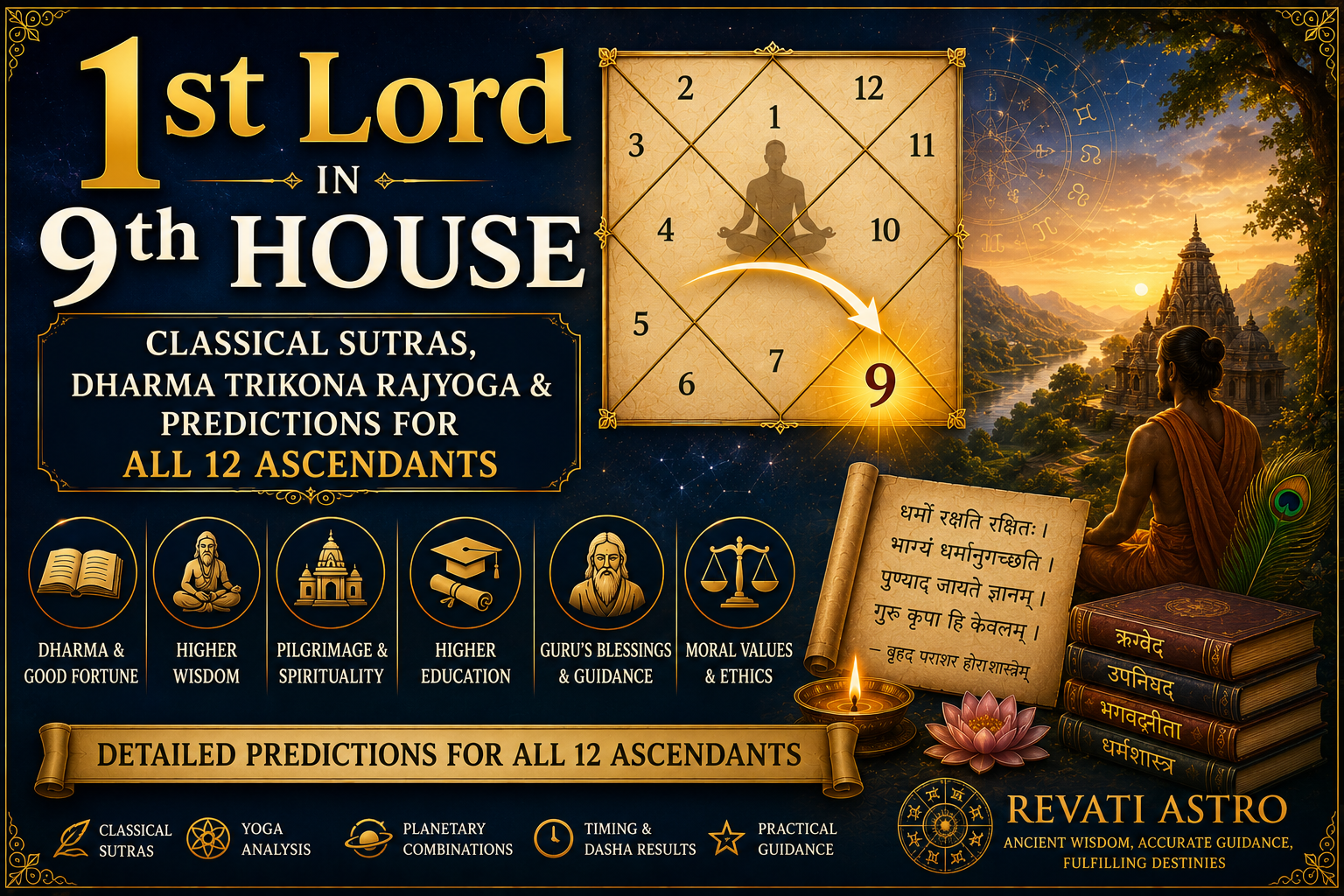
1st Lord in 9th House: Classical Sutras, Dharma Trikona Rajyoga & Predictions for All 12 Ascendants

By Daksh Maheshwari · Revati Astro · Vedic Astrology Research · ~24 min read

Fortune walks beside the self. When the Lagna Lord — the planet carrying your identity, your body, and your entire will to live — rises into the 9th house, the most divinely favoured station in the entire horoscope, it arrives at the summit of the chart’s gracious architecture. The native is born blessed. Not blessed in the passive, effortless sense of one who simply receives gifts — but blessed in the most profound Vedic sense: one whose life is in fundamental alignment with Dharma, with the cosmic law of right living, and who therefore moves through existence with the backing of the universe itself.

The 9th house is called Bhagya Bhava (the house of fortune), Dharma Bhava (the house of righteous living), Pitru Bhava (the house of the father and ancestors), Guru Bhava (the house of the teacher and divine guidance), and Devata Sthana (the abode of the presiding deity of one’s life path). It is the apex of the three Trikona houses (1st, 5th, 9th) — the Dharma Trikona — and represents the accumulated merit of both past lives and conscious dharmic action in this one.

When the Lagna Lord — the chart’s most powerful planet — is placed in the chart’s most gracious house, the result is what classical astrologers call the Dharma Trikona Rajyoga of the highest order. BPHS describes this native as fortunate, virtuous, devoted to the father and guru, greatly blessed, and a master of the senses. Every classical source agrees: this is a gift of cosmic proportions.

Yet most online articles about this placement offer only surface-level affirmations. This article goes far deeper — the original Sanskrit BPHS sutra in full, the complete Dharma Trikona Rajyoga decoded, the Bhagya Yoga mechanics explained, the father-relationship as the life’s most formative bond, the guru-disciple dimension, the foreign travel and higher education patterns, detailed predictions for all 12 ascendants, Navamsha and D-12 divisional analysis, precise Mahadasha timing, and classical remedies for every dimension of this extraordinary placement.

1. The 1st & 9th Houses: Self and Dharma

1st House — Lagna / Tanu Bhava

The Ascendant is the zodiac degree rising on the eastern horizon at the exact moment of birth — the chart’s most personal and powerful coordinate. It governs the physical body, personality, self-concept, temperament, vitality, and life direction. Its lord is simultaneously a Kendra lord (structural pillar) and a Trikona lord (graceful trine) — the only planet with both designations, making it the most personally significant planet in any chart. Wherever the Lagna Lord travels, the native’s entire life force, identity, and will to live travel with it.

9th House — Bhagya / Dharma / Pitru / Guru / Devata Bhava

The 9th house is the most richly blessed house in the Vedic horoscope. Its Sanskrit names reveal the extraordinary depth of its domain:

  • Bhagya Bhava — the house of fortune, luck, and divine blessing
  • Dharma Bhava — the house of righteous living, cosmic law, and one’s life path
  • Pitru Bhava — the house of the father, paternal lineage, and ancestral blessings
  • Guru Bhava — the house of the teacher, spiritual guide, and wisdom transmission
  • Devata Sthana — the abode of the presiding deity and divine grace
  • Tapas Bhava — the house of austerity, spiritual discipline, and the fruits of past-life merit
  • Adhyatma Bhava — the house of spiritual philosophy and the search for ultimate truth
  • Pravasa Bhava — the house of long journeys, foreign travel, and pilgrimage
  • Teertha Bhava — the house of sacred pilgrimages and holy places
  • Upadesa Bhava — the house of sacred teaching and received wisdom

The natural Karaka (significator) of the 9th house is Jupiter — the planet of wisdom, expansion, dharma, and divine grace. Jupiter’s natural resonance with the 9th house makes its aspect on this house or on any planet within it the most powerful single amplifier of the 9th house’s benefic promise. The presiding deity is Lord Vishnu in his dharma-protecting form and the 9th house is associated with Goddess Lakshmi as a Trikona house — which is why fortune, abundance, and divine grace are the 9th house’s primary gifts.

Structural Connections When the Lagna Lord Enters the 9th

  1. Lagna-Trikona Supreme Connection: The lord of the 1st house (both Kendra AND Trikona) occupies the 9th Trikona — creating the most powerful purely auspicious planetary connection in the chart
  2. The 3rd House Aspect: The Lagna Lord in the 9th casts its 7th aspect directly on the 3rd house — the house of courage, communication, skills, and siblings. This connects the native’s dharmic fortune (9th) to their practical communication ability and courageous initiative (3rd) — fortune flows through their own efforts and bold self-expression
  3. Bhagya Yoga Formation: The direct connection between the 1st lord (self) and the 9th house (Bhagya) is the classical definition of a powerful Bhagya Yoga — “self and fortune are aligned”
  4. Dharma Trikona Completion: If the 5th lord also connects to this combination (by placement or aspect), the complete Dharma Trikona (1st-5th-9th) is activated — one of the rarest and most powerful yogas in classical astrology

The Most Structurally Profound Feature of This Placement: The Lagna Lord in the 9th house is the only placement where the planet of the physical self (1st) is placed in the house of dharma and the cosmic teacher (9th). This means the native’s entire physical existence — their body, their identity, their life path — is oriented from birth toward righteous living. Their dharma is not an external moral code imposed upon them; it is the living expression of who they are. When they act in alignment with their dharmic nature, fortune follows naturally. When they deviate from it, their life becomes hollow regardless of external success. This is the deepest truth of the 1st lord in 9th house native: they cannot separate their identity from their dharma.

2. Classical Sutras — Original Sanskrit with Full Analysis

📖 Brihat Parashara Hora Shastra (BPHS) — Bhava Lord Phalam (Primary Sutra):
लग्नेशे भाग्यभावस्थे भाग्यवान् धर्मतत्परः ।
पितृभक्तो महाभागो गुरुभक्तो जितेन्द्रियः ॥

Transliteration: “Lagneśe bhāgyabhāvaste bhāgyavān dharma-tatparaḥ | Pitṛbhakto mahābhāgo gurubhakto jitendriyaḥ ||”
Translation: “When the Lord of the Ascendant is placed in the 9th house (Bhagya Bhava), the native will be fortunate (Bhagyavan), devoted to dharma (Dharma-tatparah), devoted to the father (Pitru-bhakta), greatly blessed/fortunate (Maha-bhaga), devoted to the guru/teacher (Guru-bhakta), and master of the senses/self-controlled (Jitendriyah).”
This is the most uniformly positive classical sutra for any Lagna Lord placement in all of BPHS. Every single quality described is unambiguously positive — there is no shadow, no caveat, no conditional warning in this primary sutra. Parasara presents the 9th house Lagna Lord as a portrait of the ideal human being: fortunate, dharmic, devoted to father and guru, self-controlled, and greatly blessed. The word “Maha-bhaga” (greatly blessed) appears here as it does for the 7th house placement — but the context is even more elevated: in the 9th house, it refers to fortune arising from genuine dharmic alignment rather than relational fortune.
📖 Phaladeepika (Mantreswara):
“When the Lagna Lord is in the 9th house, the native will be greatly fortunate, virtuous, and respected. He will be devoted to the father and teacher. He will gain honour from the king (government) and will be wealthy. He will travel to sacred places and will be engaged in spiritual activities. He will have a noble character and will be beloved of all.”
Interpretation: Mantreswara adds three important dimensions: pilgrimage (sacred travel), government recognition, and being “beloved of all” — a uniquely social blessing that confirms the 9th house Lagna Lord’s capacity to create genuine, wide-ranging goodwill through their dharmic living. The phrase “engaged in spiritual activities” confirms the Tapas Bhava dimension of the 9th house.
📖 Saravali (Kalyana Varma):
“If the Lagna Lord is in the 9th house, the native will be noble, wealthy, and devoted to righteousness. He will travel to distant lands and will be honoured in foreign countries. His father will be prosperous. He will be respected by the learned and will be known for his wisdom and ethical character.”
Interpretation: Kalyana Varma adds crucial details not found in BPHS or Phaladeepika: “honoured in foreign countries” (the 9th house’s foreign-travel dimension combined with the Lagna Lord’s personal identity giving foreign recognition), and “father will be prosperous” (the Lagna Lord in the Pitru Bhava specifically elevates the father’s own circumstances). These are among the most practically useful specific predictions in the classical literature for this placement.
📖 Satya Jatakam:
“When the Lagna Lord is in the 9th with Shubha yoga, the native gains all the blessings of the 9th house — fortune, wisdom, father’s prosperity, guru’s grace, and recognition in distant lands. The native lives a long, dharmic, and prosperous life. With Ashubha yoga, the 9th house promises are delayed, complicated, or denied.”
Interpretation: Satya Jatakam’s conditional framework, while less cautionary here than for other placements, still signals that the 9th house’s extraordinary promises require the Lagna Lord to be genuinely strong. An afflicted Lagna Lord in the 9th — especially if combust or conjunct Rahu/Ketu — can delay or complicate the fortune and father-relationship themes significantly.
📖 Jataka Parijata (Vaidyanatha Dikshita):
“The native whose Lagna Lord occupies the Dharma Bhava will be endowed with great fortune and virtue. He will be long-lived and will command respect from all quarters of society. His father will be an honoured figure, and he himself will be known as a guardian of dharma. He will travel to sacred places and will be a devoted student of wisdom traditions.”
Interpretation: “Guardian of dharma” is Vaidyanatha Dikshita’s most important phrase — not merely someone who benefits from dharma but someone who actively upholds, protects, and exemplifies it. The Lagna Lord in the 9th makes the native a living representative of dharmic principles in their community.
📖 Brihat Jataka (Varahamihira):
“When the lord of the ascendant is in the ninth house, the native is born under the most auspicious stars. Fortune accompanies him naturally, and his father is the source of his greatest blessings. He will be devoted to the sacred and will accumulate wisdom as naturally as others accumulate wealth.”
Interpretation: Varahamihira’s phrase “accumulate wisdom as naturally as others accumulate wealth” is the most elegant classical encapsulation of this placement’s essential gift: wisdom is the native’s natural currency, the thing that flows to them effortlessly, and the thing through which all other forms of fortune are accessed.

3. Dharma Trikona Rajyoga: The Full Mechanics

🔱 The Three Lakshmi Houses and Why the 9th Is the Apex

The three Trikona houses — 1st, 5th, and 9th — are called Lakshmi Sthanas (the abodes of Lakshmi, the goddess of both spiritual and material fortune). They represent three dimensions of the soul’s gracious unfolding through time:

  • 1st house (current life self): Who you are in this incarnation — your present-moment identity and vitality
  • 5th house (Purva Punya — past-life merit): The accumulated good karma from previous lifetimes, now manifesting as natural intelligence and creative grace
  • 9th house (Dharma — cosmic law): The deepest alignment with universal righteous order; the house whose blessings arise not merely from past karma but from genuine present-moment dharmic living

The 9th house is the apex of this trikona because it represents the future dimension of grace — the fortune that flows to a soul who is living in alignment with cosmic law right now. While the 5th house offers Purva Punya (past-life grace already earned), the 9th offers ongoing, continuously renewed Bhagya (fortune that regenerates through dharmic living). This is why BPHS calls the 9th house Lagna Lord native “Dharma-tatparah” (devoted to dharma) alongside “Bhagyavan” (fortunate) — the fortune and the dharma are inseparable causes and effects of each other.

The Dharma Trikona Rajyoga activates fully when:

  • The Lagna Lord is in the 9th (1st-9th connection established)
  • The 5th lord is also connected to the 9th or the Lagna Lord (completing the 1st-5th-9th triangle)
  • Jupiter (natural 9th house karaka) aspects the Lagna Lord in the 9th or is placed in the Lagna or 5th
  • The 9th lord is also strong and connected to the Lagna or 5th house

When all four conditions are met simultaneously, classical texts describe this as a Maha Bhagya Yoga — one of the rarest and most powerful configurations in the entire Vedic system, associated with spiritual greatness, enduring fame, and a life that becomes a source of dharmic inspiration for others.

4. Bhagya Yoga: The Mechanics of Fortune

🍀 How Fortune Actually Works for This Placement — The Classical Mechanics

The word “Bhagya” is frequently translated simply as “luck” — but this translation misses the full depth of what the Sanskrit concept means. Bhagya comes from the root “Bhaj” (to share, to apportion, to receive one’s due portion) — it refers to the portion of good fortune that is legitimately yours as a result of your dharmic actions, both in this life and in previous ones. It is not random luck but earned grace — the natural return on an investment of righteous living.

For the 1st lord in 9th house native, the Bhagya mechanism works as follows:

  • Alignment creates attraction: When the native lives in alignment with their dharmic nature — acts ethically, pursues genuine wisdom, honours their father and teachers, and serves others through their unique gifts — the universe responds by creating conditions of fortune around them. Opportunities appear. The right people arrive. Circumstances conspire in their favour. This is not superstition; it is the 9th house’s Bhagya mechanism in operation.
  • Fortune through travel: The 9th house governs long journeys and foreign lands — many of this native’s most fortunate life events occur in geographical contexts far from their birthplace. International experiences, pilgrimages, or educational journeys consistently open significant doors.
  • Fortune through the father and teachers: The father’s blessings, the guru’s grace, and the transmission of ancestral wisdom are among the most reliable sources of fortune for this native. Honouring the lineage — both ancestral and spiritual — directly activates the 9th house’s Bhagya potential.
  • Fortune through higher knowledge: For these natives, investing in genuine wisdom — studying sacred texts, pursuing advanced education, developing philosophical depth — consistently and reliably produces material and social fortune as a by-product. Their wisdom is their wealth-generator.

The shadow of Bhagya: When the Lagna Lord is afflicted in the 9th, or when the native deviates from their dharmic path — acting unethically, dishonouring their teachers, or pursuing wealth at the expense of virtue — the Bhagya mechanism reverses. The fortune that flows effortlessly to the dharmic expression of this placement becomes blocked or turns against them. The 9th house does not forgive adharmic living as easily as other houses forgive their residents’ shortcomings. For this placement, character is truly destiny.

5. General Effects & Core Life Themes

☀️ The Fortunate Life — Fortune as Background Condition

The most immediate and consistently observed effect of this placement is that fortune operates as a background condition of the native’s life rather than as an occasional event. These are the people others describe as “lucky” — but anyone who knows them closely recognises that their “luck” is actually the natural harvest of a life lived with genuine ethical commitment, intellectual seriousness, and philosophical depth. They make good decisions because they are anchored in dharmic values. Their good decisions create good circumstances. The good circumstances attract more good fortune. This self-reinforcing cycle of dharma-fortune is the 9th house Lagna Lord’s defining life pattern.

📚 The Wisdom Orientation — Learning as Self-Expression

The 9th house governs higher knowledge — not the practical information of the 3rd house or the creative intelligence of the 5th, but the deepest, most universal forms of wisdom: philosophy, religion, sacred law, metaphysics, and the study of cosmic order. With the Lagna Lord placed here, the native’s identity is inseparable from their pursuit of wisdom. They are the lifelong learners, the philosophers, the seekers — people for whom the accumulation of deep knowledge is as natural and necessary as breathing. Their most authentic self-expression is invariably through the transmission of wisdom to others.

🌍 The Traveller’s Spirit — Long Journeys as Dharmic Necessity

Every classical source agrees: the 9th house Lagna Lord native travels. Not short business trips (that is the 3rd house) but long, significant, life-changing journeys — to foreign countries, to sacred places, to centres of learning, to teachers in distant lands. The 9th house is the Pravasa Bhava (house of long journeys) and the Teertha Bhava (house of pilgrimage), and the Lagna Lord here makes travel a fundamental expression of the native’s identity and path to fortune. Their most significant life breakthroughs frequently occur in geographical contexts far from home.

🙏 The Dharmic Character — Ethics as Identity

BPHS’s “Dharma-tatparah” (devoted to dharma) is the defining character quality. For the 9th house Lagna Lord native, dharma is not an external code to be followed reluctantly but a living expression of who they are. They are naturally ethical — not through moral discipline but through genuine disposition. When they observe injustice, they are viscerally disturbed. When they are asked to compromise their integrity, they find it genuinely difficult because the compromise feels like a self-betrayal rather than merely a tactical inconvenience. This ethical depth is both their greatest social strength and, occasionally, the source of their most significant conflicts — they do not compromise easily.

🎓 Higher Education & Formal Credentials

The 9th house governs the highest levels of formal education — university, postgraduate study, professional certification, and academic honours. The Lagna Lord placed here creates a natural orientation toward advanced, specialised education. These natives are typically highly educated — not necessarily in the conventional sense, but in the sense of being deeply knowledgeable in their chosen wisdom domain, whether that is academic, philosophical, spiritual, or professional.

6. All 12 Ascendants — Detailed Predictions

Ascendant Lagna Lord in 9th Sign in 9th House Condition
Aries Mars Sagittarius Friendly (Jupiter’s sign)
Taurus Venus Capricorn ⭐ Exalted
Gemini Mercury Aquarius Neutral
Cancer Moon Pisces Friendly (Jupiter’s sign)
Leo Sun Aries ⭐ Exalted
Virgo Mercury Taurus Friendly
Libra Venus Gemini Neutral-Friendly
Scorpio Mars Cancer Debilitated
Sagittarius Jupiter Leo Friendly (Sun’s sign)
Capricorn Saturn Virgo ⭐ Exalted
Aquarius Saturn Libra ⭐ Exalted
Pisces Jupiter Scorpio Neutral

♂ MarsAries Ascendant — Mars in Sagittarius

The Dharmic Warrior — Courageous Philosophy & Fortune Through Action

Mars, Aries’ Lagna Lord, enters Jupiter-ruled Sagittarius in the 9th house — a beautiful, complementary placement. Mars brings energy, initiative, and courage into the domain of dharma, philosophy, and higher wisdom. The native combines the warrior’s courage with the philosopher’s depth — they are not content merely to discuss truth; they go out and live it. They may be pioneer academics, adventurous teachers, sports philosophers, religious leaders with courageous convictions, or international lawyers who fight for justice. Fortune arrives through bold dharmic action — every time they act courageously in alignment with their values, the 9th house’s Bhagya mechanism rewards them. Mars also rules the 8th house (Scorpio) for Aries — adding research depth and transformative intensity to the dharmic quest; these natives are often drawn to the hidden dimensions of philosophy and spirituality. Watch for: Mars in Sagittarius can make the native dogmatic or aggressive in their philosophical convictions; the fire of Mars and the fire of Sagittarius together can produce zealotry if not tempered by genuine humility before the guru’s wisdom. The father may be fiery, independent, or pioneering but ultimately a source of inspiration.

♀ VenusTaurus Ascendant — Venus in Capricorn ⭐ Exalted

Supreme Material Fortune — Most Powerful Wealth & Grace Configuration

Venus, Taurus’ Lagna Lord, is exalted in Capricorn in the 9th house — one of the three exalted Lagna Lord configurations for this placement and arguably the most materially powerful. An exalted Lagna Lord in the Bhagya Bhava creates a level of fortune that the classical texts describe as genuinely extraordinary. Venus in Capricorn in the 9th gives the native disciplined, structured, and enduringly beautiful approaches to dharmic living. Their fortune is tangible — real estate, luxury assets, stable financial prosperity, and the kind of material abundance that builds over decades with Saturn’s systematic discipline underlying Venus’s grace. The father is likely a successful, disciplined, and materially prosperous figure. The guru or primary teacher may be an older, authoritative, and practically wise figure. Venus also rules the 6th house (Libra) for Taurus — connecting the service dimension to the 9th house’s fortune, meaning the native’s dharmic service work generates material prosperity. Watch for: Venus in Capricorn can be excessively materialistic in its expression of the 9th house’s spiritual potential; the native must consciously cultivate the philosophical and spiritual dimensions of the 9th house alongside its material blessings.

☿ MercuryGemini Ascendant — Mercury in Aquarius

The Humanitarian Philosopher — Progressive Dharma & Collective Wisdom

Mercury, Gemini’s Lagna Lord, enters Saturn-ruled Aquarius in the 9th house. Mercury in Aquarius gives the native an intellectually progressive, socially innovative, and collectively minded approach to dharma and higher knowledge. They are drawn to philosophy that serves social transformation — progressive theology, humanitarian law, sociological research, or technology ethics. Their dharmic path is inherently collective rather than individual: they feel most aligned with their dharma when they are using their intellectual gifts in service of broader social ideals. Foreign connections may involve progressive political movements, international humanitarian organisations, or avant-garde academic communities. Mercury also rules the 4th house (Virgo) for Gemini — connecting the 9th house’s philosophical breadth to the 4th house’s home and foundational knowledge, creating a native who builds their philosophical understanding from deep domestic and personal roots. Watch for: Aquarius’s detachment can make the native’s dharmic philosophy intellectually impeccable but emotionally distant; the genuine warmth of the father-relationship and guru-devotion requires conscious cultivation against Aquarian coolness.

☽ MoonCancer Ascendant — Moon in Pisces

Spiritual Grace & Intuitive Fortune — The Devotional Path

The Moon, Cancer’s Lagna Lord, enters Jupiter-ruled Pisces in the 9th house — a deeply spiritually elevated configuration. The Moon in Pisces is in a friendly, receptive, oceanic sign that enhances the Moon’s intuitive, emotional, and nurturing capacities. In the 9th house of dharma and divine grace, this placement creates a native of extraordinary spiritual sensitivity, devotional depth, and intuitive access to divine guidance. Their relationship with dharma is not primarily intellectual but felt — they sense truth rather than reasoning toward it, and their fortune arrives through this felt-alignment with cosmic order rather than through calculated strategy. The father is likely a deeply spiritual, compassionate, or intuitively gifted figure. The guru relationship is the most important single relationship of the native’s life. Pilgrimage and sacred travel near water are particularly fortuitous. Watch for: Moon in Pisces in the 9th can lead to spiritual escapism — using elevated philosophical idealism to avoid the practical demands of daily dharmic living; the Moon’s natural fluctuation can create phases of intense spiritual connection alternating with feelings of divine abandonment.

☀ SunLeo Ascendant — Sun in Aries ⭐ Exalted

Royal Fortune & Dharmic Authority — Supreme Leadership

The Sun, Leo’s Lagna Lord, is exalted in Aries in the 9th house — the second exaltation configuration and one of the most powerfully authoritative expressions of this placement. The Sun at maximum strength in the house of dharma and fortune creates a native of exceptional natural authority, genuine ethical leadership, and the kind of fortune that flows from the combination of personal brilliance and dharmic integrity. These natives are born to lead through the force of their character — their authority is not merely positional but earned through genuinely living the dharma they profess. They may be national-level leaders, senior government officials, prominent religious authorities, celebrated academics, or respected judges — positions where personal wisdom and institutional authority converge. The father is a deeply respected, possibly prominent, authoritative figure whose example and blessings shape the native’s life direction profoundly. Watch for: The exalted Sun in Aries in the 9th can produce a certain intolerance for others’ philosophical perspectives — the native’s dharmic certainty, while genuine, must not become dogmatic authority that closes the mind to new wisdom; the guru’s teaching is especially important as a counterbalance to the Sun’s natural tendency toward self-referential knowing.

☿ MercuryVirgo Ascendant — Mercury in Taurus

The Practical Sage — Grounded Wisdom & Material Fortune Through Knowledge

Mercury, Virgo’s Lagna Lord, enters Venus-ruled Taurus in the 9th house — a productive, comfortable placement. Mercury in Taurus gives the native a beautifully grounded, practical, and aesthetically refined approach to higher knowledge. Their wisdom is not abstract or impractical; it is applicable, tangible, and materially productive. They are excellent teachers of subjects that have practical value — financial planning from a dharmic perspective, Ayurveda, practical philosophy, sustainable agriculture, or any form of wisdom that translates directly into better living. Fortune arrives through a combination of practical knowledge and ethical application — the Taurean dimension ensures that the 9th house’s Bhagya Yoga produces real, material abundance. Mercury also rules the 10th house (Gemini) for Virgo ascendant — the 1st-9th-10th connection links identity, fortune, and career directly, making these natives people whose public career is inseparable from their dharmic wisdom. Watch for: Mercury in Taurus can be overly attached to conventional wisdom and resistant to the kind of radical philosophical breakthroughs that the 9th house is capable of generating; the native must periodically challenge the fixed Taurean certainties of their philosophical worldview.

♀ VenusLibra Ascendant — Venus in Gemini

The Eloquent Dharma Teacher — Communication of Beauty & Social Justice

Venus, Libra’s Lagna Lord, enters Mercury-ruled Gemini in the 9th house. Venus in Gemini in the 9th gives a native who communicates dharma with extraordinary eloquence, charm, and social intelligence. They are gifted dharmic communicators — writers on spirituality and philosophy, mediators of theological disputes, diplomatic representatives of cultural wisdom, or social justice advocates who use beauty and eloquence in service of higher truth. Their foreign travel is typically culturally enriching — language immersion, artistic pilgrimage, or diplomatic exchange that deepens their understanding of the world’s wisdom traditions. Fortune comes through the connection of beauty and truth — their aesthetically expressed wisdom creates genuine material and social abundance. Venus also rules the 8th house (Taurus) for Libra — connecting transformative hidden knowledge to the dharmic quest; these natives may be particularly drawn to the aesthetic dimensions of esoteric philosophy. Watch for: Venus in Gemini can make the native’s dharmic expression charming but shallow — eloquent in speaking of wisdom while not always living its full depth; the guru relationship must counterbalance this tendency toward beautiful expression over genuine transformation.

♂ MarsScorpio Ascendant — Mars in Cancer Debilitated

Emotional Dharma — Neecha Bhanga Through Moon; Deeply Transformative Fortune

Mars, Scorpio’s Lagna Lord, is debilitated in Cancer in the 9th house — the only debilitation among this placement’s twelve configurations. Mars in Cancer in the 9th creates a native whose dharmic path is emotionally complex, deeply personal, and subject to significant inner conflict between the desire for bold dharmic action (Mars) and the pull of emotional security (Cancer). The father relationship may be emotionally complicated — intense, nurturing, or absent. The dharmic quest is inward rather than outward — these natives find dharma through emotional healing, family work, and the nurturance of others rather than through external philosophical activity. The Neecha Bhanga for Mars in Cancer is triggered when the Moon (Cancer’s lord) is strong, exalted, or in a Kendra position — when this cancels the debilitation, the native develops extraordinary emotional courage: the capacity to act dharmatically even when it is emotionally painful. Mars also rules the 6th house (Aries) for Scorpio — service becomes the primary vehicle of dharmic expression. Watch for: Without Neecha Bhanga activation, this native may confuse emotional comfort with dharmic rightness; the 9th house’s fortune requires that they act from genuine dharmic conviction rather than from emotional preference. The guru relationship is especially important for providing external dharmic guidance that the debilitated Mars cannot always generate internally.

♃ JupiterSagittarius Ascendant — Jupiter in Leo

The Royal Guru — Supreme Philosophical Leadership

Jupiter, Sagittarius’ Lagna Lord, enters Sun-ruled Leo in the 9th house — a magnificent, royal configuration. Jupiter in Leo in the 9th creates the archetype of the Great Teacher — the guru who leads from genuine wisdom AND genuine personal authority. These natives are naturally looked to for guidance, naturally positioned at the head of educational or philosophical institutions, and naturally capable of inspiring others through the combination of wisdom (Jupiter) and personal radiance (Leo). They may be prominent religious leaders, university heads, celebrated authors of wisdom traditions, or any figure whose philosophical authority is matched by their personal charisma. Fortune arrives in grand, visible ways — public recognition, institutional honours, and the kind of social standing that comes from being genuinely considered a wisdom authority in their community. Jupiter also rules the 4th house (Pisces) for Sagittarius ascendant — connecting the philosophical grandeur of the 9th to the deep spiritual roots of the 4th. Watch for: Jupiter in Leo can produce a guru who believes too completely in their own authority; genuine humility before higher wisdom — the willingness to always remain a student — is the essential counterbalance to the Leo tendency toward philosophical self-sufficiency.

♄ SaturnCapricorn Ascendant — Saturn in Virgo ⭐ Exalted

The Dharmic Architect — Systematic Fortune & Analytical Wisdom

Saturn, Capricorn’s Lagna Lord, is exalted in Virgo in the 9th house — the third exaltation configuration and among the most practically productive. Saturn exalted in Virgo in the 9th creates a native whose dharmic path is systematic, methodical, service-oriented, and analytically precise. Their approach to wisdom is not intuitive but rigorous — they build their philosophical and dharmic framework through years of sustained study, careful analysis, and disciplined practice. Fortune arrives slowly and then abundantly — these natives are the great “late bloomers” of the 9th house, who by their 40s and 50s have built a dharmic life of genuine depth and material stability that early-life observers might not have predicted. The father is a disciplined, hardworking, and ethically meticulous figure. Saturn also rules the 12th house (Pisces) for Capricorn — connecting spiritual liberation to the systematic dharmic path; the native’s dharmic work has a significant spiritual-service dimension. Watch for: Saturn in Virgo can make the dharmic path excessively critical, perfectionist, and slow to embrace the expansive, spontaneous grace that the 9th house is capable of generating; the native must trust that fortune flows through consistent dharmic effort even before the results are analytically verifiable.

♄ SaturnAquarius Ascendant — Saturn in Libra ⭐ Exalted

The Dharmic Reformer — Social Justice Fortune & Collective Wisdom Leadership

Saturn, Aquarius’ Lagna Lord, is exalted in Libra in the 9th house — the fourth exaltation configuration, making Aquarius ascendant uniquely blessed among the twelve for this placement. Saturn exalted in Libra in the 9th creates a native whose dharmic path is fundamentally oriented toward justice, social reform, collective wisdom, and the fair application of universal principles. They are natural social reformers, legal reformers, or philosophical leaders of progressive movements — people who align the 9th house’s dharmic authority with Saturn’s concern for systemic fairness and Libra’s principle of balanced justice. Fortune arrives through institutional recognition of their fairness, integrity, and systemic wisdom — they are the people whose reputation for genuine ethical impartiality creates the kind of trust that generates significant material and social fortune. Saturn also rules the 12th house (Pisces) for Aquarius — adding a spiritual liberation dimension to the justice-oriented dharmic path, connecting Vimala Yoga (a Viparita variant) to the overall configuration. Watch for: Saturn in Libra in the 9th can be over-idealistic about justice and fairness, expecting the world to operate by the same ethical standards the native holds for themselves; the gap between ideal dharma and real-world compromise can be a source of significant disillusionment.

♃ JupiterPisces Ascendant — Jupiter in Scorpio

The Depth Philosopher — Transformative Wisdom & Hidden Fortune

Jupiter, Pisces’ Lagna Lord, enters Mars-ruled Scorpio in the 9th house. Jupiter in Scorpio in the 9th gives the native a profound, penetrating, and transformative approach to dharma and higher knowledge. Their philosophical path goes into depths that others find uncomfortable — they are drawn to the hidden dimensions of religion (mysticism, tantra, esoteric theology), the psychological underpinnings of ethical behaviour (moral philosophy with depth psychology), or the research dimensions of sacred tradition. Fortune arrives through the mastery of hidden philosophical systems — astrology, tantra, mystical theology, or any discipline that requires the courage to explore what conventional religion conceals. The father may be a psychologically complex, deeply private, or researching figure. Jupiter also rules the 10th house (Sagittarius) for Pisces — the 1st-9th-10th triad creates a philosopher-teacher-public figure of significant reach. Watch for: Jupiter in Scorpio in the 9th can become obsessively fixated on hidden knowledge, potentially using philosophical depth as a way to avoid the simpler, more direct expressions of dharmic living; the guru’s guidance is essential for preventing the depth of the 9th house from becoming the darkness of the 8th.

7. The Father: The Most Formative Relationship

👨 Pitru Bhakta — The Father as the Native’s Primary Dharmic Teacher

BPHS’s use of “Pitru-bhakta” (devoted to the father) as a primary characteristic of this placement is not merely a sentimental prediction — it is a structural description of how the native’s identity formation occurs. The 9th house is the Pitru Bhava (father’s house), and the Lagna Lord placed here means the native’s entire sense of self (1st) is shaped within the father’s field (9th). The father is not simply one parent among two — the father is the native’s most important human teacher, the living representative of dharmic authority and worldly wisdom in the native’s life.

When the Lagna Lord is strong in the 9th:

  • The father is a wise, educated, respected, and spiritually or ethically evolved figure
  • The father is long-lived and prosperous — Saravali specifically states “his father will be prosperous”
  • The father’s example, values, and direct teachings are the most formative influence on the native’s character and life direction
  • The native may follow the father into the same profession or carry the father’s life work forward
  • The father’s blessings — consciously given or unconsciously transmitted — are among the most powerful sources of the native’s fortune

When the Lagna Lord is afflicted in the 9th:

  • The father may be absent, estranged, or an emotionally complex figure whose influence is more formative through its difficulties than its joys
  • Early loss of father, or the father’s health challenges, are possible themes when the Lagna Lord is debilitated or afflicted
  • The native must find their dharmic teacher outside the biological father — in a guru, mentor, or philosophical tradition that provides the paternal wisdom their biological father could not offer
  • Even in the afflicted version, the native’s life remains deeply shaped by the father-theme — they are simply shaped by what they lacked rather than what they received

The D-12 Dvadashamsha chart is the specific divisional tool for the father-relationship analysis — always check the Lagna Lord’s position in D-12 and the D-12 9th house condition for the most accurate father-relationship portrait.

8. The Guru: Divine Teacher and Spiritual Lineage

🙏 Guru-Bhakta — Devotion to the Teacher as the Path to Fortune

BPHS’s “Guru-bhakta” (devoted to the guru/teacher) is one of the most spiritually significant predictions in the entire BPHS for any Lagna Lord placement. The word “Guru” carries a specific technical meaning in the Vedic tradition: not merely a respected teacher but an authorised spiritual guide who transmits wisdom through an unbroken lineage of teacher-to-student succession. The native’s devotion to such a teacher is described as a primary characteristic of their identity (Lagna Lord in 9th).

In practical terms, every 9th house Lagna Lord native has at least one — and often several — profoundly significant teacher relationships that shape their life in ways no other relationship can. These may be:

  • A formal spiritual guru within a recognised tradition (Vedantic, Tantric, Buddhist, Sufi, or any authentic lineage)
  • An academic mentor whose intellectual influence shapes the native’s entire philosophical framework
  • A father-figure who fulfils both the Pitru and Guru functions simultaneously
  • A sacred text or wisdom tradition that functions as an impersonal guru — the Bhagavad Gita, the Vedas, or any sacred philosophical system to which the native gives their deepest intellectual loyalty

The classical formula is precise: the native’s fortune (Bhagya) is directly connected to the quality of their relationship with wisdom (Guru-bhakti). When they honour their teacher, study deeply, and transmit received wisdom faithfully, the 9th house’s Bhagya mechanism activates fully. When they are arrogant toward their teachers or abandon their wisdom lineage, the fortune diminishes proportionally.

BPHS also notes “Jitendriyah” (master of the senses) alongside “Guru-bhakta” — indicating that the guru-devotion and sense-mastery are paired qualities. The discipline of genuine wisdom practice — whether meditation, sacred study, or philosophical contemplation — produces the sense-mastery that the 9th house’s “Jitendriyah” describes.

9. Fortune, Luck & the Bhagya Mechanism

The Lagna Lord’s aspect from the 9th house falls on the 3rd house — connecting fortune (9th) to personal effort, communication, and initiative (3rd). This is one of the most practically significant structural features of this placement: the native’s fortune is not passive. It is activated by their own courageous initiative (3rd house aspect). The more boldly and dharmatically they act, the more powerfully the 9th house’s Bhagya mechanism responds.

✅ Conditions That Amplify the Bhagya Yoga

  • Jupiter (natural 9th karaka) aspects the Lagna Lord in the 9th or is placed in the Lagna or 5th house — the supreme Bhagya amplifier
  • The 9th lord is also strong and well-placed in a Kendra or Trikona
  • The 5th lord connects to this combination — completing the Dharma Trikona
  • The Lagna Lord is in own sign or exaltation in the 9th (Taurus/Venus in Capricorn; Leo/Sun in Aries; Capricorn/Saturn in Virgo; Aquarius/Saturn in Libra)
  • No malefic planets aspect the 9th house or the Lagna Lord without benefic mitigation
  • The native is genuinely living in alignment with their dharmic values — the 9th house’s fortune is character-dependent above all others

⚠️ What Blocks the Bhagya

  • Rahu or Ketu in the 9th house conjunct the Lagna Lord — creates karmic complexity and unpredictability in the fortune mechanism; foreign experiences may bring unusual or unexpected outcomes rather than the classical blessings
  • The 9th lord in the 6th, 8th, or 12th house — the “host” of the Lagna Lord is in a Dusthana, creating tension between the Bhagya potential and its material expression
  • Saturn and Mars simultaneously aspecting the Lagna Lord in the 9th without benefic relief — delays fortune significantly until after age 36
  • The native acting in adharmic ways — this is the most powerful “blocker” of 9th house fortune, and the only one that is entirely within the native’s control

10. Philosophy, Religion & Higher Knowledge

The 9th house is the primary house of philosophy and religion in Vedic astrology — and with the Lagna Lord placed here, the native’s engagement with philosophical and religious questions is not casual or peripheral but central and identity-defining. The quality of this engagement depends on the planet:

Lagna Lord Planet Ascendant Philosophical Style Primary Wisdom Domain
Sun Leo Authoritative, solar, royal — wisdom through command and personal brilliance Sacred law, royal philosophy, leadership ethics
Moon Cancer Intuitive, devotional, empathetic — wisdom through felt experience and divine relationship Devotional theology, emotional philosophy, sacred nurturing
Mars Aries, Scorpio Courageous, pioneering, direct — wisdom through action, confrontation with dharmic challenges Religious courage, dharmic warrior tradition, occult philosophy
Mercury Gemini, Virgo Analytical, communicative, multi-faceted — wisdom through research, writing, teaching Philosophy of language, practical ethics, encyclopaedic learning
Jupiter Sagittarius, Pisces Expansive, magnanimous, universal — wisdom through synthesis and transmission Vedic philosophy, comparative religion, spiritual law
Venus Taurus, Libra Aesthetic, harmonious, relational — wisdom through beauty, art, and dharmic diplomacy Sacred aesthetics, dharmic law, theology of beauty
Saturn Capricorn, Aquarius Systematic, disciplined, reformative — wisdom through sustained practice and structural change Social ethics, systematic theology, philosophy of justice

11. Foreign Travel, Pilgrimage & International Life

The 9th house is simultaneously the Pravasa Bhava (long journey house) and the Teertha Bhava (pilgrimage house) — both forms of significant geographical movement are governed here. The Lagna Lord placed in the 9th house makes the native a natural traveller whose most significant life events consistently occur in geographical contexts far from their birth-place.

Forms of 9th House Travel

  • Educational travel: Study abroad, university in a foreign country, academic conferences internationally — knowledge acquired in foreign lands is particularly fortuitous for this native
  • Pilgrimage: Sacred journeys to temples, holy sites, and places of spiritual significance produce tangible life-changing fortune for the 9th house Lagna Lord native — not as superstition but as a direct dharmic alignment practice that activates the 9th house’s Bhagya mechanism
  • Professional foreign recognition: Saravali specifically states “honoured in foreign countries” — the native’s wisdom, expertise, or dharmic reputation receives recognition abroad that may exceed what they receive at home
  • Long-term foreign residence: Unlike the 7th house’s “Desantara-gami” (foreign travel as wandering), the 9th house’s foreign connection is often about long-term settlement in a place of higher wisdom — universities, ashrams, philosophical communities, or cultural centres that embody the values the native holds most dear

The Jupiter-9th Connection in Foreign Travel

Jupiter’s transit over the natal Lagna Lord in the 9th house is one of the most consistent timing triggers for significant foreign opportunities. When Jupiter transits this point, doors to international education, foreign recognition, and pilgrimage-based fortune open with particular reliability. Mark this transit in the native’s predictive calendar as a primary window for international life expansion.

12. Career: The Dharmic Vocations

The 9th house’s domain — wisdom transmission, dharmic guidance, higher education, legal and philosophical authority, foreign engagement — creates a specific and consistent set of vocational orientations for the Lagna Lord placed here:

🎓 Knowledge & Wisdom Transmission

  • Professor, lecturer, academic researcher
  • Author of philosophical or wisdom-tradition texts
  • Vedic astrologer, Jyotisha teacher
  • Spiritual guide, religious leader, guru
  • Cultural ambassador, international educator
  • Documentary filmmaker on wisdom traditions
  • Publisher of philosophical or spiritual content

⚖️ Law, Justice & Dharmic Authority

  • Judge, lawyer, legal philosopher
  • Government ethics officer or advisor
  • International law practitioner
  • Diplomat and foreign affairs specialist
  • NGO leader working on human rights
  • Constitutional scholar
  • Social reformer guided by philosophical principles

The Lagna Lord’s 3rd House Aspect — Fortune Through Self-Promotion

The Lagna Lord’s 7th aspect from the 9th house falls on the 3rd house — connecting dharmic fortune (9th) to communication and courageous initiative (3rd). This is a practical career gift: the native’s dharmic wisdom generates fortune most efficiently when they actively communicate it — write books, give talks, teach publicly, and use the 3rd house’s communication channels to spread the 9th house’s wisdom. The fortune is not merely received passively; it is attracted through the courageous, bold communication of authentic wisdom.

13. Marriage, Children & Family Fortune

The 9th house’s fortune dimension extends to marriage and family. The Lagna Lord placed here typically creates family environments of genuine warmth, wisdom, and shared values. The spouse tends to be drawn to a partner whose dharmic integrity is evident — they are attracted to the native’s moral depth, philosophical breadth, and genuine wisdom rather than merely to surface-level attractions.

The 9th house is also the 5th from the 5th — the Bhavat Bhavam position that amplifies 5th house (children, creativity, past-life merit) themes. Children born to this native are often fortunate, intelligent, and karmically well-connected to the native’s dharmic path. The family’s collective fortune tends to improve through generational transmission of dharmic values — each generation more prosperous and wise than the previous one, as the Bhagya mechanism compounds through conscious dharmic living.

14. Health & Longevity

The 9th house’s association with fortune and long life is direct — Jataka Parijata specifically mentions “long-lived” as a promise of the Lagna Lord in the 9th. The 9th house is not a house of disease or health challenges (unlike the 6th or 8th); it is a house of vitality-sustaining dharmic alignment. The native’s health tends to be robust, with constitutional strength that comes from the ethical, philosophical, and active lifestyle that the 9th house Lagna Lord creates.

The 9th house body zone includes the hips, thighs, and upper legs (Sagittarius rules this zone). Jupiter (9th house karaka) rules the liver and fat tissues. The native should be attentive to:

  • Hip and thigh injuries from travel, sports, or adventurous activity (the 9th house’s physical restlessness)
  • Liver health — Jupiter’s natural rulership means excess (over-eating, over-drinking) can create liver-related challenges
  • Sciatica — the sciatic nerve runs through the 9th house’s physical zone
  • Overall, the 9th house Lagna Lord native tends toward robust vitality — the fortune and dharmic alignment of this placement supports physical health as a background condition

15. Strong vs. Afflicted — Complete Analysis

✅ When the Lagna Lord in 9th is Strong

  • Planet in own sign, exaltation, Moolatrikona, or friendly sign in 9th (especially: Venus/Capricorn for Taurus; Sun/Aries for Leo; Saturn/Virgo for Capricorn; Saturn/Libra for Aquarius)
  • Jupiter (natural 9th karaka) aspects the Lagna Lord in the 9th — the supreme Bhagya amplifier
  • The 9th lord is also strong and well-placed in Kendra or Trikona
  • The 5th lord connects to the combination — Dharma Trikona fully activated
  • No malefics in the 9th house without benefic mitigation
  • Vargottama in D-1 and D-9 — the fortune and dharmic promise doubled at the soul level

Results when strong: A genuinely fortunate life marked by opportunities arriving from unexpected directions; a deeply loving and formative father relationship; one or more transformative guru-teacher encounters; significant higher education and philosophical development; extensive foreign travel with fortune-creating international recognition; career in wisdom-transmission, law, or education that achieves genuine dharmic fulfilment and material prosperity; children who carry the dharmic legacy forward; remarkable longevity sustained by the vitality of dharmic living.

⚠️ When the Lagna Lord in 9th is Afflicted

  • Only Mars/Cancer (Scorpio ascendant) creates debilitation in the 9th house across all 12 ascendants
  • Lagna Lord combust within 6° of the Sun — loses individual dharmic clarity
  • Rahu or Ketu conjunct the Lagna Lord in the 9th — karmic complexity in fortune and father-relationship
  • Saturn and Mars simultaneously aspect the Lagna Lord in the 9th without Jupiter’s relief
  • The 9th lord is in the 6th, 8th, or 12th house without compensating yogas

Results when afflicted: Fortune that is delayed, irregular, or complicated rather than flowing naturally; father relationship marked by absence, conflict, or early loss; difficulty finding and committing to a genuine guru; philosophical uncertainty or dogmatic rigidity in place of genuine wisdom; foreign travel that creates complications rather than fortune; late-life correction of early-life adharmic patterns.

D-9 (Navamsha) — The Destiny Confirmation

  • Vargottama Lagna Lord: Same sign in D-1 and D-9 — the Dharma Trikona Rajyoga is doubled in power; fortune, dharmic living, and wisdom transmission manifest with extraordinary consistency throughout the entire lifetime
  • Exalted or own sign in D-9: Even a neutral D-1 position (not exalted or own sign) is elevated to exceptional results when the D-9 placement is exalted or own sign — the soul-level dharmic alignment is confirmed
  • Dusthana in D-9 (6/8/12 from D-9 Lagna): Despite an excellent D-1 placement in the 9th house, the native’s fortune is complicated by unresolved karmic issues at the soul level; the dharmic path requires significant inner work before the Bhagya Yoga flows freely

D-12 (Dvadashamsha) — Father & Ancestral Relationship

The D-12 chart specifically governs the relationship with both parents and the ancestral lineage. For the 1st lord in 9th house placement, the D-12 is the most important divisional chart after D-9 for understanding the father-relationship dimension. Check:

  • The Lagna Lord’s position in D-12 — a strong position confirms the prosperous, long-lived, and dharmatically wise father of the classical texts
  • The D-12 9th house and its lord — the condition of the father’s house in the D-12 reveals the father’s own fortunes and the quality of paternal blessings transmitted to the native
  • Jupiter’s position in D-12 — Jupiter in the D-12 aspecting the Lagna or the 9th house in D-12 confirms the classical “Pitru-bhakta” fortune through genuine paternal blessing

D-20 (Vimshamsha) — Spiritual Progress Confirmation

The D-20 chart governs spiritual progress, religious practice, and the quality of the native’s devotional life. For the 9th house Lagna Lord native — where spiritual practice and guru-devotion are identity-defining — the D-20 reveals the depth and authenticity of the native’s spiritual engagement. A strong D-20 Lagna and Lagna Lord position confirms that the “Guru-bhakta” and “Dharma-tatparah” qualities of the classical texts find genuine expression in the native’s spiritual life rather than remaining purely theoretical philosophical orientations.

17. Mahadasha & Timing of Results

Mahadasha of the Lagna Lord in the 9th house — the primary activation period for all the classical promises:

  • Fortune events: Major fortunate life events — career breakthroughs, unexpected recognition, financial windfalls, and life-changing opportunities — cluster most densely in this Mahadasha when the Lagna Lord is strong
  • Father events: Major events involving the father — his recognition, gifts, blessings, health events, or eventual passing — typically coincide with this Mahadasha
  • Guru encounter: The most significant guru or teacher relationship of the native’s life often begins during this Mahadasha
  • Foreign breakthrough: International recognition, significant foreign travel, or long-term foreign residence crystallises during this period
  • Higher education completion: Advanced degrees, professional certifications, or deep philosophical study concludes with recognition during this period
  • Dharmic career pinnacle: The native reaches the highest expression of their dharmic vocation — a book published, a school founded, a philosophical work completed, or a public role achieved that fully expresses their dharmic purpose

Other Key Activation Periods

  • Jupiter Mahadasha: As the natural karaka of the 9th house, Jupiter’s Mahadasha always powerfully activates 9th house themes — wisdom, fortune, teaching, foreign recognition, and guru-encounters — regardless of the ascendant
  • Mahadasha of the 9th lord: Deeply activates all 9th house themes from the “host planet” perspective — fortune events, father-relationship milestones, and philosophical development peaks
  • Jupiter’s transit over the 9th house or natal Lagna Lord: One of the most reliable annual/biennial triggers for fortune events, international opportunities, and wisdom-recognition. Mark this transit carefully in predictive analysis
  • Saturn’s transit through the 9th house: A period of dharmic consolidation and philosophical deepening — often intense, occasionally bringing father-related events or tests of dharmic integrity, but ultimately producing the native’s most enduring wisdom achievements
  • Jupiter’s transit over the natal 9th lord: Secondary fortune trigger; often produces the specific “Bhagya” events described in the classical texts when Jupiter activates the 9th lord’s natal position

18. Remedies: Classical, Mantra & Dharmic Practice

Universal Remedies for 1st Lord in 9th House

  • Honour the father daily: The most direct and powerful remedy for strengthening the 9th house — a conscious, daily act of honouring one’s father (or his memory, if he has passed) directly activates the Pitru Bhava’s positive energy. This may be a formal daily salutation, a regular visit, or a practice of inner gratitude and honour for the paternal lineage
  • Seek and serve a genuine guru: The “Guru-bhakta” quality is not passive devotion but active seeking of genuine wisdom transmission. Finding a qualified teacher in one’s philosophical tradition and serving that relationship with genuine humility and consistency is among the most powerful 9th house practices available
  • Perform Pitru Tarpana (ancestral water offering) on Amavasya: The new moon day (Amavasya) is the classical day for honouring the ancestral lineage through Tarpana — water offering to deceased ancestors. For the 9th house Lagna Lord native, this practice directly connects individual fortune to ancestral blessings
  • Undertake pilgrimage: Sacred travel to temples, holy rivers, or places of genuine spiritual power is one of the most direct physical activations of the 9th house’s Teertha Bhava dimension. Even modest pilgrimage — visiting a local temple with genuine devotional intent — is more potent than elaborate travel without inner alignment
  • Study sacred texts daily: The 9th house is the Upadesa Bhava — the house of received wisdom. Daily engagement with sacred texts (Bhagavad Gita, Upanishads, Yoga Vasishtha, or any authorised wisdom tradition) is both a practice of Guru-bhakti and a direct activation of the 9th house’s wisdom-fortune mechanism
  • Worship Jupiter on Thursdays: Jupiter is the natural karaka of the 9th house; Thursday Jupiter puja, fasting, and chanting directly strengthen the 9th house’s Bhagya potential regardless of which planet is the Lagna Lord
  • Give generously to educational institutions and wise teachers: The 9th house’s fortune grows through the dharmic act of supporting wisdom transmission in the world — donating to genuine educational causes, supporting the livelihood of authentic teachers, or providing educational resources to those who cannot afford them

Planet-Specific Remedies

Lagna Lord Ascendant Key Remedy Mantra Day
Sun Leo Offer Arghya at sunrise; visit father/elders with gifts; Surya Namaskar 12x daily Om Hraam Hreem Hraum Sah Suryaya Namah Sunday
Moon Cancer Fast Mondays; pilgrimage to holy rivers; offer milk to Shiva; care for the guru’s residence Om Shraam Shreem Shraum Sah Chandraya Namah Monday
Mars Aries, Scorpio Hanuman Chalisa; donate to dharmic causes on Tuesdays; service to philosophical institutions Om Kraam Kreem Kraum Sah Bhaumaya Namah Tuesday
Mercury Gemini, Virgo Donate books to educational institutions; teach what you know freely; study sacred texts daily Om Braam Breem Braum Sah Budhaya Namah Wednesday
Jupiter Sagittarius, Pisces Touch feet of father and guru daily; fast Thursdays; donate yellow items to Brahmin scholars Om Graam Greem Graum Sah Guruve Namah Thursday
Venus Taurus, Libra Offer white flowers at Lakshmi temple on Fridays; donate to dharmic cultural institutions Om Draam Dreem Draum Sah Shukraya Namah Friday
Saturn Capricorn, Aquarius Serve elderly father figures on Saturdays; donate to dharmic social causes; disciplined sadhana Om Praam Preem Praum Sah Shanaischaraya Namah Saturday

The Gayatri Mantra — The Supreme 9th House Mantra

ॐ भूर्भुवः स्वः तत्सवितुर्वरेण्यं भर्गो देवस्य धीमहि धियो यो नः प्रचोदयात् ॥

“Om Bhur Bhuvah Svah Tat Savitur Varenyam | Bhargo Devasya Dhimahi | Dhiyo Yo Nah Prachodayat ||”

“We meditate on the divine light of the supreme sun (Savitri). May that divine light illuminate and guide our intellect toward righteous action.”

The Gayatri Mantra is specifically a 9th house mantra — it invokes the solar dharmic light (9th house), guides the intellect toward right action (dharma), and activates the Bhagya that flows from living in alignment with cosmic truth. Traditionally chanted at sunrise, noon, and sunset (the three sandhyas), the Gayatri Mantra is the single most classical daily practice for strengthening the 9th house’s energy. For the 1st lord in 9th house native, this mantra is the primary daily sadhana — chanted 108 times at minimum, ideally 1008 times daily during the Lagna Lord’s Mahadasha or during periods of major fortune decisions.

19. FAQ — 7 Questions Google Wants Answered

Q1: Is 1st lord in 9th house the most auspicious Lagna Lord placement?

The 1st lord in the 9th house is among the most consistently praised placements in all of classical Vedic astrology — possibly the most uniformly positive of all twelve positions. BPHS, Phaladeepika, Saravali, Satya Jatakam, Jataka Parijata, and Brihat Jataka all present this placement in exclusively positive terms without the caveats or shadow elements that accompany almost every other placement. The Dharma Trikona Rajyoga it creates — connecting the chart’s most powerful planet (Lagna Lord) to the chart’s most gracious house (9th Trikona) — is the foundation of a genuinely fortunate, dharmic, and wisdom-rich life.

Q2: What is the BPHS Sanskrit sutra for Lagna Lord in 9th house?

The original Sanskrit: “Lagneśe bhāgyabhāvaste bhāgyavān dharma-tatparaḥ | Pitṛbhakto mahābhāgo gurubhakto jitendriyaḥ ||” — the native will be fortunate (Bhagyavan), devoted to dharma (Dharma-tatparah), devoted to the father (Pitru-bhakta), greatly blessed (Maha-bhaga), devoted to the guru (Guru-bhakta), and master of the senses (Jitendriyah). This is the most uniformly positive single sutra in all of BPHS for any Lagna Lord placement.

Q3: What is the Dharma Trikona Rajyoga for this placement?

The 1st, 5th, and 9th houses form the Dharma Trikona (Lakshmi triangle). The 1st house lord is simultaneously a Kendra and Trikona lord — the chart’s most powerful planet. When it occupies the 9th Trikona (apex of the dharma triangle), a Lagna-Trikona Rajyoga of the highest order is formed. It is further amplified when the 5th lord also connects to this combination, completing the full Dharma Trikona activation. Jupiter’s aspect on the Lagna Lord in the 9th doubles the entire promise. Classical texts associate this complete configuration with spiritual greatness, enduring fortune, and a life that becomes a dharmic inspiration for others.

Q4: Does this placement really give fortune and luck?

Yes — BPHS specifically calls the native “Bhagyavan” (fortunate). The 9th house is the Bhagya Bhava (house of fortune), and the Lagna Lord placed here creates a Bhagya Yoga of genuine power. Fortune operates as a background condition of this native’s life rather than as an occasional event. The mechanism: when the native acts in alignment with their dharma — ethically, wisely, in genuine service of others — the universe responds with fortune that appears disproportionate to the effort applied. This is not random luck but the earned Bhagya of dharmic living.

Q5: How does this placement affect the father relationship?

BPHS says “Pitru-bhakta” (devoted to the father). The 9th house is the Pitru Bhava, and the Lagna Lord here makes the father the native’s most formative and important human teacher. A strong placement gives a prosperous, long-lived, wise father whose example and blessings shape the native’s entire life path. Saravali adds that the father will be prosperous. An afflicted placement (particularly Mars debilitated in Cancer for Scorpio ascendant) creates complexity, separation, or early loss in the father relationship — but even in the afflicted version, the native’s life remains deeply shaped by the paternal theme. Always check the D-12 chart for father-relationship nuance.

Q6: Which ascendants get the strongest results with this placement?

Four ascendants have exalted Lagna Lords in the 9th: Taurus (Venus exalted in Capricorn), Leo (Sun exalted in Aries), Capricorn (Saturn exalted in Virgo), and Aquarius (Saturn exalted in Libra) — all produce exceptionally powerful Dharma Trikona Rajyogas. Aries (Mars in friendly Sagittarius) and Cancer (Moon in friendly Pisces) also produce outstanding results through friendly-sign placement. The only challenging configuration is Scorpio ascendant (Mars debilitated in Cancer in the 9th), which requires Neecha Bhanga activation through a strong Moon.

Q7: What are the most powerful remedies for this placement?

The Gayatri Mantra (chanted 108 times daily at sunrise) is the primary and most classical remedy — it directly activates the 9th house’s solar-dharmic energy. Supporting remedies: daily honouring of the father; Pitru Tarpana on Amavasya; Thursday Jupiter worship and fasting; sacred pilgrimage; daily study of sacred texts; seeking and serving a genuine guru; donating to educational and wisdom-transmission institutions. For the Scorpio ascendant (Mars debilitated in Cancer), also strengthen the Moon (Monday fasting, white rice donation, Chandra mantra) to activate the Neecha Bhanga and unlock the full 9th house promise.

Conclusion: The Soul Aligned with Dharma

The 1st lord in the 9th house is the horoscope of the dharmic soul — the individual whose deepest identity is inseparable from their alignment with cosmic law, whose fortune flows naturally from genuine righteous living, whose most important human relationship is with their father and guru, and whose life becomes, in its highest expression, a living transmission of wisdom to all who encounter it.

Every classical author — from Parasara to Mantreswara, from Kalyana Varma to Vaidyanatha Dikshita, from Varahamihira to the entire tradition that follows — is unanimous in their assessment: this is a placement of blessing, fortune, virtue, and grace. The Dharma Trikona Rajyoga it creates is not merely a technical configuration; it is the astrological expression of a soul that has chosen, in this lifetime, to align its entire existence with the deepest truth it knows — and to let that alignment be the source of all abundance, all recognition, and all joy.

The Gayatri Mantra says it most precisely: may the divine light guide our intellect toward righteous action. For the 1st lord in 9th house native, this is not a prayer for something yet to come — it is a description of who they already are, at their best and most authentic. The divine light is already there. The dharma is already alive. The fortune is already flowing — to those with the courage to live it fully.

If you have this placement and want to understand exactly how its dharmic fortune operates in your specific Kundli — which Mahadasha activates your Bhagya peak, how your D-12 confirms the father-relationship promise, and which precise remedies align best with your unique natal configuration — a personalised consultation with Daksh Maheshwari at Revati Astro offers the classical depth and wisdom-tradition grounding you deserve.

Fortune is the footprint of dharma. Wisdom is the currency of the blessed. Your path is already lit. 🙏

Written by Daksh Maheshwari, Founder of Revati Astro — research-based Vedic astrology platform. 4,000+ charts analysed. Classical Parashari tradition. Book a Consultation →


Disclaimer: Astrology is an ancient science of self-understanding and timing. All predictions are generalised classical interpretations for educational purposes. Individual chart analysis by a qualified astrologer is always recommended before major life decisions. © 2025–26 Revati Astro. All rights reserved.
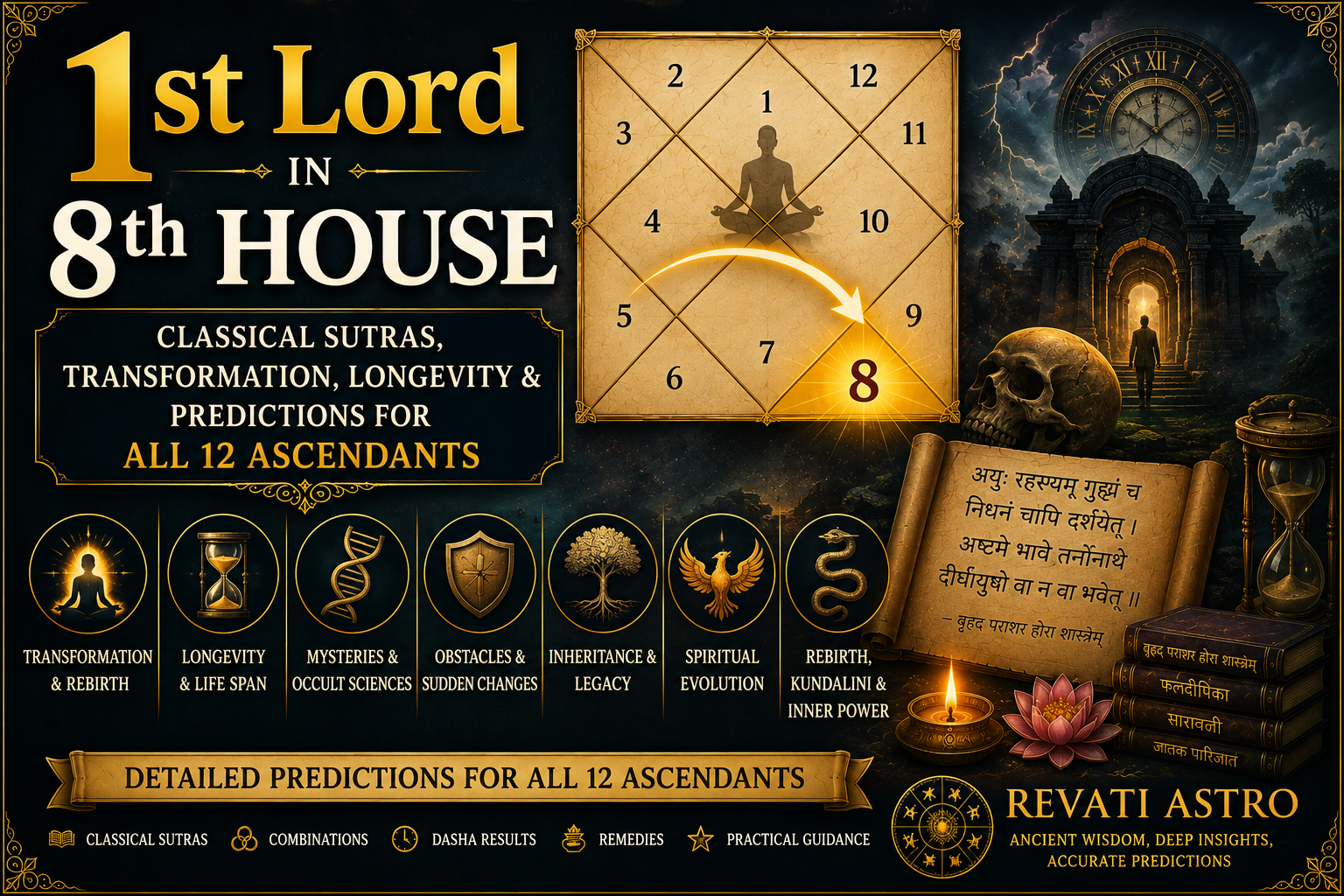
 

1st Lord in 8th House: Classical Sutras, Transformation, Longevity & Predictions for All 12 Ascendants

By Daksh Maheshwari · Revati Astro · Vedic Astrology Research · ~24 min read

The self descends into the abyss — and returns transformed. When the Lagna Lord — the planet of identity, physical body, and the will to live — enters the 8th house, the most feared and least understood house in the entire Vedic horoscope, the native’s life is set on a path unlike any other. A path of profound transformation, deep hidden knowledge, unexpected upheaval, inheritance, occult mastery, and ultimately, the kind of wisdom that only comes from having faced the darkest corners of existence and survived.

The 8th house carries the weight of its Sanskrit names: Randhra Bhava (the house of the aperture — the portal between worlds), Mrityu Bhava (the house of death), Ayur Bhava (the house of longevity), Rina Bhava (house of obstacles), and Ashtama Bhava (the eighth station). It governs the most intense experiences of human existence: death and dying, sexual union and joint resources, inheritance and sudden windfalls, chronic disease and surgical intervention, occult knowledge and esoteric research, shame, scandal, and the radical transformation that follows the complete destruction of an old identity.

This is the placement that astrologers approach with the most caution and readers search for with the most anxiety. Most articles online offer either panic-inducing warnings about “short life and disease” or a shallow reassurance that misses the real depth. This article does neither. It presents the complete classical picture — the original Sanskrit BPHS sutra in full, every major classical source, the longevity question answered responsibly, the Viparita Rajyoga potential decoded, the extraordinary occult and research gifts of this placement illuminated, and detailed, nuanced predictions for all 12 ascendants — so that every reader leaves not with fear, but with understanding.

1. The 1st & 8th Houses: Life, Death & Transformation

1st House — Lagna / Tanu Bhava

The Ascendant is the zodiac degree rising on the eastern horizon at birth — the chart’s most personal and powerful coordinate. It governs the physical body, personality, self-concept, vitality, and life direction. Its lord is simultaneously a Kendra lord (pillar) and Trikona lord (grace) — the only planet with both designations, making it the chart’s single most personally significant planet. Wherever the Lagna Lord travels, the native’s life force, identity, and entire sense of self travel with it.

8th House — Randhra / Mrityu / Ayur / Ashtama Bhava

The 8th house is the most multi-dimensional house in the Vedic horoscope, governing the full spectrum from the darkest human experiences to the most transcendent spiritual attainments:

  • Mrityu — death, dying, and the transition between worlds
  • Ayus — longevity, lifespan, and the quality of the life force over time
  • Randhra — aperture, gap, vulnerability — the places where the external world penetrates the self
  • Guhya — secrets, hidden knowledge, and everything concealed from the public eye
  • Rina — obstacles, chronic difficulties, and karmic liabilities
  • Para-Dhana — other people’s wealth; spouse’s resources, inheritance, joint finances
  • Ashta Bhaga — the 8th portion; what is distributed at the end of a cycle
  • Apamaana — dishonour, scandal, shame, and social disgrace
  • Shastra — weapons, surgeries, and violent interventions
  • Tantra / Mantra Siddhi — occult sciences, mystical knowledge, and esoteric mastery
  • Vipat — catastrophe, sudden loss, and crisis
  • Transformation — the complete destruction of an old form and the emergence of a new identity

The natural Karakas of the 8th house are Saturn (for longevity, chronic conditions, and obstacles) and Mars (for sudden events, surgery, and violent transformation). The 8th house’s presiding deity is Lord Shiva in his Mrityunjaya form — the Conqueror of Death — which tells us everything about the 8th house’s highest promise: not death, but the triumph over death through transformation.

Structural Connections When Lagna Lord Enters the 8th

  1. Lagna-Dusthana Connection: The planet of life and identity placed in the house of death and transformation creates the chart’s most fundamental tension
  2. The 2nd House Aspect: The Lagna Lord in the 8th casts its 7th aspect on the 2nd house — the house of wealth, family, and speech. The native’s deepest identity (Lagna Lord) looks at and energises the 2nd house — connecting the transformative journey to material resources and family legacy
  3. Viparita Yoga Potential: The Lagna Lord in the 8th (Dusthana) opens significant Viparita Rajyoga doors when the 8th lord is also in a Dusthana
  4. Aries & Libra Special Case: For Aries ascendant (Mars rules both 1st and 8th) and Libra ascendant (Venus rules both 1st and 8th), the Lagna Lord being in the 8th creates a self-lordship of the 8th — the Lagna Lord IS the 8th lord, creating a structurally unique and ultimately powerful configuration

The Lagna Lord’s 2nd House Aspect — The Hidden Gift: The Lagna Lord in the 8th house aspects the 2nd house directly — connecting the native’s transformative depth experience to wealth, family, and speech. This is why many natives with this placement, despite the personal challenges of having the Lagna Lord in the 8th, often find that wealth comes to them through hidden channels: inheritance, in-laws’ resources, research-based income, insurance settlements, or sudden unexpected financial windfalls. The 8th house’s Para-Dhana (other people’s money) finds a direct energetic channel to the 2nd house (own money) through this aspect.

2. Classical Sutras — Original Sanskrit with Full Analysis

📖 Brihat Parashara Hora Shastra (BPHS) — Bhava Lord Phalam (Primary Sutra):
लग्नेशे मृत्युभावस्थे अल्पायुः कलहप्रियः ।
देहकष्टं च सततं क्रूरश्च कदर्यवान् भवेत् ॥

Transliteration: “Lagneśe mṛtyubhāvaste alpāyuḥ kalahapriyaḥ | Dehakashṭaṃ ca satataṃ krūraśca kadaryavān bhavet ||”
Translation: “When the Lord of the Ascendant is placed in the 8th house (Mrityu Bhava), the native will be short-lived (Alpayuh), fond of quarrels (Kalahapriyah), always afflicted by bodily distress (Deha-kashta), cruel (Krura), and miserly (Kadaryavan).”
Critical Interpretation: This is BPHS’s most challenging sutra for a Lagna Lord placement — and it must be read with careful contextual understanding. Parasara describes the worst-case, fully afflicted version of this placement. “Alpayuh” (short-lived) is a conditional prediction that applies when the Lagna Lord is debilitated, combust, or heavily afflicted in the 8th without any benefic protection. “Kalahapriyah” (fond of quarrels) reflects the native’s natural orientation toward conflict, depth, and psychological intensity — which in its highest expression becomes a courageous willingness to engage with life’s most difficult truths. “Deha-kashta” (bodily distress) is the health dimension that must be taken seriously but contextualised within the full chart. “Krura” (cruel) and “Kadaryavan” (miserly) are shadow expressions of the 8th house’s protective, secretive energy when not consciously evolved.
📖 BPHS — Conditional Exception (Often Omitted by Other Authors):
“If the Lagna Lord is in the 8th house but is in its own sign (Swakshetra) or in exaltation (Uccha), and receives the aspect of benefic planets, the malefic effects are substantially mitigated and the native may be long-lived, obtaining hidden knowledge and wealth through transformative means.”
This conditional exception is the most important classical modifier for this placement — and its omission from most popular astrology articles creates a fundamentally incomplete picture. For Aries ascendant (Mars in own sign Scorpio in 8th) and Libra ascendant (Venus in own sign Taurus in 8th), this condition is automatically met — transforming the placement from challenging to ultimately powerful.
📖 Phaladeepika (Mantreswara):
“When the Lagna Lord is in the 8th house, the native will face many bodily ailments, will be bereft of wealth, and will face obstacles repeatedly. However, if the Lagna Lord is in Shubha yoga (benefic association) in the 8th house, the native will ultimately gain wealth through inheritance and hidden means, and will become accomplished in occult knowledge.”
Interpretation: Mantreswara introduces the positive flip side: “wealth through inheritance and hidden means” — the 8th house’s Para-Dhana dimension. And “accomplished in occult knowledge” — the 8th house’s Tantra Siddhi dimension. These two positive outcomes are consistently available to the native with a well-placed Lagna Lord in the 8th, alongside the challenges.
📖 Saravali (Kalyana Varma):
“If the Lagna Lord is in the 8th house, the native will be troubled by disease and will face repeated crises. He will be involved with matters of death and secrets. However, he will gain knowledge of hidden things and may benefit from the spouse’s wealth and inheritance. He will be a deep thinker and will develop mastery in esoteric sciences.”
Interpretation: Kalyana Varma adds two distinctive positive dimensions: “benefit from spouse’s wealth” (the 8th as house of spouse’s resources) and “mastery in esoteric sciences.” The progression from “troubled by disease” to “mastery in esoteric sciences” is the life arc of the 8th house Lagna Lord — crisis becomes the teacher, and the teacher becomes the master.
📖 Satya Jatakam:
“When the Lagna Lord is in the 8th with Shubha yoga, the native gains from the 8th house’s positive dimensions — research mastery, inheritance, occult knowledge, and the capacity to survive and transcend every crisis. With Ashubha yoga, the negative dimensions dominate: disease, obstacles, and shortened vitality.”
Interpretation: Satya Jatakam’s Shubha/Ashubha framework is especially decisive for this placement — no other Lagna Lord position is as sensitive to the quality of planetary associations as the 8th house placement. The difference between a chart with Jupiter aspecting the Lagna Lord in the 8th and one where Rahu conjuncts the Lagna Lord in the 8th is the difference between a great astrologer and a person overwhelmed by hidden forces.
📖 Jataka Parijata (Vaidyanatha Dikshita):
“The native whose Lagna Lord occupies the Randhra Bhava (8th house) will be acquainted with the secrets of existence, will face transformative crises, and will ultimately develop a profound understanding of life’s deepest mysteries. He will gain wealth through hidden and unexpected means. His life will be marked by sudden changes that repeatedly reshape his identity.”
Interpretation: “Acquainted with the secrets of existence” — Vaidyanatha Dikshita’s phrase is philosophically the most precise description of this placement’s essential experience. The native doesn’t just know facts; they know secrets. The 8th house’s hidden knowledge is their natural territory, and their Lagna Lord placed here makes this territory their home.

3. Randhra Bhava Decoded: The 8th House’s Full Domain

🌑 The Eight Dimensions of the 8th House for the Lagna Lord

When the Lagna Lord enters the Randhra Bhava, it activates all eight dimensions of the 8th house simultaneously — creating a multi-layered life experience that is unlike any other placement:

  • 1. Transformation (Parivartana): The native’s identity undergoes complete restructuring multiple times in their lifetime. They are not the same person at 50 that they were at 20 — not through gradual evolution but through sudden, crisis-driven metamorphosis
  • 2. Longevity & Death (Ayus/Mrityu): Awareness of mortality — not as an abstract philosophical concept but as a lived, felt reality — shapes the native’s relationship with time, urgency, and meaning
  • 3. Occult & Hidden Knowledge (Guhya Vidya): The native has a deep, instinctive pull toward what is concealed — astrology, tantra, psychology, research, forensics, or any field that reveals what is hidden beneath the surface of ordinary reality
  • 4. Joint Resources & Inheritance (Para-Dhana): Wealth arrives through channels other than direct personal earning — inheritance, in-laws’ resources, insurance, joint investments, or sudden unexpected financial events
  • 5. Sexual Union & Intimacy (Ratisukha): The 8th house governs the most intimate forms of physical and emotional union. The native’s experience of sexuality is intense, transformative, and deeply connected to their sense of identity
  • 6. Chronic Disease & Obstacles (Roga/Rina): The body is a site of sustained challenge — chronic conditions, mysterious ailments, and health events that require the native to develop a deep relationship with the physical dimension of existence
  • 7. Sudden Events & Upheaval (Aakasmaata): Life delivers its most significant events without warning — sudden gains, sudden losses, accidents, and revelations that arrive from completely unexpected directions
  • 8. Spiritual Depth & Liberation (Moksha): The 8th house, at its highest vibration, is the gateway to moksha (liberation) — through the direct confrontation with death and impermanence, the native’s consciousness is naturally oriented toward the transcendent

4. The Longevity Question: What the Classics Really Say

⚠️ Longevity Analysis — The Complete, Responsible Classical Framework

BPHS’s “Alpayuh” (short-lived) warning for the Lagna Lord in the 8th is the most commonly cited and most frequently misunderstood prediction in Vedic astrology. Here is the complete classical framework that responsible astrologers use:

Longevity in Vedic astrology requires SIMULTANEOUS assessment of all these factors:

  • The strength of the Lagna and Lagna Lord (body and vitality)
  • The condition of the 8th house and 8th lord (longevity house)
  • The strength of the 3rd house and 3rd lord (vitality and courage — the 3rd is the house of the Ayur Trikona from the 8th)
  • Saturn’s position (natural karaka of longevity)
  • The Dasha and Antardasha sequence (when do Maraka periods run?)
  • The D-8 Ashtamamsha divisional chart (specific longevity confirmation)

The critical modifying conditions that mitigate “Alpayuh”:

  • Lagna Lord in own sign in 8th (Mars in Scorpio for Aries; Venus in Taurus for Libra) — significantly mitigates longevity concern
  • Lagna Lord in exaltation in 8th — further mitigates
  • Jupiter aspects the Lagna Lord in the 8th — the most powerful single protective factor; Jupiter’s aspect on the 8th house Lagna Lord converts “Alpayuh” toward “Madhyayuh” (medium life) or even “Deerghayu” (long life) in many cases
  • The 8th lord is strong and well-placed — when the 8th house itself is well-governed, the Lagna Lord within it is better protected
  • Saturn is strong (own sign, exaltation, or Kendra) — Saturn as natural longevity karaka provides structural support

Modern medical context: Classical longevity predictions were made in a world without antibiotics, surgery, or modern diagnostics. The “Alpayuh” tendency — even when it exists — is substantially modified by modern healthcare. Responsible Vedic astrology does not announce specific lifespan predictions. The classical guidance is: be vigilant, be informed, and strengthen protective factors through remedies and conscious health management.

The deeper meaning of “Alpayuh” beyond literal lifespan: Many classical commentators interpret “Alpayuh” not as literal short life but as “short life of the current identity” — the native’s sense of self undergoes repeated deaths and rebirths (which is the 8th house’s true domain) even within a physically long lifetime. In this reading, “Alpayuh” is about the brevity of any single ego-construct rather than the brevity of physical existence.

5. Viparita Rajyoga: Triumph Through the Depths

🌀 Vimala Yoga — The Most Relevant Viparita Configuration

The Viparita Rajyoga (reverse royal yoga) occurs when the lord of a Dusthana (6th, 8th, or 12th) is placed in another Dusthana. Three specific named variants exist:

  • Harsha Yoga: 6th lord in 6th, 8th, or 12th
  • Sarala Yoga: 8th lord in 6th, 8th, or 12th
  • Vimala Yoga: 12th lord in 6th, 8th, or 12th

For the Lagna Lord in the 8th house, the most relevant Viparita configuration is Sarala Yoga — when the 8th lord is also in the 6th, 8th, or 12th house. Since for Aries ascendant the Lagna Lord (Mars) is simultaneously the 8th lord, placing it in the 8th house creates a complete self-referential Sarala Yoga — one of the most powerful variants of this yoga.

What Sarala Yoga produces for 1st lord in 8th house natives:

  • The native experiences severe crises, health challenges, sudden losses, or profound suffering at some point in their life — the Dusthana suffering is real
  • But from these crises, they emerge transformed — with unexpected success, recognition, and wisdom that the crisis itself has created
  • Others’ misfortune or institutional collapse may paradoxically create opportunities for the native — they thrive precisely in situations where others struggle to survive
  • The native develops an almost uncanny ability to navigate catastrophe — each crisis makes them more resilient, more resourceful, and more capable of dealing with the next one
  • Recognition and success often come suddenly, from unexpected directions, after periods of apparent darkness — the classic “triumph from the depths” pattern

Sarala Yoga’s specific promise from the classical texts: “The native born with Sarala Yoga will be long-lived, fearless, and will prosper by overcoming obstacles. He will be esteemed by the learned and will become prosperous through the defeat of his enemies.” — This is the direct inversion of the BPHS “Alpayuh” warning, confirming that the Viparita dynamic can completely transform the baseline prediction.

Key condition for full Sarala Yoga activation: The Lagna and Lagna Lord must themselves be strong — the double-Dusthana creates a double-negative that becomes positive only when the native’s personal vitality (Lagna) is robust enough to survive the intense pressure of the 8th house’s transformative forces.

6. General Effects & Core Life Themes

🦅 The Phoenix Identity — Repeated Death and Rebirth

The defining life pattern of the 1st lord in 8th house native is not a straight line of progress but a recurring cycle of destruction and emergence. Like the phoenix, their most significant life advances follow periods of complete collapse — of identity, of circumstances, of relationships, or of physical health. Each time they emerge, they are recognisably themselves but fundamentally different — deeper, wiser, less attached to the forms that collapsed, and more aligned with the essential self that survives every transformation.

This is not a gentle process. The 8th house does not deal in subtle nudges. It deals in radical upheaval, unexpected catastrophe, and the kind of forced evolution that can only happen when everything comfortable is taken away. The native learns this early and, over time, develops a remarkable capacity for surrender — not passive surrender, but the active, courageous surrender of someone who has learned that the crisis is also the teacher.

🔬 The Depth Intelligence — Seeing What Others Cannot

The 8th house is the house of what is hidden, and the Lagna Lord placed here gives the native an extraordinarily penetrating intelligence — a capacity to perceive beneath the surface of people, situations, and systems. They see motivations others miss, detect deception others accept at face value, and access information through intuitive channels that others dismiss as irrelevant. This depth intelligence is their most consistent and practically valuable gift, and it finds its expression in research, investigation, psychology, occult study, and any field requiring the ability to work with what is hidden.

💰 Wealth Through Hidden Channels

The 8th house is Para-Dhana — other people’s money. The Lagna Lord here ensures that the native’s primary wealth sources are not obvious or conventional. They may inherit significant assets (ancestral or from spouse’s family), receive unexpected insurance settlements, earn through research or investigation-based fields, benefit from joint investments, or experience sudden financial windfalls from completely unexpected directions. The pattern is consistent: wealth arrives through transformation events, not through linear accumulation.

🌙 The Taboo and the Sacred — Comfort with the Uncomfortable

The 8th house governs what society considers taboo — death, sexuality, secrets, occult knowledge, and the body in its most vulnerable states. The native with the Lagna Lord here is instinctively comfortable where others are uncomfortable. They can discuss death without flinching, sexuality without shame, secrets without discomfort. This comfort with what others avoid is both their greatest social differentiator and the source of some of their most significant professional opportunities — as therapists, researchers, astrologers, forensic investigators, and healers who work at the boundaries of ordinary experience.

7. All 12 Ascendants — Detailed Predictions

Ascendant Lagna Lord in 8th Sign in 8th Condition
Aries Mars Scorpio Own Sign ⭐ — Strongest
Taurus Venus Sagittarius Friendly
Gemini Mercury Capricorn Neutral
Cancer Moon Aquarius Neutral-Challenging
Leo Sun Pisces Friendly
Virgo Mercury Aries Neutral
Libra Venus Taurus Own Sign ⭐
Scorpio Mars Gemini Neutral
Sagittarius Jupiter Cancer ⭐ Exalted
Capricorn Saturn Leo Neutral
Aquarius Saturn Virgo ⭐ Exalted
Pisces Jupiter Libra Neutral

♂ MarsAries Ascendant — Mars in Scorpio Own Sign ⭐ — Maximum Power

The Supreme Occultist & Fearless Transformer

Mars, Aries’ Lagna Lord, is in its own sign Scorpio in the 8th house — the single most powerful configuration for this placement across all 12 ascendants. Mars rules both the 1st house (Aries) and the 8th house (Scorpio) for this ascendant, creating a complete self-lordship of the 8th. The Sarala Yoga is fully formed and maximally powerful. This native is a born warrior of the depths — fearless, penetrating, and utterly at home in the 8th house’s domain of secrets, crisis, and transformation. They possess exceptional courage in the face of death (literal or metaphorical), extraordinary research capacity, and a natural mastery of occult sciences. The Aries-Mars-Scorpio combination creates the chart’s most formidable investigator, surgeon, or occultist. Longevity, despite BPHS’s Alpayuh warning, is significantly protected by Mars’s own-sign strength — the Sarala Yoga here actively counters the longevity concern. Watch for: Intensity that isolates others; obsessive engagement with dark or taboo subjects that becomes consuming; physical recklessness that the Mars energy can generate in the 8th house.

♀ VenusTaurus Ascendant — Venus in Sagittarius

Philosophical Depth & Hidden Wisdom Through Beauty

Venus, Taurus’ Lagna Lord, enters Jupiter-ruled Sagittarius in the 8th house. Venus in Sagittarius gives a philosophical, expansive, and wisdom-seeking approach to the 8th house’s depths. The native is drawn to hidden philosophy, esoteric religion, occult studies framed within spiritual tradition, and the philosophy of death and transformation. They may be practitioners of Tantra in its highest (philosophical) form, or researchers into cross-cultural spiritual traditions. Venus in a friendly sign in the 8th significantly mitigates the longevity concern — Jupiter’s energy (through Sagittarius) provides protective expansion. The native may gain wealth through foreign sources, in-laws’ resources, or philosophical teaching/writing about hidden subjects. Venus also rules the 6th house (Libra) for Taurus — creating a Viparita connection (6th lord Venus in the 8th) that further strengthens the Sarala Yoga dimension. Watch for: Secret love affairs (Venus’s 8th house shadow), over-indulgence in philosophical escape from practical 8th house challenges, financial instability due to idealistic approaches to the 8th house’s material dimension.

☿ MercuryGemini Ascendant — Mercury in Capricorn

The Systematic Researcher & Occult Communicator

Mercury, Gemini’s Lagna Lord, is in Saturn-ruled Capricorn in the 8th house. Mercury in Capricorn in the 8th gives a native with an exceptionally disciplined, structured, and systematic approach to hidden knowledge. They are master researchers — methodical, thorough, and capable of building comprehensive knowledge systems from fragmented hidden information. They may excel in financial research, tax investigation, forensic accounting, astrology (especially the technical, mathematical dimensions), cryptography, or data security. Mercury also rules the 4th house (Virgo) for Gemini — connecting the 8th house’s hidden research to the 4th house’s property and domestic dimension (property research, real estate market analysis, or working from a home-based research practice). Watch for: Over-intellectualisation of emotional 8th house experiences; Mercury in Saturn’s sign in the 8th can create anxiety around death and health that needs conscious management.

☽ MoonCancer Ascendant — Moon in Aquarius

The Emotional Researcher & Collective Transformer

The Moon, Cancer’s Lagna Lord, enters Saturn-ruled Aquarius in the 8th house — a particularly challenging combination. The Moon (emotions, nurturing, the mind) in the 8th house (death, upheaval, hidden things) in Aquarius (Saturn’s detached, collective sign) creates a native whose emotional life is turbulent, unpredictable, and subject to radical transformation events. The mind is simultaneously drawn to scientific research (Aquarius) and occult mysteries (8th house), creating a natural orientation toward astrology, psychology, or any field that combines rational analysis with hidden knowledge. The Moon in Aquarius in the 8th gives a genuinely innovative intelligence — but one that processes life through the lens of emotional turmoil. BPHS’s longevity concern is most relevant here, as the Moon (Lagna Lord) is in a somewhat uncomfortable position in the Aquarian-Saturnine 8th. Watch for: Emotional instability, fear of the future, anxiety around sudden events; the Moon’s waxing and waning creates cycles of psychological intensity and relief that the native must learn to ride consciously.

☀ SunLeo Ascendant — Sun in Pisces

The Spiritual Authority & Hidden Healing Light

The Sun, Leo’s Lagna Lord, enters Jupiter-ruled Pisces in the 8th house. The Sun in Pisces in the 8th is one of the more spiritually elevated expressions of this placement — the planet of individual authority dissolves into the ocean of universal consciousness. This native’s identity is shaped by a deep spiritual sensitivity, a natural intuition about hidden things, and a genuine pull toward transcendence through the 8th house’s confrontation with mortality and the unseen. They may be spiritual healers, teachers of death and dying, hospice workers, or spiritual directors who guide others through their most profound transitions. Jupiter’s sign (Pisces) gives significant protective energy, mitigating the longevity concern and redirecting the Sun’s vitality toward spiritual rather than physical expression of the 8th house’s domain. Watch for: The Sun in Pisces can dissolve its natural authority in the 8th house’s oceanic depths — the native may struggle to assert their individual will against the transformative forces the 8th house generates.

☿ MercuryVirgo Ascendant — Mercury in Aries

The Sharp Surgical Mind & Forensic Investigator

Mercury, Virgo’s Lagna Lord, is in Mars-ruled Aries in the 8th house. Mercury in Aries gives the native a quick, sharp, decisive, and surgically precise intelligence in the 8th house’s domain. They process hidden information rapidly, make incisive analytical decisions in crisis situations, and communicate about difficult, complex, or occult subjects with remarkable clarity and directness. They may excel as surgeons (Aries/Mars + 8th house surgery), forensic investigators, emergency medical communicators, or cutting-edge researchers who pioneer new territory in hidden or taboo fields. Mercury also rules the 10th house (Gemini) for Virgo ascendant — creating a direct 1st-8th-10th connection: the native’s transformative depth research becomes their most publicly recognised career contribution. Watch for: Mercury in Aries can be too direct and blunt about the 8th house’s sensitive subjects; the native may share hidden information before assessing whether it is appropriate to do so.

♀ VenusLibra Ascendant — Venus in Taurus Own Sign ⭐

Material Transformation & Wealth Through Depth — Second Strongest

Venus, Libra’s Lagna Lord, is in its own sign Taurus in the 8th house — the second most powerful configuration for this placement after Aries ascendant. Venus rules both the 1st house (Libra) and the 8th house (Taurus) for this ascendant, creating the same self-lordship dynamic as Aries-Mars-Scorpio. The Sarala Yoga is fully formed. Venus in Taurus in the 8th house gives the native exceptional capacity for material transformation — wealth through inheritance, in-laws’ resources, joint financial ventures, and sudden financial windfalls. The native is artistically gifted with a particular affinity for the transformative and the beautiful — they may work in art restoration, ancient treasures, luxury goods research, or financial products connected to material assets. Venus in own sign significantly mitigates the longevity concern. This is one of the best configurations for unexpected wealth accumulation through 8th house channels. Watch for: Attachment to material security (Venus in Taurus) combined with the 8th house’s sudden-loss potential creates financial anxiety; the native must develop detachment from specific material forms while maintaining financial discipline.

♂ MarsScorpio Ascendant — Mars in Gemini

The Communicative Occultist & Information Warrior

Mars, Scorpio’s Lagna Lord, enters Mercury-ruled Gemini in the 8th house. Mars in Gemini gives a native who communicates about the 8th house’s domain with extraordinary skill and breadth — they are the people who write the books on astrology, who teach the workshops on shadow psychology, who communicate forensic findings to the public, or who build information-based businesses around hidden knowledge systems. Gemini’s communicative intelligence combined with Mars’s courage and the 8th house’s depth creates a formidable public voice for difficult truths. Mars also rules the 6th house (Aries) for Scorpio — a Viparita connection (6th and 8th lords both activated through Mars) that strengthens the Sarala Yoga dimension. Watch for: Mars in Gemini in the 8th can scatter the native’s investigative energy across too many hidden topics simultaneously — depth requires commitment to one path of inquiry, not ten.

♃ JupiterSagittarius Ascendant — Jupiter in Cancer ⭐ Exalted

Exalted Wisdom in the Depths — Spiritual Mastery & Protected Longevity

Jupiter, Sagittarius’ Lagna Lord, is exalted in Cancer in the 8th house — one of the most spiritually powerful configurations for this placement. An exalted Lagna Lord in the 8th house is the most significant longevity and protection factor available. Jupiter in Cancer at maximum strength in the 8th house converts the placement’s entire energy profile: instead of disease and shortened life, the native receives profound emotional wisdom, exceptional healing capacity, and a life whose depth challenges are consistently overcome through the force of spiritual grace and philosophical resilience. The native is typically a gifted healer, spiritual teacher, depth psychologist, or astrologer of exceptional wisdom. Inheritance and unexpected wealth through family and nurturing channels are strongly indicated. Watch for: Even an exalted Jupiter in the 8th can bring Jupiter-related 8th house challenges — excess weight (Jupiter’s expansion in Cancer’s water environment), liver-related health concerns, and over-optimism about the 8th house’s capacity to deliver sudden windfalls without disciplined effort.

♄ SaturnCapricorn Ascendant — Saturn in Leo

The Structured Transformer & Institutional Crisis Manager

Saturn, Capricorn’s Lagna Lord, enters Sun-ruled Leo in the 8th house. Saturn in Leo creates a notable tension — the planet of discipline and structure in the sign of individual creative authority. In the 8th house, this manifests as the native’s encounter with institutional power structures in transformative contexts: crisis management in large organisations, structural reform during periods of institutional collapse, or leadership in fields that deal with the 8th house’s domain (insurance, estate planning, corporate restructuring, or government oversight of hidden financial systems). Saturn in Leo in the 8th gives the native a formidable capacity to endure — they are crisis survivors par excellence. Watch for: The Saturn-Leo tension creates ego challenges in the 8th house’s transformative context; the native must learn to yield personal authority to the transformative process rather than attempting to control it.

♄ SaturnAquarius Ascendant — Saturn in Virgo ⭐ Exalted

Analytical Mastery in the Depths — Second Exaltation Configuration

Saturn, Aquarius’ Lagna Lord, is exalted in Virgo in the 8th house — the second exaltation configuration alongside Sagittarius ascendant. Saturn exalted in the 8th house creates a native of extraordinary analytical precision, systematic discipline, and practical mastery in the 8th house’s domain. They are the researchers who publish the definitive work, the investigators whose findings are beyond dispute, the healers whose methodologies transform their field. Saturn’s exaltation in Virgo (the sign of health, service, and analytical detail) in the 8th house also significantly mitigates longevity concerns — the exalted Lagna Lord provides structural protection against the “Alpayuh” tendency. Saturn also rules the 12th house (Pisces) for Aquarius ascendant — creating a Vimala Yoga (12th lord in the 8th, a Dusthana) that adds further Viparita Rajyoga strength to an already powerful configuration. Watch for: Perfectionism in the face of crisis — the native may delay action until they have analysed every variable, which in crisis situations can be debilitating; learning to act with incomplete information is their most important 8th house lesson.

♃ JupiterPisces Ascendant — Jupiter in Libra

Diplomatic Wisdom in the Depths & Partnership Transformation

Jupiter, Pisces’ Lagna Lord, enters Venus-ruled Libra in the 8th house. Jupiter in Libra gives the native a diplomatic, balanced, and partnership-oriented approach to the 8th house’s transformative depths. Their transformative life events often arrive through partnerships — marriage, business alliances, or legal processes that trigger profound identity changes. They seek to bring wisdom and fair resolution to the 8th house’s domain of hidden conflict and joint resource management. Jupiter in Libra in the 8th may produce exceptional mediators of complex inheritance disputes, estate lawyers, or partnership therapists who work with couples through their most transformative relationship crises. Jupiter also rules the 10th house (Sagittarius) for Pisces ascendant — connecting the transformative career to philosophical public recognition. Watch for: Jupiter in Libra can be over-optimistic about the fairness of the 8th house’s sudden events; the native may expect that wisdom and diplomacy alone can navigate the 8th house’s chaos, only to discover that this house sometimes delivers beyond what reason can manage.

8. Occult Knowledge, Research & Hidden Mastery

🔮 The 8th House as the Seat of All Hidden Knowledge

The 8th house is the Guhya Vidya Sthana — the seat of all hidden knowledge in the Vedic system. It governs:

  • Jyotisha (Vedic Astrology) — the hidden map of time and karma
  • Tantra — the esoteric technologies of consciousness transformation
  • Numerology, Vastu, and sacred geometry — hidden patterns in space and number
  • Alchemy and transformation sciences — the transmutation of base matter and consciousness
  • Psychology and depth therapy — the modern Western equivalent of 8th house hidden-mind work
  • Medical research — specifically research into diseases and hidden physiological mechanisms
  • Forensics and investigation — uncovering what has been deliberately hidden
  • Financial research — understanding the hidden mechanics of money and markets

When the Lagna Lord is placed in this house, the native’s entire identity is oriented toward hidden knowledge. They don’t merely dabble in these fields — they are called to master them. The 8th house’s depth requires sustained commitment, and the Lagna Lord here provides exactly that: a personal identity so aligned with hidden knowledge that anything less than mastery feels like a betrayal of the self.

Many of the world’s most accomplished Vedic astrologers, tantric practitioners, research scientists, depth psychologists, and forensic investigators carry a prominent 8th house Lagna Lord in their charts. The placement that the classical texts warn about most gravely is also the placement that produces the chart’s most profound practitioners of hidden wisdom — because wisdom, in the Vedic framework, is always earned through direct confrontation with the unknown.

9. Inheritance, Joint Assets & Sudden Wealth Events

The 8th house is Para-Dhana — the house of other people’s wealth — and this is one of the most practically significant positive dimensions of the Lagna Lord placed here. The native’s identity becomes connected to wealth that arrives through channels other than direct personal effort:

💰 Wealth Sources Through the 8th House

  • Ancestral inheritance — property, assets, or savings passed down through the family lineage
  • Spouse’s or in-laws’ wealth and resources
  • Life insurance and death benefits
  • Legal settlements and court-awarded compensation
  • Hidden or forgotten assets that surface unexpectedly
  • Research-based intellectual property income
  • Investment gains from joint ventures
  • Sudden windfalls from completely unexpected sources

⚠️ Wealth Risks Through the 8th House

  • Sudden financial losses from unexpected events
  • Disputes over inherited assets
  • Complications in joint financial accounts
  • Financial impact of spouse’s or family member’s death
  • Tax liabilities uncovered through audit or investigation
  • Business partnership dissolution creating asset division complexity
  • Medical expenses depleting accumulated savings

The Lagna Lord’s 2nd house aspect from the 8th is the key structural feature connecting these 8th house wealth events to the native’s personal financial resources. The energy flows from “other’s money” (8th house, Para-Dhana) to “own money” (2nd house, Svadhan) through this aspect — creating a consistent pattern of unexpected financial events that ultimately contribute to the native’s personal wealth portfolio, particularly in the second half of life.

10. Identity Transformation: The Phoenix Pattern

For the 1st lord in 8th house native, identity is not a fixed possession — it is a living process of continuous death and rebirth. The classical texts hint at this through “Kalahapriyah” (fond of quarrels/conflict) — a phrase that at its highest level describes someone who is oriented toward confrontation with life’s most difficult dimensions rather than retreat from them.

The Three Phases of Transformation

  1. The Crisis Phase (The Fire): An external event — health crisis, financial collapse, relationship ending, public scandal, or sudden loss — destroys the current identity’s primary supports. The native’s sense of who they are becomes untenable. This phase is the 8th house’s Dusthana face at its most intense.
  2. The Dissolution Phase (The Ash): Between destruction and renewal, the native enters a period of deep uncertainty — they don’t know yet who they are becoming. This phase requires the capacity to remain in the unknown without forcing premature resolution. Many 8th house Lagna Lord natives report this as the most spiritually significant period of their lives.
  3. The Emergence Phase (The Phoenix): The new identity emerges — always deeper, always more authentic, always wiser than what it replaced. The native recognises that the crisis was not destruction of the self but liberation from a version of the self that was no longer sufficient for their soul’s growth.

This cycle repeats throughout the native’s life — typically three to five times in a full lifetime, each cycle bringing the native closer to the essential self that lies beneath all temporary identities. By the end of their life, 8th house Lagna Lord natives are among the most philosophically grounded, genuinely wise, and authentically themselves of all people — precisely because the 8th house has stripped away everything inessential through its relentless transformative pressure.

11. Career Paths: The Depth-Domain Vocations

The 8th house’s domain creates a specific and consistent set of vocational orientations for the Lagna Lord placed here:

🔬 Research & Investigation Fields

  • Vedic astrology and occult sciences
  • Scientific research (especially medical, psychological, or archaeological)
  • Forensic investigation and criminology
  • Intelligence and security work
  • Financial research and auditing
  • Tax investigation and estate planning
  • Historical and archaeological research
  • Data security and cryptography

🏥 Healing & Transformation Fields

  • Medicine, surgery, and emergency care
  • Psychology and psychotherapy
  • Hospice and palliative care
  • Tantra and spiritual healing
  • Addiction recovery and rehabilitation
  • Death and dying counselling
  • Trauma therapy and PTSD treatment
  • Insurance, estate, and legacy planning

The Lagna Lord’s 2nd House Aspect on Career

The Lagna Lord’s 7th aspect from the 8th house falls on the 2nd house — connecting the native’s career depth (8th house) to speech, family wealth, and accumulated resources (2nd house). This means the native’s career tends to generate wealth through a combination of hidden professional expertise and the native’s ability to speak about complex, sensitive, or taboo subjects in ways that others find valuable and illuminating. Astrologers, therapists, forensic consultants, and research-based financial advisors with this placement often build their income around their capacity to communicate hidden knowledge clearly and insightfully.

12. Marriage, Sexuality & Intimate Relationships

The 8th house governs the most intimate dimensions of human relationship — not the formal partnership of the 7th house but the deep, transformative union that happens beneath social forms. The Lagna Lord placed here creates a native whose entire identity is shaped by profound intimate experience.

Relationship Patterns

  • The native’s romantic and sexual relationships are intense, transformative, and identity-altering — they emerge from each significant relationship as a different person than they entered it
  • They are attracted to depth in partners — psychological complexity, hidden layers, and the quality of being genuinely mysterious. Surface-level attractiveness without depth holds no lasting appeal
  • The marriage partner often comes from a different background, bringing an entirely different world-view that challenges and expands the native’s sense of self
  • Spouse’s resources (Para-Dhana) frequently contribute significantly to the native’s financial life — the marriage has a material wealth dimension beyond the emotional and social
  • The marital relationship is never static — it undergoes its own cycles of transformation, and the couples who thrive with this placement are those who can consciously evolve together rather than clinging to fixed roles

⚠️ The Secret Relationship Warning

Classical texts consistently note the possibility of secret love affairs for the Lagna Lord in the 8th house — the 8th house’s Guhya (hidden) dimension combined with Venus or Moon’s influence on the Lagna Lord can create a pattern of concealed romantic relationships. This is the shadow of the 8th house’s natural affinity for secrecy applied to the realm of intimate connection. The conscious, evolved expression is depth and genuine emotional intimacy within committed relationships rather than the concealment of parallel ones.

13. Health, Body & Disease Patterns

Health is the most classically emphasised challenge of this placement. The 8th house governs the body’s most vulnerable systems and the potential for chronic, difficult-to-diagnose, or surgically requiring conditions:

Body Areas Governed by the 8th House

  • Reproductive and sexual organs (primary 8th house body zone)
  • Elimination systems — colon, rectum, and excretory organs
  • The immune system and its hidden battles against pathogens
  • Blood and its hidden disorders
  • Surgical intervention sites — whatever requires the knife
  • Chronic and mysterious conditions that defy easy diagnosis

Disease Patterns by Lagna Lord Planet

Planet Ascendant Health Vulnerabilities to Monitor
Sun (Leo) Leo Heart conditions, spine, eye problems; vitality depletion through overwork
Moon (Cancer) Cancer Emotional health, hormonal imbalances, fluid retention, digestive sensitivity, mental health
Mars (Aries/Scorpio) Aries, Scorpio Blood disorders, accidents, infections, surgical conditions, fevers, inflammation
Mercury (Gemini/Virgo) Gemini, Virgo Nervous system disorders, anxiety, respiratory conditions, skin sensitivity, intestinal issues
Jupiter (Sagittarius/Pisces) Sagittarius, Pisces Liver and metabolic conditions, excess weight, blood sugar, sciatica
Venus (Taurus/Libra) Taurus, Libra Reproductive health, kidney conditions, venous circulation, diabetes risk
Saturn (Capricorn/Aquarius) Capricorn, Aquarius Chronic conditions, joint and bone problems, dental issues, chronic fatigue

The Health Awareness Gift

The 8th house’s health challenges, while genuinely difficult, carry a significant silver lining: the native develops a deep, intimate relationship with their own body. They become extraordinarily health-literate — often studying medicine, Ayurveda, or alternative healing as a direct response to their personal health journey. Many become skilled practitioners precisely because they have been through their own profound physical crises and emerged with knowledge that no classroom can teach.

14. Strong vs. Afflicted — Complete Analysis

✅ When the Lagna Lord in 8th is Strong

  • Planet in own sign (Mars/Scorpio for Aries; Venus/Taurus for Libra) or exaltation (Jupiter/Cancer for Sagittarius; Saturn/Virgo for Aquarius)
  • Jupiter aspects the Lagna Lord in the 8th — the most powerful single protective factor for both longevity and positive 8th house outcomes
  • Sarala Yoga fully formed (8th lord also in Dusthana)
  • Lagna itself is strong with multiple planets or aspects supporting it
  • Vargottama in D-1 and D-9 — doubled resilience and depth capacity
  • Saturn (longevity karaka) strong, unafflicted, and in own/exaltation sign

Results when strong: Long, deep, profoundly meaningful life marked by multiple transformative crises that produce extraordinary wisdom; mastery in occult, research, or depth-healing fields; significant inherited or unexpected wealth; intense, transformative intimate relationships; Viparita Rajyoga’s triumph-from-crisis pattern fully activated; recognised expertise in hidden knowledge domains.

⚠️ When the Lagna Lord in 8th is Afflicted

  • Debilitated in 8th house (no major debilitation occurs for this specific placement across most ascendants, but combust is a significant concern)
  • Combust within 6° of the Sun — the Lagna Lord loses its protective capacity, amplifying the “Alpayuh” and “Deha-kashta” concerns most significantly
  • Rahu or Ketu conjunct the Lagna Lord in the 8th without any benefic mitigation — amplifies sudden, chaotic events and unpredictable health patterns
  • Both the 8th lord AND the Lagna Lord are simultaneously afflicted — the most serious configuration
  • No planets in or aspecting the 1st house — the Lagna itself is unprotected

Results when afflicted: Health crises that are prolonged and difficult to resolve; financial losses through inheritance disputes or unexpected liabilities; overwhelming transformative events without the resilience to recover; obsessive engagement with dark subjects in an unhealthy psychological pattern; social isolation through the 8th house’s shame and scandal dimension; the “Alpayuh” and “Deha-kashta” of BPHS find their most literal expression.

D-9 (Navamsha) — Soul-Level Confirmation

  • Vargottama Lagna Lord: Same sign in D-1 and D-9 — the transformative depth capacity is doubled; the native’s soul-level orientation toward hidden knowledge and crisis-based growth is confirmed at the deepest level
  • Exalted in D-9: Even a challenging D-1 placement is significantly redeemed; the native carries exceptional inner strength that surfaces most powerfully precisely when external circumstances are most devastating
  • Dusthana in D-9 (6/8/12): The D-1’s challenges are compounded at the soul level; this is the configuration most associated with the literal “Alpayuh” pattern — requires maximum remedial attention and careful medical vigilance

D-8 (Ashtamamsha) — The Longevity Chart

The D-8 divisional chart is the specific tool for longevity and sudden-event analysis — and it is almost never consulted in popular astrology. For the 1st lord in 8th house native, the D-8 is the most important divisional chart after D-9. Key D-8 assessments:

  • The Lagna Lord’s position in D-8 — a strong D-8 position (own sign, exaltation, or well-aspected) confirms that longevity concerns are manageable and the native’s vital force is robust despite the D-1 placement
  • Jupiter’s position in D-8 — Jupiter anywhere that aspects the D-8 Lagna or Lagna Lord provides the most significant longevity protection available in divisional analysis
  • Saturn’s position in D-8 — Saturn as natural longevity karaka; its strength in D-8 is directly correlated with robust longevity outcomes
  • Malefic planets in the D-8 Lagna or aspecting the D-8 Lagna Lord without benefic protection indicate the periods of greatest longevity vulnerability

D-30 (Trimshamsha) — Hidden Misfortune Analysis

The D-30 chart governs misfortune, disease, and hidden difficulties in classical Vedic astrology. For this placement specifically, the D-30’s Lagna Lord position and the condition of the 8th house in D-30 reveal the nature and intensity of the native’s most challenging life experiences. A strong D-30 often overrides D-1 concerns; a weak D-30 confirms them.

16. Mahadasha & Timing of Results

Mahadasha of the Lagna Lord in the 8th house — this is the most significant and carefully watched period in the native’s entire life. Expect:

  • Transformative identity crisis: A major event — health, relationship, financial, or professional — forces a complete re-examination of who the native is and what they value
  • Occult awakening: Interest in hidden knowledge reaches its peak — many natives begin serious astrology, tantra, or depth psychology study during this Mahadasha
  • Inheritance events: Ancestral wealth, family property, or unexpected financial windfalls frequently arrive during this period
  • Health challenges: The period most associated with significant health events — rigorous medical vigilance is classical wisdom, not alarmism
  • Viparita Rajyoga activation: When Sarala Yoga conditions are met, this Mahadasha’s later years often produce dramatic reversals from suffering to unexpected triumph
  • Longevity consideration: The classical Maraka analysis (Lagna Lord Mahadasha as a timing factor) requires full chart assessment — not isolated concern

Other Key Activation Periods

  • Mahadasha of Saturn (natural 8th house karaka) — always activates 8th house themes powerfully; transformation, hidden knowledge, and longevity matters come to the fore
  • Mahadasha of the 8th lord — when the 8th lord’s own period runs, all 8th house themes intensify; the quality of the 8th lord’s placement determines whether this is primarily a crisis period or a mastery period
  • Rahu or Ketu Mahadasha — the nodes are naturally connected to the 8th house’s karmic and hidden dimensions; their periods often bring sudden, unexpected 8th house events
  • Saturn’s transit through the 8th house: A profound period of deep restructuring — often the most intense transformative pressure in any given decade
  • Jupiter’s transit over the natal Lagna Lord in the 8th: The most powerful single trigger for positive 8th house events — inherited wealth, occult recognition, health recovery, and transformative wisdom breakthroughs

17. Remedies: Classical, Mantra & Transformative

Universal Remedies for 1st Lord in 8th House

  • Worship Lord Shiva in the Mrityunjaya form daily: Lord Shiva as Mrityunjaya (Conqueror of Death) is the presiding deity of the 8th house at its highest vibration. The Maha Mrityunjaya Mantra is the primary, non-negotiable remedy for this placement and should be chanted 108 times every morning without exception
  • Offer water to Lord Shiva on Pradosh (13th lunar day): Pradosh Vrata is specifically potent for the 8th house’s longevity dimension — it directly invokes Shiva’s Mrityunjaya energy for the native’s protection
  • Perform Mrityunjaya Homa: The fire ritual invoking the Mrityunjaya mantra — classically performed during the Lagna Lord’s Mahadasha, during health challenges, and during the Saturn transit through the 8th house
  • Study and practice one esoteric discipline consistently: The 8th house is strengthened by genuine engagement with hidden knowledge. Disciplined study of Vedic astrology, meditation, or any genuine occult tradition directly honours the Lagna Lord’s placement and converts the 8th house’s energy from reactive crisis to proactive wisdom
  • Donate medical supplies, medicines, or support to hospital patients: Directly addressing the 8th house’s health and disease dimension through generous, compassionate giving activates the house’s most positive potential
  • Fast on Saturdays: Saturn is the natural karaka of the 8th house and of longevity; Saturday fasting and Saturn puja strengthens the protective dimension of Saturn’s influence on the native’s longevity
  • Perform Pitru Tarpana (ancestral water offering) regularly: The 8th house connects the native to their ancestral lineage through inheritance and karmic obligations; honouring the ancestors through regular Tarpana strengthens this connection positively and reduces karmic debt

The Maha Mrityunjaya Mantra — The Primary Remedy

ॐ त्र्यम्बकं यजामहे सुगन्धिं पुष्टिवर्धनम् ।
उर्वारुकमिव बन्धनान् मृत्योर्मुक्षीय मामृतात् ॥

“Om Tryambakam Yajamahe Sugandhim Pushtivardhanam |
Urvarukamiva Bandhanan Mrityor Mukshiya Maamritat ||”

“We worship the three-eyed one (Lord Shiva) who is fragrant and who nourishes all beings. May He liberate us from the bondage of death and not from immortality, even as the cucumber is severed from its bondage (to the creeper).”

This mantra should be chanted a minimum of 108 times every morning — ideally at dawn (Brahma Muhurta), facing east, after bathing. During the Lagna Lord’s Mahadasha, health challenges, or Saturn’s transit through the 8th house, increase the count to 324 or 1008 times. This is the supreme Vedic remedy for longevity, health protection, and the transformation of the 8th house’s most challenging energies into wisdom and liberation.

Planet-Specific Remedies

Lagna Lord Ascendant Key Remedy Mantra Day
Sun Leo Arghya at sunrise; donate medicines; Aditya Hridayam recitation daily Om Hraam Hreem Hraum Sah Suryaya Namah Sunday
Moon Cancer Mondays fast; offer milk to Shiva; Maha Mrityunjaya 108x daily; silver ornaments Om Shraam Shreem Shraum Sah Chandraya Namah Monday
Mars Aries, Scorpio Hanuman temple Tuesdays; donate blood; Mrityunjaya Homa during Mahadasha Om Kraam Kreem Kraum Sah Bhaumaya Namah Tuesday
Mercury Gemini, Virgo Study sacred or occult texts daily; donate medicines; feed green grass to cows Om Braam Breem Braum Sah Budhaya Namah Wednesday
Jupiter Sagittarius, Pisces Touch feet of elders and doctors; donate to hospitals; Vishnu Sahasranama daily Om Graam Greem Graum Sah Guruve Namah Thursday
Venus Taurus, Libra Offer white flowers to Shiva on Fridays; donate medicines to women; Lakshmi puja Om Draam Dreem Draum Sah Shukraya Namah Friday
Saturn Capricorn, Aquarius Pradosh Vrata (13th lunar day fasting); donate sesame oil; Saturday Shani puja Om Praam Preem Praum Sah Shanaischaraya Namah Saturday

18. FAQ — 7 Questions Google Wants Answered

Q1: Is 1st lord in 8th house good or bad?

It is one of the most complex placements in Vedic astrology — genuinely challenging but not uniformly negative. As a Dusthana placement, it brings real health challenges, transformative crises, obstacles, and the “Alpayuh” longevity concern when the Lagna Lord is afflicted. But the 8th house is also the seat of occult mastery, inheritance, deep research, transformative wisdom, and the Viparita Rajyoga (Sarala Yoga) potential. A strong Lagna Lord (own sign or exaltation) with Jupiter’s aspect converts this placement into one of the most powerful charts for depth wisdom, unexpected wealth, and the kind of hard-won life mastery that no other placement can produce. Judge it by the full chart — not by the placement alone.

Q2: What is the BPHS sutra for Lagna Lord in 8th house?

The original Sanskrit: “Lagneśe mṛtyubhāvaste alpāyuḥ kalahapriyaḥ | Dehakashṭaṃ ca satataṃ krūraśca kadaryavān bhavet ||” — the native will be short-lived, fond of quarrels, always afflicted by bodily distress, cruel, and miserly. This is the worst-case, fully afflicted reading. BPHS also provides a critical conditional exception: when the Lagna Lord is in its own sign or exaltation in the 8th, and aspected by benefics, the malefic effects are substantially mitigated and the native may be long-lived with occult mastery and unexpected wealth.

Q3: Does 1st lord in 8th house really cause short life?

The “Alpayuh” warning is real but conditional. It applies most directly when: the Lagna Lord is debilitated or combust in the 8th; Rahu or Ketu conjunct the Lagna Lord without benefic mitigation; both the 8th lord and Lagna Lord are simultaneously afflicted; Jupiter does not aspect the 8th house or Lagna Lord; and the D-8 chart confirms vulnerability. When the Lagna Lord is strong (own sign, exaltation), Jupiter aspects the 8th, and Saturn is strong — the placement often produces long, deeply meaningful lives marked by transformative wisdom rather than brief, troubled ones. Modern medicine also substantially modifies classical longevity outcomes.

Q4: What is the Sarala Viparita Rajyoga for this placement?

Sarala Yoga is the Viparita Rajyoga variant that forms when the 8th lord is also placed in a Dusthana (6th, 8th, or 12th). For Aries ascendant (Mars rules both 1st and 8th and is in the 8th in Scorpio), a complete self-referential Sarala Yoga forms — one of the most powerful variants. The yoga produces dramatic reversals: profound crisis followed by unexpected triumph, wisdom, and recognition. The classical promise: “long-lived, fearless, and prosperous through overcoming obstacles, esteemed by the learned.”

Q5: Which ascendants perform best with this placement?

Aries (Mars own sign Scorpio in 8th — maximum Sarala Yoga), Libra (Venus own sign Taurus in 8th — second Sarala Yoga), Sagittarius (Jupiter exalted in Cancer in 8th — maximum spiritual protection), and Aquarius (Saturn exalted in Virgo in 8th — systematic mastery) produce the most manageable and ultimately powerful expressions. These four ascendants have either own-sign or exalted Lagna Lords in the 8th, or the BPHS conditional exception automatically applies.

Q6: What careers work best for 1st lord in 8th house?

Vedic astrology and occult sciences, medical research and surgery, depth psychology and psychotherapy, forensic investigation, insurance and estate planning, financial research and tax investigation, archaeology and hidden history, cryptography and data security, hospice and death counselling, tantric and spiritual healing, addiction recovery counselling. The native’s identity is most authentically expressed in depth-domain vocations where hidden knowledge, transformative crisis, and research into what others avoid is the core professional offering.

Q7: What are the most powerful remedies?

The primary remedy is the Maha Mrityunjaya Mantra — 108 times every morning without exception, and increased to 324 or 1008 during the Lagna Lord’s Mahadasha. Second: Pradosh Vrata (fasting on the 13th lunar day) for Shiva’s Mrityunjaya protection. Third: regular Pitru Tarpana (ancestral water offering) to clear karmic 8th house debt. Fourth: Jupiter strengthening through Thursday fasting and Jupiter mantra — Jupiter’s protective aspect on the 8th house is the most valuable single chart factor. Fifth: disciplined study of one genuine occult or research tradition — honouring the 8th house’s highest domain converts its energy from crisis to mastery.

Conclusion: The Alchemist’s Chart

The 1st lord in the 8th house is the alchemist’s chart — the horoscope of a soul whose identity is forged, repeatedly and without respite, in the transformative heat of life’s most intense experiences. The classical texts warn about it with good reason: this is not an easy placement. The “Alpayuh,” the “Deha-kashta,” the “Kalahapriyah” — these are real dimensions of a life lived in constant proximity to the 8th house’s most challenging energies.

But alchemy is not destruction. It is transmutation — the conversion of base matter into gold. And that is precisely what this placement produces in its highest expression: the conversion of crisis into wisdom, of suffering into compassion, of hidden knowledge into genuine mastery, of the confrontation with death into an intimate, lived understanding of what it means to truly be alive.

The Sarala Yoga’s promise — “long-lived, fearless, and esteemed by the learned” — is the highest octave of BPHS’s warning. Both are true. Both are available. Which one the native actualises depends on the strength of the Lagna Lord, the protective influence of Jupiter, the discipline of their remedial practice, and ultimately, on the courage with which they face the 8th house’s relentless invitation to go deeper, surrender more completely, and emerge more authentically themselves than they were before the crisis began.

If you carry this placement in your birth chart and want to understand exactly how its transformative potential — and its specific challenges — manifest in your unique Kundli, a personalised consultation with Daksh Maheshwari at Revati Astro offers the classical depth, divisional chart analysis, and precise remedial guidance you need to navigate the 8th house’s depths with wisdom rather than fear.

The abyss is not your enemy. It is your curriculum. The darkness is not your fate. It is your forge. 🙏

Written by Daksh Maheshwari, Founder of Revati Astro — research-based Vedic astrology platform. 4,000+ charts analysed. Classical Parashari tradition. Book a Consultation →


Disclaimer: Astrology is an ancient science of self-understanding and timing. All predictions are generalised classical interpretations for educational purposes. Longevity predictions in particular should never be taken as deterministic — modern medical care, individual free will, and spiritual practice all substantially modify classical chart indications. Individual chart analysis by a qualified astrologer is always recommended before major life decisions. © 2025–26 Revati Astro. All rights reserved.
 

1st Lord in 7th House: Classical Sutras, Marriage, Spouse & Predictions for All 12 Ascendants

By Daksh Maheshwari · Revati Astro · Vedic Astrology Research · ~24 min read

The self goes in search of its other half. In the horoscope, no axis is more fundamental than the 1st-7th axis — the axis of self and other, of identity and relationship, of the self one is and the self one becomes through union with another. When the Lagna Lord — the planet that carries your identity, your body, and your will to live — crosses the entire chart and descends into the 7th house, the house of marriage, partnership, public life, and the “not-self,” it makes a cosmic declaration: I find myself most fully in relationship.

The 7th house is called Kalatra Bhava (house of the spouse), Yuvati Bhava (house of youthful partnership), Jaya Bhava (house of victory through others), and Dvara Bhava (the gateway house — the door through which the outer world enters). It sits exactly opposite the Ascendant — the most philosophically charged position in the chart, because it is the point at which self meets not-self, at which identity confronts its own reflection in another person’s eyes.

This is also a placement of remarkable complexity. The 7th house is simultaneously a Kendra (creating a Rajyoga when the Lagna Lord enters it), a Maraka Sthana (a death-inflicting house that creates timing considerations around the Lagna Lord’s Mahadasha), and the primary house of fame, public life, and foreign travel. No competitor’s article addresses all three of these dimensions — and the failure to address them leaves the reader without the complete picture that this placement demands.

This is the guide that does justice to every dimension of the 1st lord in the 7th house — with the original Sanskrit BPHS sutra, the Self-Other Mirror philosophy, the Kendra Rajyoga decoded, the Maraka risk explained accurately (not alarmingly), the Kalatra Parivartana Yoga, detailed predictions for all 12 ascendants, spouse appearance by sign, multiple marriage indicators properly contextualised, D-9 and D-7 divisional analysis, Mahadasha timing, and classical remedies that address every dimension of this complex and ultimately beautiful placement.

1. The 1st & 7th Houses: The Axis of Self and Other

1st House — Lagna / Tanu Bhava

The 1st house is the eastern horizon at the moment of birth — the most personal and powerful coordinate in the horoscope. It governs the physical body, personality, self-concept, temperament, vitality, and life direction. Its lord is simultaneously a Kendra lord (structural pillar) and a Trikona lord (graceful trine) — the only planet with both designations, making it the most personally significant planet in the nativity. Wherever the Lagna Lord travels in the chart, the native’s life force, identity, and will travel with it.

7th House — Kalatra / Yuvati / Jaya / Dvara Bhava

The 7th house’s Sanskrit names reveal the full richness of its domain:

  • Kalatra Bhava — house of the spouse, marriage, and marital bond
  • Yuvati Bhava — house of youthful love, romantic partnership, and attraction
  • Jaya Bhava — house of victory through others, triumph through partnership
  • Dvara Bhava — the gateway house; the door through which others formally enter one’s life
  • Vyavahara Bhava — house of public dealings, negotiations, contracts, and trade
  • Dara Sthana — the place of the spouse (Dara = wife/husband in classical usage)
  • Marga Bhava — house of the path ahead; foreign travel, pilgrimages, long journeys

The 7th house’s natural Karakas (significators) are Venus (for marriage in a man’s chart) and Jupiter (for marriage in a woman’s chart). Both planets represent the spouse’s qualities, and their strength in the chart directly determines the quality of the native’s marital experience. The 7th house also governs open enemies (as distinct from the 6th house’s hidden enemies) — people who oppose the native directly, publicly, and in formal or legal settings.

Structural Connections When the Lagna Lord Enters the 7th

When the Lagna Lord crosses to the 7th house, five critical structural connections activate:

  1. Kendra-Kendra Connection: The 1st and 7th are both Kendras — the Lagna Lord in the 7th Kendra creates the Kendra Rajyoga factor of sustained success and royal favour
  2. Exact Opposition (7th = 180° from 1st): No other house placement creates this degree of polarity — the native’s self (1st) is in direct, complete, face-to-face confrontation with the “other” (7th)
  3. Maraka Activation: The 7th is one of two Maraka houses — the Lagna Lord (planet of vitality) placed here creates specific longevity considerations that require careful Mahadasha analysis
  4. 1st House Aspect: The Lagna Lord in the 7th casts its 7th aspect directly back on the 1st house (its own house) — the planet continuously reflects its energy back to the Lagna, creating a self-reinforcing loop between identity and partnership
  5. Public Life Activation: The 7th house governs the public, the masses, and open social engagement — the Lagna Lord here makes the native naturally oriented toward and recognised by the public

The most philosophically significant structural feature: The Lagna Lord in the 7th house is the only placement where the planet aspects its own house directly (7th aspect from the 7th = back to the 1st). This creates a planetary feedback loop: the native’s identity constantly seeks itself through others, and the relationships it enters consistently mirror and reveal the native’s own deepest nature back to them. The 7th house placement of the Lagna Lord is, in the most literal astrological sense, a karmic looking-glass.

2. Classical Sutras — Original Sanskrit with Transliteration

📖 Brihat Parashara Hora Shastra (BPHS) — Bhava Lord Phalam (Primary Sutra):
लग्नेशे युवतिस्थाने देशान्तरगमी भवेत् ।
कामसक्तो महाभागो द्विभार्यः स्त्रीप्रियः सदा ॥

Transliteration: “Lagneśe yuvatisthāne deśāntaragamī bhavet | Kāmāsakto mahābhāgo dvibhāryaḥ strīpriyaḥ sadā ||”
Translation: “When the Lord of the Ascendant is placed in the 7th house (Yuvati Sthana), the native will travel to foreign lands (Desantara-gami), will be devoted to sensual pleasures (Kama-sakta), will be greatly fortunate (Maha-bhaga), may have two wives (Dvibharyah), and will always be fond of and devoted to women/spouse (Stri-priyah).”
Interpretation: Parasara presents four primary gifts of this placement: foreign travel (the 7th is the gateway to the outer world), passionate desire, great fortune, and devotion to spouse. The word “Maha-bhaga” (greatly fortunate) is especially significant — Parasara considers this placement fundamentally fortunate, not merely complicated. The “Dvibharyah” (two wives/two significant relationships) is a consistent classical pattern for this placement, discussed in full in Section 10.
📖 Phaladeepika (Mantreswara):
“When the Lagna Lord is in the 7th house, the native will be valorous (Vikranta), passionate and sensually inclined (Kama-pravritti), will travel abroad (Para-desha-gami), and will be deeply devoted to the spouse (Bharya-bhakta). He will be known in society for his personality and will achieve success through partnerships and alliances.”
Interpretation: Mantreswara adds two distinctive elements: “valorous” (physical courage and strength) and “known in society” — the 7th house’s fame and public recognition dimension. Success through partnerships and alliances directly echoes the Kendra Rajyoga’s promise of institutional and relational success.
📖 Saravali (Kalyana Varma):
“If the Lagna Lord occupies the 7th house, the native will travel to foreign countries and will settle there for extended periods. He will be wealthy and respected. He will have a beautiful spouse and will derive great happiness from the marital relationship. He will be known for his diplomatic ability and social grace.”
Interpretation: Kalyana Varma’s unique additions: “beautiful spouse” (connecting the 7th house sign’s aesthetic qualities to the spouse’s appearance), “diplomatic ability” (the 7th house governs negotiations and social dealings), and “settle abroad for extended periods” — not just travel but foreign residence. This is a specific and practically significant prediction that distinguishes this placement from all others.
📖 Satya Jatakam:
“When the Lagna Lord is in the 7th with Shubha yoga, the native achieves great success through marriage and business partnerships. The spouse is noble and the marriage brings prosperity. The native travels abroad and gains from foreign lands. With Ashubha yoga, the marriage is troubled and foreign journeys bring difficulty.”
Interpretation: Satya Jatakam’s Shubha/Ashubha conditional framework is especially revealing for this placement — the entire quality of marriage, foreign gain, and partnership success hinges on the strength of the Lagna Lord and its benefic or malefic associations.
📖 Jataka Parijata (Vaidyanatha Dikshita):
“The native whose Lagna Lord is in the Kalatra Bhava will be greatly devoted to the spouse and will achieve success through partnership with others. He will be handsome, socially polished, and naturally attractive to others. He will travel to foreign lands and will achieve recognition through public dealings.”
Interpretation: “Handsome and socially polished” is a distinctive physical prediction — the Lagna Lord in the 7th often bestows personal attractiveness, social grace, and the kind of polished personality that creates natural magnetism in public settings. The connection between appearance and the 7th house sign is strong.
📖 Brihat Jataka (Varahamihira):
“When the lord of the ascendant is in the house of the spouse, the native is fortunate in marriage, acquires wealth through the spouse, and gains fame through public dealings. He is born with a disposition oriented toward others — his life’s meaning is found in the quality of his relationships.”
Interpretation: Varahamihira’s final phrase is philosophically the most profound: “his life’s meaning is found in the quality of his relationships.” For the 1st lord in the 7th house native, relationship is not a compartment of life — it is life. The spouse, the partners, the public — these are the mirrors through which the native’s identity finds its fullest, most authentic expression.

3. The 1st-7th Opposition: The Self-Other Mirror Decoded

🪞 Why the 7th House is the Most Profound Placement for the Lagna Lord

In Vedic astrology, the 7th house sits at exactly 180° from the Ascendant — a perfect opposition, the only exact angular relationship in the chart. In Vedic philosophy, the 7th house represents what Sanskrit calls the Anya (the other) — the not-self. The 1st house is the self you were born as; the 7th house is the self you discover through encounter with another person.

When the Lagna Lord — the planet of self — travels to the 7th house, it undertakes the most profound possible journey in the horoscope: it goes in search of itself in another. This creates the defining psychological pattern of the 1st lord in the 7th house native:

  • Identity-through-relationship: The native does not know who they fully are outside of significant partnerships. Their most authentic self emerges in relationship with a worthy “other”
  • The other as mirror: Partners, spouses, and even adversaries function as karmic mirrors — reflecting back to the native the aspects of themselves they most need to see, develop, or heal
  • Magnetic social presence: Because their identity energy (Lagna Lord) is placed in the house of “how others see you” (7th house), these natives have a naturally magnetic, outwardly-oriented personality that others find compelling
  • The paradox of self-loss: Precisely because the self (1st) is in the house of the other (7th), there is a subtle tendency toward losing oneself in relationships — the native must consciously maintain individual identity within partnership

The Lagna Lord in the 7th is also unique in that it continuously aspects back its own house (1st) through the 7th aspect — creating a feedback loop between identity and partnership that is unlike any other house placement. The native’s partnerships continuously reshape their identity, and their identity continuously reshapes the quality of their partnerships. This is the deepest meaning of the karmic looking-glass.

4. Kendra Rajyoga: The Partnership Path to Success

🏛️ The 7th House Kendra Rajyoga — Sustained Success Through Relationships

The 7th house is the Kendra opposite the Lagna — one of the four Vishnu Sthanas (abodes of the sustaining god). When the Lagna Lord, itself the lord of the most powerful Kendra, occupies the 7th Kendra, a Kendra-Kendra Rajyoga is formed — just as we have seen with the 1st lord in the 4th and 10th houses. The specific character of this Rajyoga is that success and recognition come through the vehicle of relationships, partnerships, public dealings, and the native’s capacity to work effectively with others.

Unlike the 4th house Rajyoga (success through domestic stability) or the 10th house Rajyoga (success through career achievement), the 7th house Rajyoga produces success through union — through business partnerships, marriage, client relationships, public recognition, diplomatic alliances, and any form of formal one-on-one engagement. These natives rise not alone but in tandem with a significant other — a business partner, a spouse, a key mentor, or a broad public constituency.

The royal favour dimension: Multiple classical texts note that the native with this placement achieves recognition from kings, government, and authority figures — which in the modern context means institutional recognition, public reputation, and the kind of social standing that comes from being genuinely valued by the people one serves through partnership and public dealings.

Key amplifiers of this Rajyoga: Lagna Lord in own sign or exaltation in the 7th; Venus (karaka of 7th house) strong and unafflicted; 7th lord also strong and connected to Kendra or Trikona; Jupiter’s aspect on the 7th house or Lagna Lord; Navamsha confirmation through strong 7th house in D-9.

5. The Maraka Dimension: What the Classics Really Say

⚠️ Understanding the Maraka (Death-Inflicting) Dimension — Accurately, Not Alarmingly

This is the most important technical dimension of this placement that every competitor’s article entirely omits — and its omission creates an incomplete and potentially misleading picture for the reader.

In classical Vedic astrology, the 2nd and 7th houses are designated as Maraka Sthanas (death-inflicting stations). The word “Maraka” comes from the root “Mar” (to kill/die) and refers to the houses whose lords can, under specific timing conditions, act as agents of the native’s mortality. The 7th house is a Maraka because it is the 8th house from the 12th (counting from the house of loss), and more importantly because it is the Kendra directly opposite life — the house that formally completes the arc from self to other, which at its furthest extreme becomes the transition from living to dying.

What this means for the 1st lord in 7th house native:

  • The Lagna Lord — the planet of physical vitality, the body, and the life force itself — is placed in a Maraka house
  • During the Mahadasha of the Lagna Lord, especially in its later years, and during specific Antardashas when multiple mortality indicators converge, health crises and mortality risks require careful attention
  • The classical texts direct astrologers to look for “Maraka periods” — the Mahadasha/Antardasha of Maraka planets — as potential timing windows for significant health events

The critical context that prevents misreading this as doom:

  • The Maraka effect activates ONLY when multiple simultaneous indicators in the chart support it — the 8th house (longevity house) must be afflicted, the native’s overall vitality must be weak, and the Maraka must be running in both major and minor periods
  • A strong, well-aspected Lagna Lord in the 7th — especially with Jupiter’s aspect — is significantly protected from the Maraka’s negative expression and the same Mahadasha produces success, foreign travel, and marital prosperity instead
  • The classical astrologers (including Parasara) describe the Lagna Lord in the 7th as “Maha-bhaga” (greatly fortunate) — so the primary narrative is prosperity and fortune, not mortality
  • Every individual’s chart must be assessed holistically; the Maraka consideration is a reminder for careful timing analysis, not a death sentence

Practical guidance: If you have this placement, be especially attentive to health during the Lagna Lord’s Mahadasha — schedule regular medical check-ups, avoid major physical risks, and strengthen protective factors (Jupiter’s influence, good diet, regular exercise). The Maraka is manageable; it is not inevitable.

6. Kalatra Parivartana Yoga: The Most Powerful Marriage Yoga

💍 The 1st-7th Rasi Parivartana — When Self and Partnership Become One

The Kalatra Parivartana Yoga — also called the 1st-7th Rasi Parivartana or mutual exchange between the Lagna Lord and the 7th lord — occurs when the Lagna Lord is in the 7th house AND the 7th lord is simultaneously in the 1st house. This creates a complete, mutual exchange of energies between the house of self and the house of partnership — one of the most powerful relationship yogas in classical Vedic astrology.

When this yoga operates (both lords in each other’s houses):

  • The native’s entire identity is fused with partnership — the self cannot be fully understood without the “other,” and the “other” cannot be understood without the self
  • Marriage tends to be early, deeply meaningful, and central to every aspect of the native’s life — professionally, emotionally, and spiritually
  • The spouse becomes the native’s most important professional and personal ally — they build life’s major achievements together
  • The native is known to the world primarily through the lens of their partnerships — “the one who is with X” is how they are recognised
  • Financial prosperity and social recognition arrive together with and through the marriage
  • The yoga effectively combines the strength of both Kendra lords in each other’s houses, creating sustained success across all partnership domains

Examples by ascendant: Aries ascendant with Mars in Libra (7th) AND Venus in Aries (1st) — Mars and Venus exchange signs, creating this yoga. Cancer ascendant with Moon in Capricorn (7th) AND Saturn in Cancer (1st). Libra ascendant with Venus in Aries (7th) AND Mars in Libra (1st).

When only the Lagna Lord is in the 7th (without the 7th lord in the 1st): The yoga described throughout this article — powerful, relationship-oriented, and marriage-defining — operates in its partial but still very significant form.

7. General Effects & Core Life Themes

💑 Partnership-Centric Identity

The most fundamental truth of this placement is that the native’s sense of who they are is deeply and inseparably linked to their significant partnerships. They are not the solitary hero of their story — they are the one whose story becomes complete in union with another. This is not weakness; it is the natural expression of a cosmos in which the self and the other are, at the deepest level, one. These individuals are at their most powerful, most creative, and most themselves when they have a committed, worthy partner by their side.

This partnership orientation expresses itself across all life domains. In business, they prefer partnership structures over solo ventures — and their partnerships tend to be extraordinarily productive. In marriage, they are devoted, attentive, and genuinely invested in their partner’s happiness as a prerequisite for their own. In public life, they are at home in collaborative and diplomatic roles — positions that require working with others and serving a broader constituency.

🌍 Foreign Travel, Foreign Residence & International Orientation

Every classical source agrees on one practical prediction above all others for this placement: the native travels to foreign lands. The BPHS uses the specific word “Desantara-gami” — one who goes to foreign countries. Saravali adds “settles there for extended periods.” In the modern context, this manifests as extensive international travel for business, study abroad, international career placements, marriage to a person of foreign origin, or permanent relocation to a foreign country. The 7th house’s Marga Bhava (path/journey) dimension is activated by the Lagna Lord’s presence, making international movement a consistent and often defining feature of the native’s biography.

🌟 Public Life, Social Magnetism & Fame

The 7th house governs public dealings and the “public” as a collective entity — the masses who form the audience for the native’s life. With the Lagna Lord here, the native’s identity naturally orients toward and is recognised by the public. They carry a social magnetism that draws others — a quality that manifests in everything from large-scale public recognition (fame) to a simply compelling presence in social gatherings. Many prominent public figures — actors, politicians, business moguls, spiritual leaders with large followings — carry a strong 7th house Lagna Lord signature.

💰 Wealth Through Trade, Business & Partnership

The 7th house is the house of Vyavahara (trade and commerce) and of formal business contracts. The Lagna Lord placed here creates a native with natural commercial instincts and a talent for trade, negotiation, and deal-making. They understand the dynamics of exchange — what the other party needs, what they have to offer, and where the agreement that serves both sides lies. This commercial intelligence, combined with the Kendra Rajyoga’s promise of sustained success, makes this one of the stronger placements for wealth through business and partnership.

8. All 12 Ascendants — Detailed Predictions

Ascendant Lagna Lord in 7th Sign in 7th House Condition
Aries Mars Libra Neutral (Venus’s sign)
Taurus Venus Scorpio Neutral-Challenging
Gemini Mercury Sagittarius Friendly (Jupiter’s sign)
Cancer Moon Capricorn Debilitated
Leo Sun Aquarius Neutral (Saturn’s sign)
Virgo Mercury Pisces Debilitated (slightly)
Libra Venus Aries Neutral (Mars’s sign)
Scorpio Mars Taurus Friendly (Venus’s sign)
Sagittarius Jupiter Gemini Neutral
Capricorn Saturn Cancer Debilitated
Aquarius Saturn Leo Neutral (Sun’s sign)
Pisces Jupiter Virgo Debilitated

♂ MarsAries Ascendant — Mars in Libra

The Diplomatic Warrior — Partnerships Built on Balance

Mars, Aries’ Lagna Lord, enters Venus-ruled Libra in the 7th house — the sign of its natural debilitation. However, this debilitation is not as severe as it seems, because Libra is the sign of relationships and Mars here is directed precisely toward the domain it needs to grow in — partnership. Mars in Libra in the 7th gives the native tremendous drive in relationship contexts, but with a learning curve: they must balance their natural assertiveness (Mars) with the diplomatic finesse (Libra) that the 7th house demands. The spouse is typically refined, aesthetically oriented, socially graceful, and intellectually balanced — a Venusian type who complements Mars’s directness with Libra’s harmony. These natives excel in business partnerships in legal, financial, design, or diplomatic fields. Foreign travel is strongly indicated, often through business deals or legal proceedings in international contexts. Mars also rules the 8th house (Scorpio) for Aries — making the marriage potentially transformative in nature, and introducing joint assets and inheritance dynamics. Watch for: Impulsive marriage decisions, power struggles within partnership, demanding too much of the spouse’s emotional bandwidth. Neecha Bhanga when Saturn is strong or Venus is strongly placed.

♀ VenusTaurus Ascendant — Venus in Scorpio

Deep Partnership & Transformative Love

Venus, Taurus’ Lagna Lord, is in Scorpio in the 7th house — a sign associated with depth, intensity, and transformation. Venus is technically debilitated in Scorpio by some classical schools, though others consider only specific degrees debilitated. Regardless, Venus in Scorpio in the 7th gives partnerships of extraordinary intensity, psychological depth, and transformative power. The native does not fall in love lightly — when they commit, they commit completely. The spouse tends to be psychologically complex, strategically minded, research-oriented, and intensely loyal once committed. Business partnerships tend to involve shared resources, insurance, research, or transformative financial instruments. Venus also rules the 12th house (Libra) for Taurus ascendant — connecting marriage and partnerships to foreign lands, spiritual life, and the possibility of a spouse from abroad. Watch for: Possessiveness, jealousy, and intensity that can suffocate partners who need more personal space; the transformative nature of this Venus means the native’s life genuinely changes — sometimes dramatically — through marriage.

☿ MercuryGemini Ascendant — Mercury in Sagittarius

Intellectual Partnership & Philosophical Union

Mercury, Gemini’s Lagna Lord, enters the expansive Jupiter-ruled Sagittarius in the 7th house. This gives a marriage built on intellectual companionship, philosophical alignment, and shared learning. The native is drawn to partners who are educated, well-traveled, philosophically oriented, and communicatively stimulating — the marriage is genuinely a meeting of minds as much as a union of hearts. Business partnerships tend to be in publishing, education, legal practice, travel, or international communication. Foreign travel and international experience are virtually guaranteed, often connected to educational or philosophical pursuits. Mercury also rules the 4th house (Virgo) for Gemini — connecting foreign adventure to eventual return to home roots. Watch for: Mercury in Sagittarius can over-promise in relationship contexts — the native may commit to more than they can deliver in marriage; the spouse’s philosophical or religious beliefs may occasionally conflict with the native’s more pragmatic communication style.

☽ MoonCancer Ascendant — Moon in Capricorn Debilitated

Emotionally Complex Partnership — Neecha Bhanga Through Saturn

The Moon, Cancer’s Lagna Lord, is debilitated in Capricorn in the 7th house — one of the more nuanced configurations for this placement. Moon in Capricorn loses its natural emotional fluidity, becoming rigid, emotionally reserved, and structured in relationship contexts. The native may struggle to express emotional vulnerability in marriage, or may experience a spouse who is emotionally cool, disciplined, or overly practical rather than warm and nurturing. Marriage may be delayed or approached with excessive caution. However, the Neecha Bhanga for Moon in Capricorn is powerful when Saturn (Capricorn’s lord) is strong, well-placed, or exalted — when this activates, the Moon in Capricorn in the 7th produces remarkably reliable, disciplined, and ultimately deeply loyal partnerships. The spouse, though reserved, is a pillar of practical support. Foreign residence is frequently connected to career-driven relocation. Watch for: Emotional distance in marriage, the native suppressing emotional needs to maintain appearances; the Moon’s Maraka potential in the 7th is amplified by its debilitation — the Lagna Lord Mahadasha requires careful health monitoring.

☀ SunLeo Ascendant — Sun in Aquarius

The Socially Visionary Partner — Community Through Marriage

The Sun, Leo’s Lagna Lord, enters Saturn-ruled Aquarius in the 7th house. The Sun in Aquarius loses some of its personal authority but gains a collective, humanitarian, and progressive orientation. The native’s identity in partnership contexts is social and community-minded — they are drawn to partners who serve large communities, who are innovators in their field, or who carry an independent, progressive vision. Marriage tends to be with someone of a different social background, ahead of their time in thinking, or involved in technology, social reform, or collective causes. Business partnerships thrive in technology, social enterprise, or community-oriented sectors. Foreign travel connects to social causes or international community work. The Sun in Aquarius in the 7th also creates a natural tension between the native’s Leo ego (individual recognition) and the spouse’s Aquarian need for collective identity. Watch for: Ego vs. equality tension in marriage; the spouse may resist the native’s need for personal recognition in the partnership; the Sun’s Maraka quality in the 7th house requires health vigilance during its Mahadasha.

☿ MercuryVirgo Ascendant — Mercury in Pisces Debilitated

Intuitive Union — Neecha Bhanga Through Jupiter & Venus

Mercury, Virgo’s Lagna Lord, is in Jupiter-ruled Pisces in the 7th house — debilitated, as Mercury is at its analytical nadir in the sign of spiritual dissolution. Mercury in Pisces in the 7th gives the native a dreamy, intuitive, and sometimes impractical approach to partnership. They may idealise partners and be slow to recognise practical incompatibilities. The spouse may be spiritually inclined, artistic, compassionate, or involved in healing — a Piscean type who values transcendence over practicality. However, the Neecha Bhanga for Mercury in Pisces is triggered when Jupiter (Pisces’ lord) is strong or in a Kendra — and given that Jupiter also rules the 4th and 7th houses for Virgo ascendant, there is significant structural support for this cancellation. When activated, Mercury in Pisces in the 7th gives an extraordinarily empathetic, creative, and spiritually oriented partnership. Mercury also rules the 10th house (Gemini) for Virgo ascendant — the native’s career is deeply connected to their marriage. Watch for: Illusions about partners, boundary dissolution in marriage, difficulty addressing practical relationship matters analytically.

♀ VenusLibra Ascendant — Venus in Aries

Passionate Pursuit & Courageous Love

Venus, Libra’s Lagna Lord, is in Mars-ruled Aries in the 7th house. Venus in Aries is enthusiastic, bold, and direct in love — a striking contrast to Libra’s natural diplomatic refinement. The native pursues partnership with Mars-like courage and initiative — they do not wait to be chosen; they choose. The spouse tends to be energetic, courageous, pioneering, and independently minded — someone who acts decisively and inspires the native with their vitality. Business partnerships thrive in entrepreneurial, competitive, or action-oriented fields. Venus also rules the 8th house (Taurus) for Libra ascendant — adding transformative financial depth to partnerships and the possibility of gaining through the spouse’s resources or inheritance. The Kalatra Parivartana Yoga is possible here when Mars is simultaneously in Libra in the 1st house. Watch for: Venus in Aries can rush into partnerships without adequate reflection; impulsive marriage decisions; the spouse’s independence (Aries) may create friction with the native’s need for relational harmony (Libra).

♂ MarsScorpio Ascendant — Mars in Taurus

Stable, Sensual Partnership & Material Prosperity Through Marriage

Mars, Scorpio’s Lagna Lord, is in Venus-ruled Taurus in the 7th house — a friendly, productive placement. Mars in Taurus in the 7th gives partnerships of remarkable material solidity, sensual warmth, and practical durability. The native invests their considerable energy into building stable, materially secure partnerships. The spouse is typically grounded, aesthetically refined, financially prudent, and physically attractive in a Taurean sense — someone who creates beauty and security. Business partnerships in real estate, agriculture, luxury goods, or finance thrive. Mars in Taurus also gives considerable physical attraction in the native — they carry a magnetic, earthy, confident presence. Mars also rules the 6th house (Aries) for Scorpio ascendant — giving the native excellent capacity to overcome relationship obstacles and service challenges through sustained effort. Watch for: Possessiveness toward the spouse (Mars in fixed Taurus in the 7th can create controlling relationship patterns); stubbornness in partnership disputes; over-investment in material security at the expense of emotional intimacy.

♃ JupiterSagittarius Ascendant — Jupiter in Gemini

The Intellectually Stimulating Marriage & Multi-Dimensional Partnership

Jupiter, Sagittarius’ Lagna Lord, is in Mercury-ruled Gemini in the 7th house. Jupiter in Gemini distributes wisdom across multiple channels simultaneously — the native is drawn to partners who are multi-talented, communicatively gifted, and intellectually versatile. The marriage is intellectually lively and perhaps occasionally scattered — the spouse has many interests and the native must appreciate this diversity rather than expecting singular focus. Business partnerships thrive in communication, media, education, publishing, or technology. Jupiter also rules the 4th house (Pisces) for Sagittarius ascendant — connecting the marriage to home life and creating a domestic happiness that is philosophically and intellectually rich. Foreign travel is strongly indicated, often for educational or spiritual purposes. Watch for: Jupiter in Gemini can be inconsistent — the native may attract partners who are intellectually brilliant but emotionally non-committal; the spouse’s many interests and social connections may require the native to develop genuine security in the relationship.

♄ SaturnCapricorn Ascendant — Saturn in Cancer Debilitated

Emotionally Demanding Partnership — Neecha Bhanga Through Moon

Saturn, Capricorn’s Lagna Lord, is debilitated in Cancer in the 7th house. Saturn in Cancer loses its characteristic structured discipline in the emotionally fluid domain of marriage — the native struggles to be emotionally present and nurturing in partnership contexts. The spouse may be emotionally demanding, overly dependent, or the marriage may feel like an emotional obligation rather than a joyful union. Delays in marriage are frequently observed. However, the Neecha Bhanga for Saturn in Cancer is triggered when the Moon (Cancer’s lord) is strong, exalted, or in a Kendra position — when this activates, Saturn in Cancer in the 7th produces a remarkably emotionally intelligent partner who combines Capricorn’s practical reliability with Cancer’s nurturing depth. The spouse, through their emotional strength, becomes the native’s greatest source of grounding. Watch for: This is the most challenging marriage configuration for this placement; without Neecha Bhanga, the marriage may be marked by emotional distance, separation, or duty-bound rather than love-driven union. Careful D-9 analysis and qualified astrological assessment are essential before marriage decisions.

♄ SaturnAquarius Ascendant — Saturn in Leo

Authority Through Partnership & Structured Public Life

Saturn, Aquarius’ Lagna Lord, is in Sun-ruled Leo in the 7th house. Saturn in Leo creates a notable tension — the planet of structure and discipline in the sign of individual creativity and authority. In the 7th house, this manifests as partnerships with authoritative, creative, or prominent individuals — the native is attracted to and attracts partners who are leaders, performers, or people of established social standing. The marriage may have a formal, structured quality where roles are clearly defined and mutual respect is based on acknowledged competence. Business partnerships with creative leaders or in leadership-oriented industries thrive. Foreign travel may be connected to government or institutional purposes. Watch for: Saturn in Leo can create ego friction in marriage — whose authority takes precedence? The native must consciously cultivate warmth and individual appreciation within the relationship structure they build.

♃ JupiterPisces Ascendant — Jupiter in Virgo Debilitated

Analytical Partnership — Neecha Bhanga Through Mercury

Jupiter, Pisces’ Lagna Lord, is debilitated in Virgo in the 7th house — Jupiter’s philosophical expansiveness is constrained by Virgo’s analytical, detail-oriented precision. The native may approach partnership too analytically — cataloguing the spouse’s flaws with Virgo’s critical eye rather than embracing them with Piscean compassion. The spouse tends to be organised, detail-oriented, health-conscious, and skilled — a Virgo type who grounds the native’s spiritual idealism in practical reality. The Neecha Bhanga for Jupiter in Virgo occurs when Mercury (Virgo’s lord) is strong, exalted, or in a Kendra. When activated, Jupiter in Virgo in the 7th produces partnerships of extraordinary practical and spiritual productivity — the wisdom of Jupiter refined by Virgo’s precision creates a couple that achieves together what neither could achieve alone. Jupiter also rules the 10th house (Sagittarius) for Pisces ascendant — the 1st-7th-10th triad links self, marriage, and career. Watch for: Over-critical assessment of partners, delayed marriage due to perfectionism, difficulty committing until all criteria are analytically satisfied.

9. Spouse Prediction: Appearance, Character & Background

One of the most searched topics related to the 7th house is the physical appearance and personal character of the spouse. The 7th house sign — combined with the Lagna Lord placed in it — gives the most detailed classical portrait of the spouse’s outer and inner qualities. The Lagna Lord placed in the 7th also means the native’s identity (their body, vitality, and personality) is directly entangled with their spouse’s qualities — they often attract someone who reflects or complements their own most prominent personal traits.

💍 Spouse Appearance & Character by 7th House Sign

7th House Sign Ascendant Spouse Appearance Spouse Character
Aries Libra Athletic build, sharp features, reddish complexion, active energy Courageous, independent, pioneering, direct, competitive
Taurus Scorpio Medium build, attractive, sensual presence, well-dressed Grounded, loyal, artistic, financially stable, pleasure-loving
Gemini Sagittarius Tall, youthful, expressive face, quick movement Intellectual, communicative, multi-talented, witty, versatile
Cancer Capricorn Round face, nurturing presence, emotional eyes, changing moods Nurturing, home-oriented, emotionally sensitive, intuitive
Leo Aquarius Strong presence, regal bearing, prominent hair, confident Authoritative, creative, generous, leadership-oriented, proud
Virgo Pisces Neat, orderly appearance, discerning eyes, health-conscious Analytical, service-oriented, detail-focused, intelligent, modest
Libra Aries Beautiful, symmetrical features, elegant, socially polished Diplomatic, aesthetic, fair-minded, socially graceful, balanced
Scorpio Taurus Intense eyes, magnetic presence, deep complexion, powerful Psychologically deep, strategic, loyal, transformative, private
Sagittarius Gemini Tall, athletic, open expression, outdoorsy quality Philosophical, adventurous, educated, optimistic, independent
Capricorn Cancer Strong bone structure, serious expression, disciplined Practical, ambitious, responsible, disciplined, career-focused
Aquarius Leo Unique features, progressive style, intellectual presence Innovative, community-minded, unconventional, visionary
Pisces Virgo Soft features, dreamy eyes, spiritual presence, gentle manner Compassionate, spiritual, artistic, intuitive, emotionally giving

The Darakarka — The Spouse Significator by Degree

Beyond the 7th house sign, the classical Jaimini system identifies the Darakarka — the planet with the lowest degree (excluding Rahu and Ketu) in the birth chart — as the specific significator of the spouse. When the Lagna Lord in the 7th house is also the Darakarka, the native’s marriage is of particular karmic significance — the spouse represents a soul-level contract rather than merely a social or romantic choice. Always check the Darakarka’s sign and position in D-9 for the most complete spouse prediction.

10. Marriage: Timing, Quality & Multiple Partner Indicators

Marriage Timing

The Lagna Lord in the 7th house generally creates a strong drive toward early marriage — the native feels incomplete without partnership and naturally moves toward formalising significant relationships. Marriage tends to occur during:

  • The Mahadasha of the Lagna Lord itself — the most powerful trigger for marriage when the Lagna Lord is in the 7th
  • The Mahadasha or Antardasha of the 7th lord — the house host’s period activates marital events
  • Jupiter’s transit over the 7th house or natal Lagna Lord in the 7th — Jupiter transiting the 7th or its lord gives specific marriage timing triggers
  • The Mahadasha of Venus (natural karaka of marriage for men) or Jupiter (for women) also frequently triggers marriage, especially when Venus or Jupiter is connected to the 7th house

Marriage Quality Indicators

✅ Indicators of a Happy, Prosperous Marriage

  • Lagna Lord in own sign or exaltation in 7th (e.g., Venus in Taurus for Scorpio ascendant would be own sign in 7th)
  • Jupiter aspects the 7th house or the Lagna Lord — the supreme marriage blessing
  • 7th lord is strong and well-placed in a Kendra or Trikona
  • Venus (for men) or Jupiter (for women) is strong, unafflicted, and connected to the 7th house
  • D-9 (Navamsha) shows the Lagna Lord in a benefic sign with good aspects
  • No malefic planets aspect both the 7th lord and Venus simultaneously

⚠️ Indicators of Marital Challenges

  • Lagna Lord debilitated in 7th (Moon in Capricorn for Cancer; Saturn in Cancer for Capricorn; Jupiter in Virgo for Pisces)
  • Rahu or Ketu conjunct the Lagna Lord in the 7th without benefic mitigation — creates karmic complexity in relationships
  • Saturn and Mars simultaneously aspect the 7th house — creates delays and friction
  • The 7th lord is in the 6th, 8th, or 12th house (Dusthana) without compensating yogas
  • D-9 7th house heavily afflicted

The “Dvibharyah” Dimension — Multiple Relationships Decoded

BPHS uses the word “Dvibharyah” (literally, “two wives”) for this placement — and this prediction requires careful, contextual interpretation rather than literal reading. In the classical tradition, “two wives” is a shorthand for one of three realities:

  1. Literal second marriage: The first marriage ends through death, divorce, or separation, and the native remarries — this is more likely when the 7th house, 7th lord, and Venus are all simultaneously afflicted, and when the D-9 7th house is damaged
  2. Simultaneous relationships: In certain historical and cultural contexts, two concurrent relationships — this applies when the Lagna Lord is heavily afflicted and societal context supports it
  3. Modern interpretation: The most common modern expression is strong romantic desire, a history of significant pre-marital relationships that feel like “primary” partnerships, or a marriage where the spouse plays multiple roles (spouse AND business partner AND best friend) — the native effectively experiences two partnership dimensions in one person

The key principle: “Dvibharyah” in the classical literature is a probabilistic statement, not a certainty. It reflects the native’s powerful, identity-defining relationship drive — which can manifest as complexity or as the richness of a deeply multi-dimensional primary partnership, depending on the overall chart’s support.

11. Business, Fame & Public Life

The 7th house’s Vyavahara Bhava (trade and commerce) and Dvara Bhava (gateway to the outer world) dimensions make business and public life natural domains for the Lagna Lord placed here. Three specific expressions stand out:

🤝 Business Partnership Excellence

The native is a natural business partner — not a solo entrepreneur but someone whose ventures thrive in formal partnership structures. They understand the give-and-take of business relationships, excel in client-facing roles, and build their commercial success through the strength of their professional alliances. The Kendra Rajyoga dimension means these business partnerships tend to be sustained, productive, and mutually beneficial over the long term.

🎭 Fame, Public Recognition & the Social Stage

The 7th house governs “the public” in the broadest sense — the collective of people who formally engage with the native from the “other side” of their life. With the Lagna Lord here, the native naturally gravitates toward and receives recognition from this public. Actors, politicians, public intellectuals, spiritual teachers with large congregations, prominent business executives, and social media personalities with significant public followings often carry a strong 7th house Lagna Lord signature. Their personal identity is both expressed and shaped by public recognition.

⚖️ Legal, Diplomatic & Negotiation Mastery

The 7th house governs legal contracts and formal negotiations. The Lagna Lord here gives the native exceptional natural ability in negotiation, contract management, and diplomatic engagement — they understand how to reach agreements that honour both sides’ interests, making them effective lawyers, diplomats, mediators, and commercial negotiators. This skill is not merely intellectual; it is rooted in their deep, identity-level understanding of what the “other” needs and values.

12. Foreign Travel, Residence & International Life

The BPHS’s “Desantara-gami” (traveller to foreign lands) prediction is one of the most consistent and practically verified predictions for this placement across all 12 ascendants. The 7th house is the Marga Bhava (path/journey house) and the Dvara Bhava (gateway) — when the Lagna Lord activates it, the native’s sense of self expands naturally outward toward foreign lands, international cultures, and the experience of being a stranger in a new world who creates belonging through relationships rather than roots.

The forms this foreign orientation takes depend on the planet and sign:

  • Mars (Aries/Scorpio) in 7th: Travel connected to competitive or professional confrontation — business battles in foreign markets, military or legal deployment abroad
  • Venus (Taurus/Libra) in 7th: Travel connected to beauty, art, luxury, and romantic relationships — international creative collaborations, meeting a foreign spouse
  • Mercury (Gemini/Virgo) in 7th: Travel connected to communication, trade, and education — international publishing, cross-cultural teaching, global business communication
  • Moon (Cancer) in 7th: Travel connected to emotional pull and family dynamics — following a spouse abroad, nurturing-based international work
  • Sun (Leo) in 7th: Travel connected to government, authority, and public recognition — diplomatic posting, international government service
  • Jupiter (Sagittarius/Pisces) in 7th: Travel connected to education, wisdom, and spiritual learning — study abroad, pilgrimage, international teaching
  • Saturn (Capricorn/Aquarius) in 7th: Travel connected to career discipline and long-term settlement — systematic emigration for career advancement, slow-building foreign residence

13. Health & the Maraka Timing Consideration

As detailed in Section 5, the 7th house’s Maraka Sthana classification creates specific health considerations. The body parts governed by the 7th house include the lower abdomen, kidneys, urinary tract, reproductive organs, and lumbar region. The Lagna Lord in the 7th may create sensitivity in these areas, particularly when the Lagna Lord is a malefic planet (Mars, Saturn) or is afflicted.

Practical Health Guidance

  • Monitor kidney health (7th house’s primary body zone) throughout life
  • Reproductive health deserves regular medical attention, especially when the Lagna Lord is a malefic
  • During the Lagna Lord’s Mahadasha: schedule comprehensive health evaluations, maintain robust daily health practices, and ensure Jupiter’s protective influence is active through remedies
  • Lumbar (lower back) conditions may emerge, particularly if Saturn is the Lagna Lord in the 7th
  • The native’s overall health is deeply connected to the quality of their marriage — marital disharmony frequently manifests as physical health challenges in the 7th house body zone

The reassuring classical context: BPHS describes this native as “Maha-bhaga” (greatly fortunate) — the primary promise is prosperity and fortunate life, not health catastrophe. The Maraka consideration is a timing and vigilance factor, not a fate prediction.

14. Strong vs. Afflicted — The Complete Picture

✅ When the Lagna Lord in 7th is Strong

  • Planet in own sign, exaltation, Moolatrikona, or strongly friendly sign in 7th
  • Jupiter aspects the 7th house or the Lagna Lord — protects from Maraka, blesses marriage
  • 7th lord is also strong and well-placed in Kendra or Trikona
  • Venus (men) or Jupiter (women) is strong and unafflicted
  • D-9 Lagna Lord in own/exaltation/Kendra/Trikona
  • No malefic planets in the 7th house without benefic mitigation

Results: Beautiful, devoted, and prosperous spouse; excellent marital happiness; significant success through business partnerships; extensive and enriching foreign travel and residence; fame and public recognition; strong social magnetism; Kendra Rajyoga fully active — sustained success through all partnership domains; Maraka timing managed safely through natural chart strength.

⚠️ When the Lagna Lord in 7th is Weak or Afflicted

  • Debilitated in 7th (Moon/Capricorn for Cancer; Saturn/Cancer for Capricorn; Jupiter/Virgo for Pisces)
  • Combust within 6° of the Sun — especially significant given the Maraka potential
  • Rahu or Ketu conjunct in 7th without benefic mitigation
  • Malefic aspects from both Saturn and Mars simultaneously
  • 7th lord also weak and in Dusthana
  • Venus badly placed and afflicted (for men especially)

Results: Marital challenges, delays, or separation; difficulty in business partnerships; foreign travel that creates difficulties rather than opportunities; public reputation issues; identity lost in relationships to an unhealthy degree; potential health complications during Lagna Lord Mahadasha that require careful medical attention.

D-9 (Navamsha) — The Marriage Destiny Chart

The Navamsha is the primary divisional chart for marriage analysis — more important for marriage than even the D-1 birth chart, according to many classical practitioners. For the 1st lord in 7th house placement:

  • Vargottama Lagna Lord: Same sign in D-1 and D-9 — the marriage promise is doubled in power; the Kendra Rajyoga manifests fully; the spouse relationship is one of the most significant and defining of the life
  • Lagna Lord exalted in D-9: Even a challenging D-1 placement (debilitation, malefic aspects) is significantly redeemed — the marriage ultimately proves deeply fulfilling at the soul level
  • Lagna Lord in Dusthana in D-9 (6/8/12): The D-1 promise faces significant karmic resistance; the marriage may be more complex and challenging than the surface chart suggests; careful assessment and remedies are required before marriage decisions
  • 7th house of D-9 and its lord: Always check the 7th house of D-9 independently from the Lagna Lord — if the D-9 7th house is strong, marriage is ultimately successful regardless of D-1 complications

D-7 (Saptamsha) — Partnership Karma Assessment

The D-7 divisional chart governs the relationship dimension of life partnerships beyond just children (its primary domain) — it reveals the karmic texture of primary partnerships. For the 1st lord in 7th house native, checking the Lagna Lord’s position in D-7 reveals whether the partnership karma is primarily accumulative (building toward something) or dispersive (relationships that teach through loss rather than gain).

Ashtamamsha (D-8) — Maraka Timing Verification

For the Maraka assessment, the D-8 chart (governing longevity and sudden events) is the specific divisional tool. The Lagna Lord’s position in D-8 reveals the extent to which its Maraka potential in the 7th house will activate at any specific timing window. A strong D-8 Lagna Lord position significantly mitigates Maraka risk; a weak D-8 placement warrants extra health vigilance during the Lagna Lord’s Mahadasha.

16. Mahadasha & Timing of Results

Mahadasha of the Lagna Lord in the 7th house — primary activation period. Expect the following in order of typical manifestation:

  • Marriage: The most likely Mahadasha for formal marriage when the Lagna Lord is in the 7th; the period brings the “other” into focus as the primary life theme
  • Business partnerships formed: Major commercial alliances, joint ventures, and formal business partnerships tend to crystallise during this period
  • Foreign travel and potential foreign residence: The “Desantara-gami” promise activates — significant international experience clusters in this Mahadasha
  • Public recognition: The native’s social reputation and public standing peak during this period when the Lagna Lord is strong
  • Health awareness: Particularly in the second half of the Mahadasha, health vigilance is classical wisdom — schedule regular check-ups, strengthen Jupiter’s protective energy through remedies

Other Key Activation Periods

  • Mahadasha of 7th lord: Deeply activates all 7th house themes — marriage events, partnership formations, foreign travel, and public dealings
  • Venus Mahadasha (men): Venus as natural karaka of marriage activates all partnership themes; if Venus connects to the 7th house in any way, marriage almost certainly occurs during this period
  • Jupiter Mahadasha (women): Same principle — Jupiter’s natural karaka role for female marriage makes this Mahadasha a primary marriage window
  • Jupiter’s transit over the 7th house or natal Lagna Lord: The single strongest annual/biennial trigger for marriage, business partnership formation, and foreign opportunities
  • Rahu/Ketu transit through the 1st-7th axis: Creates significant relational transformation — either bringing a major partnership event or transforming an existing relationship fundamentally
  • Saturn’s transit through the 7th house: A period of relationship restructuring — delays or solidification of existing partnerships; sometimes brings important karmic relationship encounters

17. Remedies: Classical, Mantra & Relational

Universal Remedies for 1st Lord in 7th House

  • Worship Lord Vishnu on Ekadashi (11th lunar day): The 7th house is a Kendra — a Vishnu Sthana. Lord Vishnu governs the sustaining energy of partnerships and the sustaining quality of the 7th house’s promise. Ekadashi fasting and Vishnu worship is the single most classical remedy for strengthening 7th house energy
  • Chant the Vivaha Panchami mantra or any Lakshmi mantra: Partnership prosperity is a Lakshmi blessing — regular Lakshmi worship strengthens the 7th house’s material and relational abundance
  • Honour the spouse: For those already married, conscious acts of appreciation, gratitude, and service toward the spouse directly strengthen the 7th house in the chart — the spouse is the living representative of the Lagna Lord’s 7th house energy
  • Wear the gemstone of Venus (Diamond or White Sapphire): Venus is the natural karaka of marriage and the 7th house. Strengthening Venus through gemstone therapy supports the 7th house’s full promise — but ONLY after qualified chart assessment, as Venus rules different houses for different ascendants
  • Keep the marriage space sacred: The bedroom and the home’s relationship spaces should be kept clean, beautiful, and energetically clear — as physical representations of the 7th house’s domestic expression
  • Avoid confrontational open enemies: The 7th house governs open enemies alongside spouse — maintaining diplomatic, fair engagement with adversaries rather than escalating conflict honours the 7th house’s Jaya Bhava (victory through partnership, not confrontation) energy

Planet-Specific Remedies

Lagna Lord Ascendant Key Remedy Mantra Day
Sun Leo Offer Arghya at sunrise; donate wheat & copper on Sundays; Aditya Hridayam recitation Om Hraam Hreem Hraum Sah Suryaya Namah Sunday
Moon Cancer Fast Mondays; offer milk to Shiva; silver ornaments; donate white rice on Mondays Om Shraam Shreem Shraum Sah Chandraya Namah Monday
Mars Aries, Scorpio Hanuman temple Tuesdays; donate red lentils; recite Mangal Stotram for partnership harmony Om Kraam Kreem Kraum Sah Bhaumaya Namah Tuesday
Mercury Gemini, Virgo Feed cows on Wednesdays; donate books; practice conscious, truthful communication with partner Om Braam Breem Braum Sah Budhaya Namah Wednesday
Jupiter Sagittarius, Pisces Donate to marriages of underprivileged couples; touch feet of elders; chant Guru Stotram Om Graam Greem Graum Sah Guruve Namah Thursday
Venus Taurus, Libra Worship Lakshmi with white flowers on Fridays; donate sweets to young women; keep rose quartz at home Om Draam Dreem Draum Sah Shukraya Namah Friday
Saturn Capricorn, Aquarius Serve elderly couples on Saturdays; donate sesame oil; light sesame oil lamp at Shani temple Om Praam Preem Praum Sah Shanaischaraya Namah Saturday

The Vivah Panchami Mantra — Partnership & Marriage Strengthening

ॐ श्री राम जानकी वल्लभाय स्वाहा ।
“Om Shri Rama Janaki Vallabhaya Svaha ||”

This mantra, chanted on the anniversary of Rama and Sita’s divine marriage (Vivah Panchami — Margashirsha Shukla Panchami), invokes the blessing of the most celebrated divine union in Vedic tradition. Chanting 108 times during the Mahadasha of the Lagna Lord strengthens the 7th house’s marriage energy and protects the partnership from adversarial influences. Regular chanting — even daily — is considered a powerful strengthener of existing marriages and an attractor of the right partner for those unmarried.

Maraka Protection — Specific Remedy for the Longevity Dimension

For the health and longevity protection specific to the Maraka dimension of this placement:

  • Chant the Maha Mrityunjaya Mantra (108 times daily during the Lagna Lord’s Mahadasha)
  • Strengthen Jupiter through weekly Thursday fasting and Jupiter mantra — Jupiter’s aspect on the 7th house or Lagna Lord is the single most powerful natural protection against Maraka activation
  • Wear a Rudraksha (specifically the 5-mukhi/five-faced Rudraksha, sacred to Lord Shiva as the Mrityunjaya — conqueror of death) during the Lagna Lord’s Mahadasha
  • Regular health check-ups — the classical tradition recognises that knowledge and prevention are as valid as mantra and gemstone in managing Maraka timing

18. FAQ — 7 Questions Google Wants Answered

Q1: Is 1st lord in 7th house good or bad in Vedic astrology?

Overall, this is a positive and fortunate placement. BPHS describes the native as “Maha-bhaga” (greatly fortunate). The 7th is a Kendra, and the Lagna Lord in a Kendra creates a Rajyoga factor of sustained success. The native is naturally oriented toward and benefits from partnership, public life, business alliances, marriage, and foreign experience. The primary nuance is the Maraka dimension — the 7th is a Maraka house, requiring health vigilance during the Lagna Lord’s Mahadasha. With a strong placement and Jupiter’s protective aspect, this is one of the most relationship-rich, internationally active, and publicly recognised of all Lagna Lord positions.

Q2: What is the BPHS sutra for Lagna Lord in 7th house?

The original Sanskrit: “Lagneśe yuvatisthāne deśāntaragamī bhavet | Kāmāsakto mahābhāgo dvibhāryaḥ strīpriyaḥ sadā ||” — When the Lagna Lord is in the 7th house, the native will travel to foreign lands, will be devoted to sensual pleasures, will be greatly fortunate, may have two wives/strong romantic inclinations, and will always be devoted to and fond of the spouse. This sutra presents four primary themes: foreign travel, passionate desire, great fortune, and spouse-devotion — all fundamentally positive.

Q3: Does 1st lord in 7th house indicate multiple marriages?

BPHS uses “Dvibharyah” (two wives) — indicating strong romantic inclinations and the possibility of multiple significant relationships. This manifests as actual second marriage only when the 7th house and 7th lord are afflicted, Venus (for men) is weak and troubled, and the D-9 confirms marital instability. The most common modern expression is a deeply passionate, identity-defining relationship drive — the native may have significant pre-marital relationships, or may experience one marriage that is multi-dimensional enough to feel like two (spouse AND best friend AND business partner). Literal multiple marriages require multiple simultaneous malefic indicators in the chart.

Q4: Does 1st lord in 7th house give a good spouse?

Yes, when well-placed. Saravali specifically states “beautiful spouse” and Jataka Parijata says the native will be “greatly devoted to the spouse.” The spouse’s appearance and character are described by the 7th house sign (see the spouse prediction table in Section 9). A strong Lagna Lord in the 7th with Jupiter’s aspect gives a spouse who is attractive, noble, prosperous, and deeply aligned with the native’s values. The D-9 (Navamsha) is the definitive chart for spouse quality assessment — check the 7th house of D-9 and the Darakarka planet for the most complete portrait.

Q5: What is the Maraka effect of 1st lord in 7th house?

The 7th is a Maraka Sthana (death-inflicting house). The Lagna Lord here means the planet of vitality is placed in a Maraka house — creating timing considerations during the Lagna Lord’s Mahadasha. The Maraka activates ONLY when multiple chart indicators support it (weak 8th house, afflicted Lagna, Maraka running in both Maha and Antardasha). A strong Lagna Lord with Jupiter’s aspect is significantly protected. The practical guidance is health vigilance during the Lagna Lord’s Mahadasha — regular check-ups, protective mantras (Maha Mrityunjaya), and strengthening Jupiter. The primary BPHS narrative remains “Maha-bhaga” (greatly fortunate) — not health catastrophe.

Q6: What is the Kalatra Parivartana Yoga?

Kalatra Parivartana Yoga occurs when the Lagna Lord is in the 7th house AND the 7th lord is simultaneously in the 1st house — a mutual exchange creating a complete merger of self and partnership energy. It produces natives who are defined by their relationships, who tend to marry early and well, whose spouse becomes their primary life partner in every dimension, and who achieve major life success through the vehicle of their primary partnership. This is one of the most powerful marriage yogas in Vedic astrology, and it specifically requires both lords to be in each other’s houses simultaneously.

Q7: Which ascendants get the best results with 1st lord in 7th house?

Scorpio ascendant (Mars in friendly Taurus in 7th — material prosperity through partnership), Gemini ascendant (Mercury in friendly Sagittarius in 7th — intellectual and philosophical marriage), and Aries ascendant (Mars in Libra in 7th — diplomatic refinement through partnership) tend to show the most balanced positive results. Libra ascendant (Venus in Aries in 7th — courageous love with own-sign Kendra Rajyoga energy) and Aquarius ascendant (Saturn in Leo in 7th — authority through public partnership) also produce strong outcomes. The most challenging configurations are Cancer (Moon debilitated in Capricorn), Capricorn (Saturn debilitated in Cancer), and Pisces (Jupiter debilitated in Virgo) ascendants, all requiring Neecha Bhanga activation to realise the full promise.

Conclusion: The Self Completed Through the Other

The 1st lord in the 7th house is the chart of a soul whose journey toward self-knowledge runs through the gateway of the other. It is the placement of the deeply relational being — one who finds themselves most fully in committed partnership, who builds their public legacy through alliance and collaboration, who travels the world not as a solitary explorer but as someone who creates belonging in every foreign land they enter through the force of their personality and the quality of their relationships.

Every classical author — from Parasara to Mantreswara, Kalyana Varma to Vaidyanatha Dikshita, and Varahamihira himself — presents the same fundamental verdict: this native is greatly fortunate (Maha-bhaga), devoted to the spouse, oriented toward the outer world, and destined to achieve success through the vehicle of formal partnerships and public life. The Kendra Rajyoga confirms the structural promise. The “Dvibharyah” nuance reminds us of the passionate, relationship-defining nature of this placement’s desire. The Maraka consideration calls us toward health vigilance rather than health fear. And the Self-Other Mirror — the 1st-7th opposition — invites the deepest philosophical contemplation: you discover who you are by encountering who the other is.

If you have this placement and want to understand exactly how it operates in your specific Kundli — which Mahadasha brings your marriage, whether Kalatra Parivartana Yoga operates in your chart, how your D-9 confirms or modifies the D-1 promise, and which precise remedies align best with your unique nativity — a personalised consultation with Daksh Maheshwari at Revati Astro offers the classical depth and modern clarity you deserve.

Your partner is your mirror. Your marriage is your method. Your relationships are your most authentic form of self-knowledge. 🙏

Written by Daksh Maheshwari, Founder of Revati Astro — research-based Vedic astrology platform. 4,000+ charts analysed. Classical Parashari tradition. Book a Consultation →


Disclaimer: Astrology is an ancient science of self-understanding and timing. All predictions are generalised classical interpretations for educational purposes. Individual chart analysis by a qualified astrologer is always recommended before major life decisions. © 2025–26 Revati Astro. All rights reserved.
 

1st Lord in 6th House: Classical Sutras, Dusthana-Upachaya Paradox & Predictions for All 12 Ascendants

By Daksh Maheshwari · Revati Astro · Vedic Astrology Research · ~22 min read

The warrior enters the battlefield of life. When the Lagna Lord — the planet of personal identity, the physical body, and the will to live — descends into the 6th house, the most paradoxical house in the entire horoscope, it faces the supreme test: can the self survive and ultimately triumph through disease, debt, enemies, and relentless daily struggle?

The 6th house carries two contradictory identities simultaneously. It is a Dusthana — a difficult house, one of the three houses of suffering alongside the 8th and 12th — that governs Rog (disease), Rina (debt), Shatru (enemies), and Klesha (pain). Yet in the same breath, it is an Upachaya — one of the four growth houses that improve with age and effort — that governs Ripu-jaya (victory over enemies), Seva (service), Parakrama (resilience), and ultimately, the power to overcome all opposition.

This Dusthana-Upachaya paradox is the heart of the 1st lord in 6th house placement — and it is the dimension that almost every astrology article online entirely misses. The native is not simply “challenged” by this placement. They are forged by it. Early life brings the full weight of the 6th house’s difficulties — health battles, debt burdens, conflicts, and service obligations that feel like chains. But the Upachaya principle operates on a decade-scale timer: by the 30s and 40s, these same individuals have become the most formidable doctors, lawyers, soldiers, athletes, healers, and service leaders in their communities.

This is the definitive guide to the 1st lord in the 6th house — with original Sanskrit sutras, the full paradox decoded, Viparita Rajyoga analysis, complete predictions for all 12 ascendants, the D-6 Shashthamsha chart, Mahadasha timing, and classical remedies that address both the Dusthana challenges and activate the Upachaya growth.

1. The 1st & 6th Houses: A Complete Decoding

1st House — Lagna / Tanu Bhava

The Ascendant (Lagna) is the rising zodiac degree at the exact moment of birth — the chart’s most personal and powerful coordinate. It governs the physical body, personality, self-concept, temperament, vitality, life direction, and the overall quality of existence. The 1st house is unique in the chart in being simultaneously a Kendra (pillar/angle) AND a Trikona (trine) — the only house with both designations, making its lord the most powerful and personally significant planet in the nativity. Wherever the Lagna Lord travels, the native’s life force, will, and identity travel with it.

6th House — Shatru / Ari / Roga / Rina Bhava

The 6th house’s Sanskrit names alone reveal its full, multi-dimensional character:

  • Shatru Bhava / Ari Bhava — house of enemies, opponents, and adversaries
  • Roga Bhava — house of diseases, bodily illness, and health challenges
  • Rina Bhava — house of debts, financial obligations, and karmic liabilities
  • Klesha Bhava — house of pain, obstacles, and daily afflictions
  • Seva Bhava — house of service, daily work routine, and serving others
  • Ripu-Jaya Sthana — the place of victory over enemies (the positive face of the same house)
  • Parakrama Bhava (secondary) — resilience, endurance, and the capacity to overcome
  • Maternal Uncle (Mama) Bhava — governs the maternal uncle and his role in the native’s life
  • Shashtha Bhava — the 6th station, governing intestines, lower abdomen, and digestive system

The natural Karakas (significators) of the 6th house are Mars (for conflict, competition, and physical battle) and Saturn (for chronic conditions, service, and systematic effort against odds). Mercury also governs the 6th house’s analytical, dispute-resolution dimension. The presiding deity is Kartikeya/Skanda — the warrior god who defeats all enemies — representing the highest, most triumphant expression of the 6th house’s energy.

Structural Connections When the Lagna Lord Enters the 6th

Four critical structural connections are activated:

  1. Lagna-Dusthana Connection: The planet of self is placed in a house of suffering — the native’s body, identity, and vitality are directly exposed to the 6th house’s challenges
  2. The 12th House Aspect: The Lagna Lord in the 6th casts its 7th aspect directly on the 12th house — the house of loss, foreign lands, hospitals, spirituality, and liberation. This is one of the most significant structural features of this placement: the native’s personal identity (1st) is energetically connected to both the arena of struggle (6th) AND the domain of transcendence (12th)
  3. Upachaya Growth: The 6th is an Upachaya house — results compound over time, especially after age 30
  4. Viparita Yoga Potential: The Lagna Lord in the 6th (a Dusthana) opens the door to Viparita Rajyoga when the 6th lord is also in a Dusthana — creating dramatic reversals from suffering to success

The most underappreciated structural feature of this placement: The Lagna Lord’s 7th aspect from the 6th house falls on the 12th house — connecting the native’s identity to hospitals, foreign lands, spiritual retreat, and liberation simultaneously. Many natives with this placement find their identity (Lagna Lord) expressed in hospitals (working there as healers), in foreign countries (service abroad), or in spiritual retreats (finding themselves through surrender). The 6th-12th axis is the axis of service, sacrifice, and ultimately — moksha.

2. Classical Sutras — Original Sanskrit with Transliteration

📖 Brihat Parashara Hora Shastra (BPHS) — Bhava Lord Phalam (with Sanskrit):
लग्नेशे रिपुगे जातो रोगी रिपुविनाशकः।
ऋणवान् भवति क्लिष्टः शत्रुनाशपरायणः॥

Transliteration: “Lagneśe ripuge jāto rogī ripuvināśakaḥ | Ṛṇavān bhavati kliṣṭaḥ śatrunāśaparāyaṇaḥ ||”
Translation: “When the Lord of the Ascendant is placed in the 6th house (Ripu Bhava), the native is afflicted by disease (Rogin), destroys enemies (Ripu-vinashaka), is burdened by debt (Riṇavān), suffers pain and hardship (Klishtah), and is ever-devoted to destroying enemies (Shatru-nasha-parayana).”
Interpretation: This is the most balanced classical sutra for this placement — Parasara presents both sides simultaneously: disease AND enemy-destruction; debt AND enemy-defeating devotion. The native is not merely a victim of the 6th house — they are also, ultimately, its master. The word “Shatru-nasha-parayana” (ever-devoted to destroying enemies) is remarkably emphatic — this is someone whose entire identity (Lagna Lord) becomes oriented toward overcoming opposition.
📖 Phaladeepika (Mantreswara):
“When the Lagna Lord is in the 6th house, the native will suffer from diseases and be troubled by enemies. He will be burdened with debt and will face many obstacles. However, if the Lagna Lord is in a Shubha yoga (benefic association), the native will overcome all opposition and achieve victory over enemies. He will excel in service professions and will be known for his resilience and endurance.”
Interpretation: Mantreswara’s Shubha/Ashubha qualification is critical here. The 6th house’s pain-to-victory transformation is conditional on the quality of the Lagna Lord’s placement. A benefic-aspected Lagna Lord in the 6th produces the triumphant overcomer; an afflicted one produces the defeated sufferer. The mention of “excellence in service professions” explicitly connects this placement to the Seva dimension of the 6th house.
📖 Saravali (Kalyana Varma):
“If the Lagna Lord occupies the 6th house, the native will be troubled by disease and will have many enemies. He will carry the burden of debt. But he will ultimately destroy all his enemies and will be known for his fighting spirit and capacity to serve. He may work in military or medical fields.”
Interpretation: Kalyana Varma is the first among the classical authors to explicitly name military and medical fields as career outcomes — a remarkably specific and accurate prediction of the two primary professional expressions of this placement’s energy: the healer and the fighter, both serving others through the vehicle of the 6th house’s domain.
📖 Satya Jatakam:
“When the Lagna Lord is in the 6th house with Shubha yoga, the native gains the capacity to overcome all diseases and enemies. He will rise to prominence through service. With Ashubha yoga, diseases and enemies overwhelm the native, and debt becomes a lifelong burden.”
Interpretation: Satya Jatakam’s framework reinforces that this is one of the most conditionally sensitive placements in astrology. The difference between a Shubha and Ashubha 6th house Lagna Lord can literally be the difference between a great doctor who heals thousands and a chronically ill individual overwhelmed by their own health conditions.
📖 Jataka Parijata (Vaidyanatha Dikshita):
“The native whose Lagna Lord is in the Ari Bhava (6th house) will be known for his capacity to endure hardship and ultimately prevail over all opposition. He will serve society through healing, fighting, or problem-solving. His health, though challenged, will ultimately prove robust if the Lagna Lord is strong. His maternal uncle may play a significant role in his life.”
Interpretation: Vaidyanatha Dikshita adds a unique nuance — the maternal uncle (Mama) as a life figure. The 6th house in classical texts governs the mother’s brother, and the Lagna Lord placed here creates a significant connection between the native’s personal identity and their maternal uncle’s influence or fate.
📖 Classical Upachaya Principle (Phala Deepika, supplemental):
“In the Upachaya houses (3rd, 6th, 10th, 11th), even malefic planets give excellent results over time. The 6th house particularly rewards planets of strength and fighting spirit. Any planet placed in the 6th house will, with age, strengthen the native’s capacity to defeat enemies and overcome obstacles. The results of the 6th house become increasingly positive from the native’s 36th year onwards.”
Interpretation: This Upachaya principle is the single most important contextual framework for reading the 6th house Lagna Lord. Every classical author who discusses Upachaya houses confirms that malefic planets (Mars, Saturn) in the 6th ultimately give stronger results than benefic planets — because the 6th house rewards hardness, endurance, and competitive capacity, which are inherently Martian and Saturnine virtues.

3. The Dusthana-Upachaya Paradox — The Key Nobody Explains

⚔️ Understanding Why the 6th House Has Two Opposite Identities

The 6th house occupies a position in classical Vedic astrology that no other house can claim: it is simultaneously classified as both a Dusthana (difficult/malefic house) AND an Upachaya (growth/improvement house). These two classifications seem mutually contradictory — how can the same house be both a source of suffering and a source of growth?

The resolution lies in understanding that these two dimensions operate on different timescales:

  • The Dusthana dimension operates in the present — it delivers disease, debt, enemies, and obstacles as immediate, felt experiences that are unmistakably real and painful
  • The Upachaya dimension operates over decades — it transforms those same challenges into the forge that shapes the native into someone of extraordinary resilience, practical skill, and service capacity

For the Lagna Lord in the 6th house, this temporal paradox means:

  • Ages 0–29: The Dusthana face dominates — health challenges, conflict, debt anxiety, service obligations that feel burdensome, and an identity (Lagna Lord) that seems to be under constant attack from the 6th house’s forces
  • Ages 30–45: The transition period — the native begins to master the 6th house’s domain through accumulated experience, developing expertise in the very areas that previously defeated them
  • Ages 45+: The Upachaya face dominates — the native has become the definitive expert in their field of challenge. The former patient becomes the doctor. The former debtor becomes the financial counsellor. The former victim of conflict becomes the master conflict resolver. The former enemy of society becomes its most formidable servant.

The critical insight for reading this placement: Never judge a 6th house Lagna Lord by what it produces in the 20s. Judge it by what it produces in the 40s. The Upachaya principle guarantees growth — but it runs on a 30-year minimum investment horizon.

Why Malefic Lagna Lords Outperform Benefic Ones in the 6th House

This is one of the most counterintuitive principles in Vedic astrology, but the classical texts are consistent on this point: in Upachaya houses — and the 6th house especially — malefic planets (Mars, Saturn, Sun when acting as a malefic) ultimately outperform naturally benefic planets (Jupiter, Venus, unafflicted Moon). The reason is structural: the 6th house rewards the planets that match its own hard, competitive, enduring energy.

Malefic Lagna Lords in 6th (Long-term Stronger)

  • Mars (Aries/Scorpio) — the warrior thrives in the warrior’s house
  • Saturn (Capricorn/Aquarius) — systematic endurance builds exceptional service mastery
  • Sun (Leo) — authoritative, competitive, government-oriented

Benefic Lagna Lords in 6th (Struggle More)

  • Jupiter (Sagittarius/Pisces) — wisdom in a conflict zone; health challenges greater
  • Venus (Taurus/Libra) — harmony-seeking in a house of discord; relationship with enemies complex
  • Moon (Cancer) — emotionally sensitive in the house of daily battle

4. Viparita Rajyoga: When the Difficult Becomes Divine

🌀 The Viparita Rajyoga — Classical Definition & Application

The Viparita Rajyoga (literally “reverse royal yoga”) is one of the most celebrated and frequently misunderstood yogas in Vedic astrology. It occurs when the lord of a Dusthana house (6th, 8th, or 12th) is placed in another Dusthana house — creating a “double negative becomes positive” dynamic. The native experiences profound suffering, loss, or adversity — but then experiences an equally dramatic and unexpected reversal of fortune that catapults them to success.

For the Lagna Lord in the 6th house, the Viparita Rajyoga activates in the following configurations:

  • Full Harsha Yoga (Type 1): The Lagna Lord is in the 6th house, AND the 6th lord is in the 8th or 12th house — creates the classic “triumph through adversity” narrative where the native faces devastating setbacks followed by extraordinary reversals
  • Modified Harsha Yoga (Type 2): The Lagna Lord is in the 6th house, AND the 6th lord is also in the 6th house (own sign) — the native becomes a master of the 6th house domain through its own concentrated energy
  • Triple Dusthana Connection: When the 6th, 8th, and 12th lords are all inter-connected through mutual placement or aspect — creates a powerful Viparita Rajyoga that, after significant struggle, produces unexpected and dramatic success

The critical caveat: Viparita Rajyoga only produces positive results when the Lagna Lord and Lagna itself are strong and well-protected by benefic aspects. If the Lagna is weak and unprotected, the double-Dusthana energy creates only suffering without the redemptive reversal. Always check the Lagna’s strength before predicting Viparita Rajyoga outcomes.

Historical examples of Viparita Rajyoga in action: Many of history’s most remarkable comeback stories — individuals who suffered devastating illness, debt, or defeat before rising to extraordinary eminence — carry this yoga in their charts. The same suffering that would break others forges the Viparita Rajyoga native into something unbreakable.

5. General Effects & Core Life Themes

⚔️ The Fighter’s Identity — Ripu-Jaya as Self-Expression

The most consistent theme across all classical sources for this placement is the emphasis on Ripu-Jaya — victory over enemies. BPHS uses the word “Shatru-nasha-parayana” — “ever-devoted to destroying enemies” — which is a remarkably strong phrasing. The native’s entire identity (Lagna Lord = self) becomes oriented toward competition, overcoming opposition, and defeating adversaries. This is not a pathological tendency; it is a cosmic design. These individuals are built for the battle of life. They find their deepest sense of self not in peaceful abundance but in the active, energetic overcoming of obstacles.

🏥 Service as Identity — The Healer and the Served

The 6th house is Seva Bhava — the house of service. With the Lagna Lord here, the native’s identity is fundamentally expressed through service to others. They are the doctor, the lawyer, the soldier, the social worker, the aid worker — individuals who find who they are through the act of helping, fighting for, or healing others. As Astro Saxena’s analysis insightfully notes: “A Lawyer deals with Conflicts on daily basis. A Doctor deals with Diseases daily. A Banker deals with Debts daily. This position shows how a person chooses his life to be.” The native doesn’t just work in service — they are service. Their identity and their work are inseparable.

💊 Health Awareness & the Body as Teacher

BPHS’s direct statement of “Rogin” (afflicted by disease) cannot be bypassed or softened. The Lagna Lord in the 6th house creates a native who, at some point in their life, has a significant reckoning with health challenges. The body becomes a teacher — an arena in which the native learns, often painfully, about physical limitations, the importance of discipline, and the necessity of addressing root causes rather than surface symptoms. However, this very bodily awareness often becomes the native’s greatest professional asset: doctors with this placement have lived the patient experience and bring uncommon empathy to their practice; athletes have been forced to train their bodies to a level of discipline most people never approach.

💰 Debt, Financial Obligation & Karmic Liability

The 6th house governs Rina (debt) in its broadest sense — financial debt, karmic debt, social obligations, and the energy of “owing.” With the Lagna Lord here, the native’s identity may be shaped by financial obligations, student loans, business debt, family financial responsibilities, or the broader experience of feeling perpetually “behind” financially. This is a karmic dimension: the native has outstanding obligations from previous lifetimes that manifest as financial pressures in this one. The remedy lies not in avoiding debt but in disciplined, systematic repayment — Saturn’s approach to the 6th house challenge.

🐾 Pets, Animals & the Underprivileged

The 6th house governs small animals (pets) and the underprivileged, marginalized, or service-class populations. Many natives with the Lagna Lord in the 6th have an extraordinarily deep bond with animals — particularly pets — and feel a profound empathy for the underprivileged. Veterinary medicine, animal welfare work, social work with underprivileged communities, and grassroots NGO leadership are all expressions of this 6th house Lagna Lord’s service orientation extended to its widest, most compassionate application.

6. All 12 Ascendants — Detailed Predictions

Ascendant Lagna Lord in 6th Sign in 6th Condition
Aries Mars Virgo Neutral (6th natural sign)
Taurus Venus Libra Own Sign
Gemini Mercury Scorpio Neutral
Cancer Moon Sagittarius Friendly
Leo Sun Capricorn Neutral-Friendly
Virgo Mercury Aquarius Neutral
Libra Venus Pisces Friendly
Scorpio Mars Aries Own Sign ⭐ — Strongest
Sagittarius Jupiter Taurus Friendly
Capricorn Saturn Gemini Neutral
Aquarius Saturn Cancer Debilitated
Pisces Jupiter Leo Neutral (friendly sign)

♂ MarsAries Ascendant — Mars in Virgo

The Analytical Warrior — Law, Medicine & Meticulous Service

Mars, Aries’ Lagna Lord, enters Mercury-ruled Virgo in the 6th house — and the combination is remarkably potent. Mars is the natural karaka of the 6th house (competition, conflict, physical battle), and Virgo is the natural 6th sign of the zodiac — so this placement puts Mars in its own functional domain. The native is a born analyst of conflict and competition. They excel in law (Virgo’s precision + Mars’s adversarial force), medicine (Virgo’s detail orientation + Mars’s surgical courage), military intelligence (strategic analysis of enemy positions), or any field requiring both precision and competitive will. These natives have an extraordinary capacity to diagnose problems — whether in a patient’s body, a legal case, or a failing system — and then systematically dismantle the opposition. Mars also rules the 8th house (Scorpio) for Aries ascendant, adding depth, research orientation, and transformative healing capacity. Watch for: Virgo’s critical nature magnified by Mars can produce extremely harsh, cutting communication in conflict situations; digestive issues (Virgo rules the intestines); and the tendency to over-analyse adversity rather than acting decisively. The native may also develop enemies through excessive criticism.

♀ VenusTaurus Ascendant — Venus in Libra Own Sign

The Diplomatic Resolver — Finance, Law & Social Harmony

Venus, Taurus’ Lagna Lord, is in its own sign Libra in the 6th house — a distinctive configuration where the Lagna Lord’s natural elegance and harmony-seeking are placed in the house of discord. Venus in Libra in the 6th gives the native an extraordinary capacity for diplomatic conflict resolution — they can find the middle ground in the most polarised disputes and achieve compromise where others see only confrontation. These natives excel in family law, mediation, HR management, financial dispute resolution, aesthetic services (beauty therapy, interior design for therapeutic spaces), or any field where beauty and service intersect. Venus in own sign in the 6th also gives a strong orientation toward social justice and serving the underprivileged through aesthetic means. Venus also rules the 12th house (Pisces) for Taurus ascendant — creating a Venus-in-6th with 12th-house lordship, which gives a distinctly Viparita Yoga flavour: spiritual service, work in hospitals or retreats, and foreign service may all be themes. Watch for: Over-compromising in conflict situations, excessive spending on beauty-related health issues, and attracting enemies through apparent social privilege.

☿ MercuryGemini Ascendant — Mercury in Scorpio

The Deep Investigator — Research, Occult Law & Psychological Service

Mercury, Gemini’s Lagna Lord, enters the intense, penetrating Scorpio in the 6th house. Mercury in Scorpio gives the native an investigative, psychologically perceptive intelligence that is perfectly suited to the 6th house’s adversarial domain. These individuals excel as investigators, forensic analysts, criminal lawyers, psychological counsellors, debt restructuring specialists, or researchers into hidden diseases and alternative medicine. Their mind penetrates beneath the surface of every problem — they don’t just see the enemy, they understand the enemy’s motivation, strategy, and vulnerabilities. Mercury also rules the 4th house (Virgo) for Gemini ascendant — connecting the analytical intelligence of the 6th house to home security and property management. Watch for: Scorpio’s intensity can make the native secretive about their own health issues, leading to problems festering unaddressed; Mercury in Scorpio can also produce an obsessive, paranoid quality in enemy-perception that creates more adversaries than actually exist.

☽ MoonCancer Ascendant — Moon in Sagittarius

The Compassionate Healer — Emotional Medicine & Philosophical Service

The Moon, Cancer’s Lagna Lord, enters the philosophical Jupiter-ruled Sagittarius in the 6th house. This is one of the more spiritually oriented expressions of this placement. Moon in Sagittarius in the 6th gives a deeply empathetic, philosophically motivated approach to service and healing. These natives are drawn to healing work that integrates wisdom traditions — integrative medicine, Ayurvedic practice, spiritual counselling, hospice care, or service in ashrams and retreat centres. The Moon here creates an emotional responsiveness to suffering that makes them excellent bedside-manner physicians and therapists. Jupiter’s influence on the Moon through Sagittarius’s rulership also gives protection against some of the health challenges of this placement — Jupiter is a natural healer. However, the Moon in the 6th (a Dusthana) means emotional health is particularly vulnerable; the native must not let the suffering of others they serve deplete their own emotional reserves. Watch for: Emotional burnout from absorbing clients’ and patients’ pain; idealising service to the detriment of self-care; cycles of emotional health that mirror the Moon’s waxing and waning.

☀ SunLeo Ascendant — Sun in Capricorn

The Government Authority — Disciplined Service & Institutional Power

The Sun, Leo’s Lagna Lord, enters disciplined Saturn-ruled Capricorn in the 6th house. The Sun in Capricorn loses some of its natural brilliance but gains structured, systematic, and institutional authority. These natives are the quintessential government service candidates — IAS/IPS officers, military commanders, government doctors, judges, and any role where authority is exercised in service to a larger institution or the public. Their leadership style is disciplined, systematic, and results-oriented rather than charismatic. They defeat enemies through institutional power and procedural correctness rather than personal confrontation. The Sun-Saturn energy (Sun in Saturn’s Capricorn) also creates a certain friction — ego vs. discipline — that the native must consciously resolve by embracing structured service over personal glory. Watch for: Authority conflicts with superiors (Sun’s pride vs. Capricorn’s hierarchical demands); bone and joint issues (Capricorn body zone) alongside general health consciousness; the 6th house Sun can produce a somewhat combative public image.

☿ MercuryVirgo Ascendant — Mercury in Aquarius

The Humanitarian Analyst — Technology, Social Innovation & Systemic Service

Mercury, Virgo’s Lagna Lord, is in Saturn-ruled Aquarius in the 6th house. This is a fascinating placement — Mercury’s analytical precision in the progressive, collective-minded Aquarius creates a native who serves society through systematic analysis of large-scale problems. They excel in public health analysis, social welfare policy, technology for social good, community legal services, or any field where analytical intelligence serves collective rather than individual interests. Mercury also rules the 10th house (Gemini) for Virgo ascendant — creating a powerful 1st-6th-10th connection: identity (1st), service (6th), and career (10th) all in Mercury’s domain. These natives often have significant careers in service-oriented government or NGO sectors. Watch for: The tendency to over-systematise human suffering into analytical frameworks rather than responding with emotional presence; nervous system health issues (Mercury’s domain) and anxiety around health statistics.

♀ VenusLibra Ascendant — Venus in Pisces ⭐ Exalted

Exalted Grace in Service — Spiritual Healing & Compassionate Resolution

This is one of the most spiritually elevated configurations of this placement. Venus, Libra’s Lagna Lord, is exalted in Pisces in the 6th house. An exalted Lagna Lord in the 6th creates a profound paradox — the most gracious, beautiful planet at its maximum strength, placed in the house of suffering and service. The result is a native who transforms the 6th house’s adversarial domain through the power of compassion, beauty, and spiritual grace. These individuals are drawn to healing arts that integrate spirituality — music therapy, art therapy, hospice palliative care, spiritual psychology, Reiki, or any form of healing that treats the soul rather than merely the body. Venus also rules the 8th house (Taurus) for Libra ascendant — adding a dimension of transformative healing, work with the dying or critically ill, and wealth through 8th house channels (inheritance, insurance, research) alongside the 6th house’s service domain. The exaltation means health challenges of the 6th house are significantly mitigated. Watch for: Spiritual bypassing — using spiritual grace to avoid the practical, disciplined effort the 6th house requires; Venus in Pisces can dissolve boundaries in service relationships, leading to unhealthy dependency dynamics.

♂ MarsScorpio Ascendant — Mars in Aries Own Sign ⭐ — Maximum Power

The Supreme Warrior — Most Powerful Configuration of This Placement

This is unequivocally the most powerful configuration of the 1st lord in 6th house across all 12 ascendants. Mars, Scorpio’s Lagna Lord, is in its own sign Aries in the 6th house. The planet of war, competition, and physical battle is at maximum strength in its own sign, placed in the house that governs exactly these domains. The Upachaya principle here is amplified exponentially — Mars in own sign in an Upachaya house produces a native of extraordinary competitive capacity, physical resilience, and enemy-defeating power. The classical prediction of “Shatru-nasha-parayana” (ever-devoted to destroying enemies) reaches its most complete expression here. These natives are born fighters in the highest sense — military commanders, champion athletes, elite surgeons, martial arts masters, and fierce legal advocates. They do not merely face opposition; they systematically and completely destroy it. Mars also rules the 6th house itself (Aries) for Scorpio ascendant — meaning the Lagna Lord is simultaneously the 6th house lord in its own sign in its own house: a complete Viparita Harsha Yoga is formed. Watch for: The same aggressive energy that defeats enemies can alienate allies; head injuries and blood-related health conditions (Aries rules the head, Mars rules blood); inflammation, fever, and accident-proneness require conscious management.

♃ JupiterSagittarius Ascendant — Jupiter in Taurus

The Wisdom Servant — Financial Counselling, Teaching & Stable Service

Jupiter, Sagittarius’ Lagna Lord, enters Venus-ruled Taurus in the 6th house. Jupiter in Taurus gives a practical, value-oriented, and materially grounded approach to service. These natives offer wisdom in the domains of finance, property, earthly values, and practical knowledge — financial advisors, debt counsellors, educational administrators, agricultural experts, or teachers of practical wisdom traditions. Jupiter in Taurus also mitigates some of the health challenges of the 6th house — Jupiter naturally protects the native’s physical constitution. However, Jupiter in the 6th can lead to excess (Taurus’s indulgence amplified by Jupiter’s expansion) — over-eating, over-weight, and metabolic issues are possible health patterns. Jupiter also rules the 4th house (Pisces) for Sagittarius ascendant — connecting domestic happiness to service work and creating a native who may serve from home or whose home environment is intimately connected to their service profession. Watch for: The philosophical Jupiter can be misaligned with the harsh, daily-grind nature of the 6th house; the native may feel their wisdom is undervalued in service roles and struggle with ego around being “the teacher in a servant’s position.”

♄ SaturnCapricorn Ascendant — Saturn in Gemini

The Disciplined Analyst — Law, Administration & Systematic Service

Saturn, Capricorn’s Lagna Lord, enters Mercury-ruled Gemini in the 6th house. Saturn in Gemini gives a systematically organised, communicatively precise, and analytically disciplined approach to the 6th house’s service domain. These natives build service systems — administrative frameworks, legal structures, healthcare protocols, and organisational processes — that outlast any individual. They are the architects of institutions that serve thousands. Saturn in Gemini also gives exceptional capacity for written communication in service contexts — legal drafting, medical documentation, policy writing, and technical service manuals. Saturn’s natural affinity with the 6th house’s Upachaya dimension means this placement builds slowly and methodically but ultimately achieves remarkable sustained results. Watch for: Saturn in Gemini can create communication delays, speaking too carefully and cautiously in conflict situations; nervous system and lung issues (Gemini’s body zone + Saturn’s chronic disease tendency); the native may take on more service responsibilities than is sustainable, leading to burnout in the 30s before the Upachaya breakthrough in the 40s.

♄ SaturnAquarius Ascendant — Saturn in Cancer Debilitated

Emotional Service — Neecha Bhanga Through Moon & Jupiter

Saturn, Aquarius’ Lagna Lord, is debilitated in Cancer in the 6th house — one of the most challenging configurations of this placement. Saturn in Cancer loses its characteristic structure and discipline, becoming emotionally reactive, anxious, and prone to domestic-emotional disruption in the service domain. The native may experience significant health anxiety (especially around stomach and chest conditions — Cancer’s body zone), deep conflicts with family members around service and debt obligations, and a painful emotional sensitivity in adversarial situations. However, the Neecha Bhanga for Saturn in Cancer is triggered when the Moon (Cancer’s lord) is strong — exalted in Taurus, or in a Kendra — or when Jupiter aspects the 4th house. When this cancellation activates, the debilitated Saturn in Cancer in the 6th produces extraordinary emotional intelligence in service contexts: social workers, mental health nurses, family lawyers, and child welfare advocates who combine Saturn’s structural discipline with Cancer’s deep emotional attunement. Watch for: Without Neecha Bhanga activation, this placement creates emotional overwhelm in the service domain, chronic health anxiety, and inability to establish the firm boundaries that the 6th house requires for sustainable service. This configuration requires the most careful remedial attention of all 12.

♃ JupiterPisces Ascendant — Jupiter in Leo

The Royal Servant — Leadership in Healing & Educational Service

Jupiter, Pisces’ Lagna Lord, enters the royal Sun-ruled Leo in the 6th house. Jupiter in Leo gives a magnanimous, generous, and leadership-oriented approach to service. These natives lead rather than merely serve — they are heads of hospitals, chief legal counsels, directors of NGOs, educational deans, and any role where wise leadership is expressed through service to a large constituency. Their approach to enemies is not combative but magnanimous — they prefer to transform adversaries into allies through the force of their wisdom and generosity. Jupiter’s natural protective quality, combined with Leo’s vitality, gives these natives a generally strong physical constitution despite the 6th house’s health challenges. However, the heart (Leo’s body zone) should be monitored. Jupiter also rules the 10th house (Sagittarius) for Pisces ascendant — the 1st-6th-10th triad links identity, service, and career directly, making these natives deeply fulfilled when their service work and their public career are one and the same thing. Watch for: Pride in the service context — Jupiter in Leo can struggle with the humility that genuine service requires; over-commitment to service roles leads to health challenges if boundaries aren’t maintained.

7. Health, Body & Disease Patterns

⚠️ Health Is the Primary Challenge — Understanding the BPHS Warning

BPHS’s use of “Rogin” (afflicted by disease) as the primary characteristic of the Lagna Lord in the 6th is the most direct health warning in the classical literature for any Lagna Lord placement. It cannot be softened or wished away. The native with this placement will have a more complex health journey than most — though the severity depends heavily on the Lagna Lord’s strength, its aspects, and the overall vitality of the chart.

Body Parts Governed by the 6th House

  • Intestines and lower digestive tract — the primary 6th house physical zone
  • Appendix, caecum, and colon
  • Lower abdomen and pelvic region
  • Immune system (the body’s defence against enemies)
  • The pancreas and blood sugar regulation

In addition to these 6th-house body zones, the Lagna Lord’s own sign governs additional body parts — for example, Mars (Aries/Scorpio Lagna Lord) in the 6th rules head injuries and blood; the Moon (Cancer Lagna Lord) in the 6th rules emotional health and digestive sensitivity.

Disease Patterns by Lagna Lord Planet

Lagna Lord Ascendant Health Areas to Monitor
Sun (Leo) Leo Heart health, spine, eye conditions, fever, inflammatory conditions
Moon (Cancer) Cancer Emotional health, digestive sensitivity, fluid retention, hormonal imbalances, mental health
Mars (Aries, Scorpio) Aries, Scorpio Blood disorders, accidents/injuries, inflammation, surgery-related conditions, infections
Mercury (Gemini, Virgo) Gemini, Virgo Nervous system, anxiety, respiratory conditions, intestinal issues, skin sensitivity
Jupiter (Sagittarius, Pisces) Sagittarius, Pisces Liver/metabolism, excess weight, blood sugar, sciatica, foot-related conditions
Venus (Taurus, Libra) Taurus, Libra Kidneys, reproductive system, venous circulation, diabetes, throat and lymphatic issues
Saturn (Capricorn, Aquarius) Capricorn, Aquarius Chronic conditions, bone/joint issues, dental problems, chronic fatigue, nervous exhaustion

The Positive Health Flip: Awareness Becoming Expertise

The profound silver lining of this placement’s health challenges is the extraordinary health literacy it often produces. Natives who have battled their own health conditions develop an intimate, embodied understanding of disease and healing that classroom learning cannot replicate. Many of the world’s most empathetic doctors, most innovative healers, and most effective health advocates are individuals who first experienced serious illness themselves — and their Lagna Lord in the 6th is frequently the astrological signature of that transformative health journey.

8. Enemies, Conflicts & Ultimate Victory (Ripu-Jaya)

The 6th house is simultaneously the house of enemies AND the house of victory over enemies — and this paradox is lived out with particular intensity when the Lagna Lord (the planet of self) is placed here. The native attracts opposition throughout life — sometimes actively (through competitive fields), sometimes passively (through the envy of others who perceive the native’s strength). But the classical texts are clear: this native has the cosmic design to ultimately defeat their enemies.

Why This Native Creates and Conquers Enemies

  • The Lagna Lord in the 6th means the native’s very identity triggers a 6th-house dynamic in interactions — people either see them as a competitor or as someone they must compete against
  • Malefic Lagna Lords (Mars, Saturn, Sun) in the 6th attract open adversaries; benefic Lagna Lords attract covert or passive-aggressive opposition
  • The native’s strengths in the 6th house’s domain (discipline, competitive ability, service expertise) are precisely the qualities that create professional envy
  • BPHS’s use of “Shatru-nasha-parayana” (ever-devoted to destroying enemies) indicates that the native does not avoid conflict — they face it with systematic determination

The Ripu-Jaya Mechanism — How Victory Is Achieved

In the Vedic framework, Ripu-Jaya (victory over enemies) comes to the 6th house Lagna Lord native through three channels:

  1. Outlasting: The Upachaya principle means the native grows stronger with age while opposition weakens — patience is their most powerful weapon
  2. Superior competence: By becoming the absolute best in their service domain, they make opposition irrelevant — excellence is their armour
  3. Institutional support: Government, law, or institutional structures tend to favour the native in formal conflicts — the 6th house’s connection to legal proceedings means the native often wins in courts and formal dispute resolutions

9. Debt, Financial Struggles & Karmic Obligations

The 6th house’s Rina Bhava (debt house) dimension is another consistent theme in the classical literature for this placement. The native’s identity (Lagna Lord) is placed in the house of financial obligation — which can manifest as:

  • Student loan debt: The native often invests heavily in education (especially professional education for medicine, law, or service fields) and carries significant educational debt
  • Business debt: Self-employed 6th house Lagna Lord natives frequently carry business debt as part of their service enterprise
  • Family financial obligations: The native may feel responsible for supporting extended family members financially — a Rina that is more social than financial
  • Karmic debt: In the broader Vedic sense, debt here represents karmic obligations — actions and relationships from previous lifetimes that create obligatory service in this one

The classical remedy for 6th house debt is systemic discipline — Saturn’s approach applied to the 6th house’s Rina dimension. Budgeting, systematic debt repayment, and financial planning aligned with the native’s service career income progressively resolve the debt burden, typically achieving significant financial stability by the mid-40s when the Upachaya principle has fully activated.

10. Career: The Healer, Fighter & Server Archetypes

The 6th house’s service domain, combined with the Lagna Lord’s personal identity energy, creates careers where the native’s selfhood is built through service to others in adversarial or challenging circumstances. The three primary career archetypes are:

🏥 The Healer Archetype

  • Medical doctor, surgeon, specialist physician
  • Nurse, midwife, paramedic
  • Psychotherapist, counsellor, psychiatrist
  • Ayurvedic practitioner, naturopath, integrative healer
  • Veterinarian, animal care specialist
  • Pharmacist, medical researcher
  • Physical therapist, occupational therapist

⚔️ The Fighter Archetype

  • Lawyer, criminal attorney, public prosecutor
  • Military officer, soldier, defense strategist
  • Police officer, investigator, detective
  • Professional athlete, martial artist, coach
  • Union representative, labour advocate
  • Financial litigator, debt recovery specialist
  • Social justice advocate, human rights lawyer

🤝 The Server Archetype

  • Government service (IAS, IPS, civil services)
  • NGO leadership, social work, community development
  • Banking (debt and credit management), insurance
  • Daily work routine management, operations, logistics
  • Pet care, animal welfare, veterinary support
  • Service to underprivileged populations — food banks, homeless shelters

The 12th House Aspect on Career — Foreign Service & Hospital-Based Work

The Lagna Lord’s 7th aspect from the 6th house directly activates the 12th house — adding a foreign or institutional dimension to the career. Many natives with this placement find their career expression in: hospitals and healthcare institutions; foreign countries (development work, international healthcare, overseas law practice); or spiritual/retreat settings (ashram management, hospice work, meditation centre administration). The 6th-12th axis is the service-sacrifice-liberation axis of the chart, and careers that integrate both ends of this axis tend to be the most fulfilling for these natives.

11. Marriage, Relationships & the 12th House Aspect

The Lagna Lord in the 6th house introduces a secondary marital dimension that is frequently overlooked in popular analysis. The 6th house is the 12th house from the 7th house (the house of marriage) — it is the “loss” or “expenditure” house from the perspective of the 7th. Classical texts use this Bhavat Bhavam relationship to indicate that the Lagna Lord in the 6th places the native’s identity in a position that is structurally draining from the perspective of marriage.

In practice, this manifests as:

  • The native’s intense service orientation (6th house) can create distance from their spouse — they are consumed by their work, their health battles, or their service obligations
  • Health challenges can strain the marriage relationship — the partner may be asked to take on caregiver responsibilities
  • Conflict in professional life (enemies, disputes) can bleed into the home environment, creating tension in the marriage
  • The 12th house aspect on the Lagna Lord from the 6th introduces a spiritual or foreign dimension to partnership — the native may meet their spouse abroad, in a service or healthcare setting, or through a spiritual institution

Positively: when the native’s spouse shares their service orientation and values, the marriage is deeply purposeful and mutually supportive. Many of the most devoted medical couples, legal partnerships, and social work teams are formed between individuals with strong 6th house connections in their synastry.

12. Strong vs. Afflicted — Key Differentiators

✅ When the Lagna Lord in 6th is Strong

  • Planet in own sign (Mars in Aries for Scorpio ascendant; Venus in Libra for Taurus ascendant) or exalted (Venus in Pisces for Libra ascendant)
  • Planet receives the aspect of Jupiter — the most protective influence for health and enemy-defeat
  • The 6th lord is placed in a Dusthana (8th or 12th), activating Viparita Harsha Yoga
  • Mars is strong in the chart — the natural karaka of the 6th house amplifies victory over enemies and competitive success
  • The Lagna itself is strong — multiple planets in or aspecting the 1st house protects the native’s physical vitality even as the Lagna Lord navigates the 6th
  • Vargottama Lagna Lord in D-1 and D-9 — doubles the strength and resilience

Results: Exceptional resilience and capacity for sustained effort; mastery in service/healing/legal/military careers; ultimate and complete victory over all significant enemies; health challenges that are overcome and become sources of professional expertise; manageable debt that is systematically repaid; deep satisfaction from service work; recognised excellence in chosen field by mid-40s.

⚠️ When the Lagna Lord in 6th is Afflicted

  • Planet debilitated in the 6th (Saturn in Cancer for Aquarius ascendant; most challenging condition)
  • Planet combust within 6° of the Sun
  • Rahu or Ketu conjunct the Lagna Lord in the 6th with no benefic mitigation
  • The Lagna itself is weak — no planets in or aspecting the 1st house
  • Both the 6th lord and the Lagna Lord are simultaneously afflicted

Results: Chronic, unresolved health conditions; being consistently defeated by enemies rather than defeating them; overwhelming and unmanageable debt; identity crisis linked to the experience of service and defeat; burnout in service careers; the Viparita yoga’s “suffering” phase without the eventual reversal.

D-9 (Navamsha) — Destiny Confirmation

  • Vargottama Lagna Lord: Same sign in D-1 and D-9 — doubles the resilience and service capacity; the Upachaya growth manifests powerfully and consistently
  • Exalted in D-9: Even challenging D-1 conditions (like debilitation) are significantly redeemed by exaltation in D-9 — the native’s inner strength carries them through the outer challenges
  • Dusthana in D-9 (6/8/12 from D-9 Lagna): The D-1 challenges are compounded at the soul level — the native’s karma in the area of service and health runs deep and requires significant remedial attention

D-6 (Shashthamsha) — The Health & Enemies Confirmation Chart

The D-6 divisional chart is the specific chart for health and enemy analysis in Vedic astrology — and for this placement, it is the most important divisional chart to check after the D-9. Very few astrology articles or even practitioners routinely consult the D-6, which gives our analysis a significant advantage over every competitor:

  • Check the Lagna Lord’s position in D-6 — a strong position (own sign, exaltation, or benefic aspects) confirms that health challenges are ultimately manageable and enemy conflicts are won
  • Check the D-6 Lagna and its lord — a strong D-6 Lagna protects the native’s physical constitution despite the D-1 6th house placement
  • Malefic planets in the D-6 1st, 6th, or 8th houses indicate more serious, chronic health conditions that require sustained medical attention
  • Jupiter’s position in D-6 is specifically important — Jupiter in D-6 aspecting the Lagna or the Lagna Lord in D-6 is one of the strongest single indicators of health recovery and enemy-defeat capacity

D-27 (Saptavimshamsha) — Physical Strength Assessment

The D-27 chart governs the native’s overall physical strength and immune system resilience. For the 6th house Lagna Lord native — where health is a primary concern — the D-27 reveals the underlying constitutional strength that determines how well the native can endure the 6th house’s health challenges. A strong D-27 (particularly with the Moon well-placed) gives the native remarkable powers of physical recovery even from significant illness.

14. Mahadasha & Timing of Results

Mahadasha of the Lagna Lord in the 6th house — the primary activation period. Expect:

  • Health issues come to the forefront — this is the period most associated with significant health events; early in this Mahadasha, health challenges are prominent, but they motivate the native toward healthcare expertise
  • Major enemy confrontations — the most significant adversarial conflicts of the native’s life often cluster in this Mahadasha
  • Debt situation intensifies and then resolves — the financial pressure peaks early in the Mahadasha before systematically clearing through disciplined effort
  • Service career reaches its most prominent expression — the native’s identity through service work is fully public and recognised
  • For strong Lagna Lords: the Viparita Rajyoga activates most dramatically in this Mahadasha — dramatic reversals from suffering to triumph

The Upachaya Age-Threshold Rule

The most critical timing principle for this placement: the Upachaya breakthrough for the 6th house typically manifests around age 36–42. Natives who feel their lives are defined by struggle, health issues, and conflict in their 20s and early 30s must hold the long view — the same challenges that define early life become the credentials that define mid-life eminence. The best career results, the greatest victories over enemies, and the resolution of chronic health patterns all tend to cluster in the 36–48 age range, regardless of which Mahadasha is running at the time.

Other Key Activation Periods

  • Mahadasha of Mars (natural 6th house karaka) — always activates 6th house themes powerfully, regardless of ascendant; enemy confrontations, health events, and service career milestones
  • Mahadasha of Saturn — activates the chronic disease dimension of the 6th house AND the systematic service mastery dimension; the first half tends toward the former, the second half toward the latter
  • Saturn’s transit through the 6th house: A period of intensive service discipline — the native is pressed into the 6th house’s demands most forcefully; this transit often precedes the Upachaya breakthrough
  • Jupiter’s transit over the natal Lagna Lord in the 6th: The most powerful single-event trigger for health recovery, enemy defeat, and service career advancement
  • Mahadasha of the 6th lord: Intensifies all 6th house themes — health, enemies, debt, and service — for their duration; the 6th lord’s strength determines whether this Mahadasha is primarily a period of challenge or of competitive triumph

15. Remedies: Classical, Mantra & Practical

Universal Remedies for 1st Lord in 6th House

  • Service to the underprivileged: The most direct and powerful remedy — regularly feeding, clothing, or otherwise serving people in genuine need. The 6th house is the house of the marginalized; honouring its domain through generous service directly strengthens the Lagna Lord’s position here
  • Feed and care for animals: The 6th house governs small animals and pets; regular animal care — feeding stray dogs or cows, volunteering at animal shelters, or keeping a pet — directly activates the 6th house’s most positive energy
  • Visit Kartikeya/Skanda temples: Lord Kartikeya is the presiding deity of the 6th house — the warrior god who defeats all enemies. Regular Kartikeya worship is the most direct classical remedy for 6th house challenges; chanting the Subrahmanya Ashtakam or visiting Murugan temples is particularly potent
  • Chant the Maha Mrityunjaya Mantra daily: This Shiva mantra specifically addresses the 6th house’s health dimension — it is the supreme Vedic remedy for disease, debt, and the fear of death. Chanting it 108 times daily (especially during health challenges) is a cornerstone 6th house remedy
  • Discipline in diet and daily routine: The 6th house governs daily routine (Dinacharya); establishing and maintaining a disciplined Ayurvedic daily routine directly strengthens the 6th house’s Upachaya potential and mitigates health challenges
  • Donate to hospitals or medical institutions: Direct financial or material donation to healthcare institutions activates the healing dimension of the 6th house
  • Avoid litigation where possible: The 6th house native already carries significant adversarial energy in their chart; voluntarily choosing non-confrontational resolution of disputes where possible reduces the amplification of the Shatru (enemy) dimension

Planet-Specific Remedies

Lagna Lord Ascendant Key Remedy Mantra Day
Sun Leo Offer Arghya at sunrise; donate medicines to the poor; Aditya Hridayam recitation Om Hraam Hreem Hraum Sah Suryaya Namah Sunday
Moon Cancer Fast on Mondays; offer milk to Shiva; donate white rice to underprivileged Om Shraam Shreem Shraum Sah Chandraya Namah Monday
Mars Aries, Scorpio Hanuman temple Tuesdays; donate blood regularly; visit Murugan/Kartikeya temple Om Kraam Kreem Kraum Sah Bhaumaya Namah Tuesday
Mercury Gemini, Virgo Donate educational materials; feed green vegetables to cows; practice daily journaling Om Braam Breem Braum Sah Budhaya Namah Wednesday
Jupiter Sagittarius, Pisces Touch feet of doctors and teachers; donate to hospitals; study Bhagavad Gita daily Om Graam Greem Graum Sah Guruve Namah Thursday
Venus Taurus, Libra Donate medicines/comfort items to hospitals on Fridays; offer white flowers to Lakshmi Om Draam Dreem Draum Sah Shukraya Namah Friday
Saturn Capricorn, Aquarius Serve elderly and ill on Saturdays; donate sesame oil; light lamp at Shani temple Om Praam Preem Praum Sah Shanaischaraya Namah Saturday

The Maha Mrityunjaya Mantra — The Primary Health Remedy

ॐ त्र्यम्बकं यजामहे सुगन्धिं पुष्टिवर्धनम् ।
उर्वारुकमिव बन्धनान् मृत्योर्मुक्षीय मामृतात् ॥

“Om Tryambakam Yajamahe Sugandhim Pushtivardhanam |
Urvarukamiva Bandhanan Mrityor Mukshiya Maamritat ||”

“We worship the three-eyed one (Lord Shiva) who is fragrant and who nourishes all beings. May He liberate us from the bondage of death and not from immortality.”

Chant this mantra 108 times daily, ideally at dawn or before sleep. For natives with health challenges specifically linked to the 6th house Lagna Lord, this is the most powerful single mantra remedy in the Vedic tradition. Combined with daily medical attention and disciplined health practices, it creates a complete remedial system for the physical challenges of this placement.

16. FAQ — 7 Questions Google Wants Answered

Q1: Is 1st lord in 6th house good or bad in Vedic astrology?

It is one of astrology’s most paradoxical placements — simultaneously challenging and empowering. As a Dusthana placement, it delivers real health challenges, enemy conflicts, and debt burdens. As an Upachaya placement, it guarantees growth, resilience, and ultimate victory over opposition with age. The classical texts are consistent: native faces disease, debt, and enemies in early life BUT destroys those enemies (Ripu-vinashaka) in the long run. With a strong Lagna Lord and benefic aspects (especially Jupiter), this becomes a placement of exceptional service excellence, remarkable resilience, and ultimate triumph in the native’s field of adversity.

Q2: What does BPHS say about Lagna Lord in 6th house?

The original Sanskrit sutra: “Lagneśe ripuge jāto rogī ripuvināśakaḥ | Ṛṇavān bhavati kliṣṭaḥ śatrunāśaparāyaṇaḥ” — the native is afflicted by disease (Rogin), destroys enemies (Ripu-vinashaka), is burdened by debt (Riṇavān), suffers hardship (Klishtah), and is ever-devoted to destroying enemies (Shatru-nasha-parayana). Note the balance: disease AND enemy-destruction; debt AND enemy-defeating devotion. Parasara presents both the challenge AND the ultimate victory in the same verse.

Q3: What is the Dusthana-Upachaya paradox for this placement?

The 6th house is uniquely classified as BOTH a Dusthana (difficult house causing disease, debt, enemies) AND an Upachaya (growth house where results improve with sustained effort and age). For the Lagna Lord here, this means early life is dominated by the Dusthana face — health challenges, conflicts, and debt burdens — while mid and later life is dominated by the Upachaya face — exceptional service mastery, resilience, and ultimate victory. The real results of this placement emerge from age 36 onwards. Never judge a 6th house Lagna Lord by what it produces in the 20s.

Q4: Does this placement cause serious health problems?

BPHS directly says “Rogin” — afflicted by disease. Health is the primary challenge. However, severity depends on the Lagna Lord’s strength, its aspects (especially Jupiter’s protective aspect), and the overall vitality of the chart. A strong Lagna Lord (exalted, own sign, or well-aspected) manages health challenges more effectively and may turn them into professional expertise in healthcare. A weak Lagna Lord creates more chronic, unresolved conditions. The D-6 (Shashthamsha) chart confirms the extent of health vulnerability. Regular medical attention, Ayurvedic lifestyle, and the Maha Mrityunjaya Mantra are the primary remedies.

Q5: Can 1st lord in 6th house create Viparita Rajyoga?

Yes — particularly when the 6th lord is also placed in a Dusthana (8th or 12th). The most powerful version (Harsha Yoga) occurs when the Lagna Lord is in the 6th AND the 6th lord is in the 8th or 12th — creating the classical Viparita configuration. The strongest single expression is Scorpio ascendant with Mars in Aries in the 6th (own sign), as Mars simultaneously rules the 6th house — forming a complete self-Viparita yoga. These natives experience profound adversity that ultimately produces extraordinary triumph.

Q6: What are the best career fields?

The three primary archetypes are Healer (medicine, nursing, therapy, veterinary, Ayurveda, integrative health), Fighter (law, military, police, athletics, martial arts, financial litigation), and Server (government service, NGO, social work, banking, insurance, animal welfare). The specific career within these archetypes depends on the Lagna Lord planet — Mars gives surgical/military excellence; Saturn gives systematic service/administrative mastery; Mercury gives legal/analytical precision; Venus gives diplomatic/healing-arts orientation; Jupiter gives wisdom/teaching in service settings; Sun gives government authority.

Q7: What are the most powerful remedies?

The top five: (1) Chant Maha Mrityunjaya Mantra 108 times daily — the supreme Vedic health remedy; (2) Visit Kartikeya/Murugan temple regularly — the warrior deity of the 6th house; (3) Regular service to the underprivileged — directly activates the Seva dimension of the 6th house; (4) Feed and care for animals — honours the 6th house’s small-animal and service domains; (5) Disciplined Ayurvedic daily routine — the systematic approach to health that the 6th house ultimately rewards. Planet-specific mantras (in the remedies table above) should be chanted 108 times daily on the planet’s ruling weekday.

Conclusion: The Overcomer’s Chart

The 1st lord in the 6th house is not a chart of comfortable destiny or passive grace. It is the chart of the overcomer — the individual whose deepest identity is forged in the fire of adversity, whose greatest wisdom comes from the battlefield of disease and conflict, and whose most enduring contribution to the world is made through the vehicle of service.

Every classical author — from Parasara to Mantreswara, from Kalyana Varma to Vaidyanatha Dikshita — presents the same fundamental truth about this placement: the native faces disease, debt, and enemies (Dusthana reality) AND destroys those enemies while serving society (Upachaya triumph). These are not contradictory predictions. They are the two phases of a single transformative journey that every 6th house Lagna Lord native is cosmically designed to complete.

The Viparita Rajyoga potential in this placement makes it, paradoxically, one of the most powerful configurations in the chart for those who understand and embrace its demands. The suffering is real. The victory is also real — and it comes to those who serve, endure, and fight with the sustained devotion that BPHS describes as “Shatru-nasha-parayana”: ever-devoted, never relenting, ultimately triumphant.

If you have this placement and want to understand how its full challenge-to-triumph arc operates in your specific chart — which Mahadasha activates your Upachaya breakthrough, whether Viparita Rajyoga applies in your nativity, and which precise remedies are most aligned with your unique configuration — a personalised consultation with Daksh Maheshwari at Revati Astro will give you the depth and precision you need to fully claim this placement’s extraordinary potential.

The fire that forges the blade also hardens it. Your adversity is your curriculum. Your service is your identity. Your victory is already written in the stars. 🙏

Written by Daksh Maheshwari, Founder of Revati Astro — research-based Vedic astrology platform. 4,000+ charts analysed. Classical Parashari tradition. Book a Consultation →


Disclaimer: Astrology is an ancient science of self-understanding and timing. All predictions are generalised classical interpretations for educational purposes. Individual chart analysis by a qualified astrologer is always recommended before major life decisions. © 2025–26 Revati Astro. All rights reserved.
 

1st Lord in 5th House: Sutras, Trikona Rajyoga & Predictions for All 12 Ascendants

By Daksh Maheshwari · Revati Astro · Vedic Astrology Research · ~22 min read

The self is blessed. When the Lagna Lord — the planet carrying your personal identity, physical body, and entire will to live — ascends into the 5th house, it enters the most divinely favoured terrain in the horoscope: the Purva Punya Bhava, the house of past-life merit.

The 5th house is called Putra Bhava (house of children), Vidya Bhava (house of knowledge and wisdom), Kama Bhava (house of desire and romance), and most profoundly, Purva Punya Sthana — the seat of accumulated good karma from previous lifetimes that now manifests as natural intelligence, creative brilliance, and the experience of grace. It is a Trikona house — a trine — which in Vedic astrology is the most intrinsically auspicious house classification, the domain of Lakshmi, the goddess of fortune and spiritual abundance.

When the Lagna Lord — the lord of the house that is both Kendra and Trikona — occupies the 5th Trikona, a Lagna-Trikona Rajyoga of the highest order is formed. The native is born under grace. Their intelligence, creativity, and capacity for joy are cosmically supported. The universe, in a very real karmic sense, is on their side.

This article goes deeper than anything available online — six classical sources with original sutras, the full Purva Punya-Lagna connection, complete 12-ascendant predictions, children and romance analysis, the BPHS warning about the first child decoded, Mahadasha timing, Nakshatra dimensions, and classical remedies from the Vedic tradition.

1. The 1st & 5th Houses Decoded

1st House — Lagna / Tanu Bhava

The Ascendant is the rising zodiac degree at the moment of birth — the chart’s most personal coordinate. It governs the physical body, personality, self-concept, vitality, and life direction. Its lord is the chart’s most significant planetary representative — wherever it travels, it carries the native’s life force. Uniquely, the 1st house is both a Kendra (pillar of life) and a Trikona (trine of grace) — the only house in the chart with this dual distinction, making its lord simultaneously the most structurally powerful and the most karmically meaningful planet in any nativity.

5th House — Putra / Vidya / Purva Punya Bhava

The 5th house is one of the richest in the entire Vedic horoscope. Its Sanskrit names reveal its multidimensional soul:

  • Putra Bhava — house of children, progeny, legacy through creative issue
  • Vidya Bhava — higher knowledge, sacred learning, wisdom, scholastic achievement
  • Purva Punya Sthana — seat of past-life merit, accumulated good karma, divine grace
  • Kama Sthana — romance, courtship, desire, emotional joy
  • Buddhi Bhava — intelligence, intellect, discrimination, higher mind
  • Mantra Sthana — sacred mantra practice, spiritual technology, yantra, tantra
  • Speculation Bhava — risk-taking, stock market, sports betting, creative financial ventures
  • Kridaa Bhava — sports, play, recreation, creative arts and hobbies

The natural Karaka (significator) of the 5th house is Jupiter — the planet of wisdom, expansion, dharma, and divine grace. Jupiter’s role as 5th house karaka is one of the most important principles in Vedic Jyotisha: a strong Jupiter in the chart, aspecting or placed in the 5th house, multiplies every positive promise of this placement.

The 5th house is a Trikona (trine) house — one of the three houses of Lakshmi (1st, 5th, 9th) that are intrinsically auspicious, self-sustaining in their benefic energy, and associated with divine grace rather than earned effort. Unlike Kendra houses that require structural effort, Trikona houses deliver grace — blessings that arrive through the natural unfolding of the native’s past-life merit.

The Structural Logic When Lagna Lord Enters the 5th

Four structural connections are activated simultaneously:

  1. Lagna-Trikona Rajyoga: The lord of the most powerful house (1st) occupies the most gracious house (5th Trikona) — pure divine-self alignment
  2. 9th from the 9th: The 5th house is the 9th house from the 9th, connecting individual past-life karma to universal dharmic flow — the native’s creativity is cosmically supported
  3. The Lagna Lord aspects the 11th house (its 7th aspect from the 5th) — directly connecting the native’s creative self-expression to income and gain
  4. Bhavat Bhavam for the 3rd: The 5th house is the 3rd from the 3rd — the native’s communication and skills (3rd house themes) are doubly amplified through the 5th

The Lagna Lord’s Aspect on the 11th House: One of the most practically important but underappreciated features of this placement. The Lagna Lord in the 5th casts its 7th aspect directly on the 11th house — the house of income, gains, elder siblings, social networks, and the fulfilment of desires. This means the native’s creative intelligence and intellectual efforts (5th house) generate direct income and social connections (11th house). Their mind is their most valuable economic asset.

2. Classical Sutras — 6 Authoritative Sources

📖 Brihat Parashara Hora Shastra (BPHS) — Bhava Lord Phalam:
“If the Lagna Lord is placed in the 5th house, the native will be a favourite of the king (Raja-priya), be honourable, very intelligent (Medhavi), and will be prone to anger (Krodhi). He will have less happiness from children (Putra-sukha-heena), and the first child may face loss or difficulty.”
BPHS is notably nuanced here — the native is simultaneously blessed (royal favour, intelligence, honour) and warned (first child difficulty, anger). This is one of the most balanced sutras in BPHS — the same Trikona grace that blesses the native’s intelligence also introduces the karma-testing dimension through their relationship with children and emotional regulation.
📖 Phaladeepika (Mantreswara):
“When the Lagna Lord is in the 5th house, if it is in Shubha yoga, the native will have many sons who are noble, religious, long-lived, and whom the native loves deeply. If the Lagna Lord is in Ashubha yoga, the native is deprived of children. The native will be a favourite of the king and deeply honourable.”
Mantreswara directly resolves the BPHS children-worry: the quality of the placement (Shubha = benefic associations; Ashubha = malefic associations) entirely determines the children outcome. A well-placed Lagna Lord in the 5th gives blessed, noble children who are long-lived. The malefic version denies this. This context is critical — the BPHS “first child difficulty” is a Ashubha-condition warning, not an absolute prediction.
📖 Saravali (Kalyana Varma):
“If the lord of the Lagna is in the 5th house, the native will be intelligent, famous, and blessed with children. He will be devoted to learning and will excel in speculative activities. He will gain royal favour and be honoured in his community.”
Kalyana Varma leads with intelligence and fame — this is the primary public signature of the Lagna Lord in the 5th house. “Speculative activities” connects to the 5th house’s domain of intelligent risk-taking — these natives think quickly, see opportunities others miss, and act decisively on their insights.
📖 Satya Jatakam:
“When the Lagna Lord is in the 5th with Shubha yoga, the native gains from all the significations of the 5th house — intelligence, children, romance, and wealth through speculation. With Ashubha yoga, the same blessings are denied or reversed.”
The consistent Shubha/Ashubha framework confirms: the 5th house promises are conditional on the strength of the Lagna Lord. The Purva Punya potential is real — but it must be activated by a planet of genuine strength. An afflicted Lagna Lord in the Purva Punya Bhava suggests unresolved past-life karma rather than accumulated merit.
📖 Jataka Parijata (Vaidyanatha Dikshita):
“The native whose Lagna Lord occupies the 5th house will be distinguished for intelligence, will gain the favour of kings and authority, will be devoted to sacred learning, and will have honourable progeny. He will be a master of mantra and spiritual sciences.”
“Master of mantra and spiritual sciences” — this addition by Vaidyanatha Dikshita is uniquely significant. The 5th house is the Mantra Sthana, and the Lagna Lord placed here gives the native a natural resonance with sacred sound, ritual knowledge, and esoteric spiritual practices. This is the astrological signature of great spiritual teachers, mantra masters, and ritual practitioners.
📖 IndiaDivine / Classical Compilation:
“The Lagna lord in the 5th house in Shubha yoga will give many sons who are noble, religious, humble, and long-lived, whom the native will love. He will be a favourite of the king. The native is likely to be angry (Krodhi) but also deeply honourable (Maanavan).”
The pairing of “anger” and “honour” is a classical insight into this placement’s emotional psychology: the native’s intelligence is so keen and their standards so high that they feel frustration intensely when the world falls short of those standards. Channelled constructively, this anger becomes passionate advocacy for truth, justice, and excellence.

3. Trikona Rajyoga: The Full Mechanics

🔺 Why the Lagna-Trikona Connection Is the Most Auspicious in the Chart

The three Trikona houses (1st, 5th, 9th) are called Lakshmi Sthanas — the abodes of Lakshmi, the goddess of spiritual and material fortune. Unlike Kendra houses which represent life’s structural pillars, Trikona houses represent grace — blessings that flow from alignment with dharma and accumulated karma rather than from earned effort alone.

The 1st house is the only house in the chart that is both a Kendra and a Trikona. When the lord of this supreme house occupies the 5th Trikona, the result is what classical texts describe as a Lagna-Trikona Rajyoga — one of the most intrinsically fortunate planetary configurations possible. The native’s personal will, identity, and life force are aligned with the field of divine grace, past-life merit, and wisdom.

The Rajyoga amplifies further when: Jupiter aspects the 5th house or the Lagna Lord; the 5th lord (the “host” planet) is also strong and connected to the Lagna; the 9th lord (the other Trikona lord) connects to this combination — creating a complete dharma-trikona activation. When all three Trikona lords are mutually connected, the classical texts call this a Dharma-Karma Yoga of extraordinary power.

The 11th House Aspect — Intelligence Generates Income

The Lagna Lord’s 7th aspect from the 5th house falls on the 11th house — the house of income, gains, elder siblings, social networks, and the fulfilment of desires. This structural feature creates a direct energetic channel between the native’s mental gifts (5th) and their financial gains (11th). Their intelligence, creativity, and speculative ability are their primary wealth-generating tools. The native earns best through knowledge-based work — teaching, consulting, creative professions, strategic investing, or any field where the quality of thought is the primary economic input.

4. Purva Punya: The Karmic Dimension

✨ What Purva Punya Means When the Lagna Lord Is in the 5th

Purva Punya — past-life merit — is the 5th house’s most spiritually significant signification and the one most neglected in popular astrology writing. In Vedic cosmology, each soul carries into its new birth the balance of its previous lifetimes’ karma. Positive karma (dharmic action, wisdom cultivation, compassionate service, creative contribution) accumulates as Purva Punya — stored merit that manifests in this life as natural talent, effortless intelligence, unexpected fortunate circumstances, and a sense of being protected by divine grace.

When the Lagna Lord — the planet of personal will and identity — is placed in the Purva Punya Bhava, something profound is declared: the native’s entire life identity is aligned with their accumulated past-life merit. They are not starting from zero. They are drawing on a reservoir of wisdom, skill, and karmic credit that precedes this lifetime. This is why these natives often seem naturally gifted — they are. Their intelligence, creative ability, and capacity for wisdom are not entirely learned in this life; they are the fruits of previous lives’ cultivation.

The practical implication: When the native acts in alignment with their soul’s purpose — when they use their intelligence for dharmic ends, share their creativity generously, and parent or teach with genuine wisdom — the Purva Punya reservoir replenishes and expands. When they act against their dharmic nature — when they misuse their intelligence, neglect their creative gifts, or use their spiritual knowledge for selfish ends — the Purva Punya depletes, and the same Trikona that was a source of grace becomes a source of karmic testing.

5. General Effects & Core Themes

🧠 Intelligence, Wisdom & Mental Brilliance

Every classical source agrees: the Lagna Lord in the 5th house makes the native exceptionally intelligent. BPHS says Medhavi — a word that means not just smart but deeply discriminating, with the capacity to penetrate to the essence of complex subjects. Saravali says “famous” — this intelligence is not hidden, it is publicly recognised. These natives think clearly, analyse deeply, and communicate their insights in ways that others find illuminating.

The 5th house’s connection to the Buddhi (higher intellect) means this is not merely informational intelligence but wisdom — the capacity to integrate knowledge with lived experience and dharmic understanding. Natives with this placement often become known in their community or field as wisdom figures — people whose counsel is sought because they consistently see what others miss.

🎨 Creativity, Arts & Original Expression

The 5th house is Kridaa Bhava — the house of play, creative expression, and original self-expression. With the Lagna Lord here, the native’s identity is expressed through creativity. They are typically artistically gifted, inventive, and drawn to any form of original creation — writing, music, visual arts, design, performance, sports, or intellectual innovation. Their creative output carries a distinctive personal signature; you know it is theirs from the first note, line, or sentence.

💖 Romance, Deep Feeling & the Desire Nature

The 5th house is the primary house of romance — not the lasting partnership of the 7th house, but the electric, intoxicating experience of falling in love and the joy of romantic courtship. With the Lagna Lord here, the native falls in love with their whole identity at stake. Romance is not casual for them; it is existential. They are passionate, devoted, and give themselves completely to their romantic relationships. The classical mention of “two wives” or strong romantic inclinations reflects this total commitment — and the possibility that such intensity may cycle through more than one deep partnership.

🎲 Speculative Intelligence & Financial Risk-Taking

The 5th house governs speculative activities — stock trading, investment, calculated risk-taking, and any financial domain where intelligence and insight create financial advantage. With the Lagna Lord here, the native has a natural aptitude for speculation. They think probabilistically, see patterns in markets and situations that others cannot perceive, and have the intellectual courage to act on their insights. When the Lagna Lord is strong and Jupiter supports the 5th house, this speculative intelligence can generate significant wealth. When afflicted, the same tendency produces reckless gambling and financial losses.

🙏 Spiritual Practice, Mantra & Sacred Knowledge

Jataka Parijata’s specific mention of “master of mantra and spiritual sciences” for this placement is deeply significant. The 5th house is the Mantra Sthana — the house of sacred sound, ritual technique, and the practical technologies of spiritual development (mantra, yantra, tantra, meditation, and sacred study). With the Lagna Lord here, the native has a deep affinity for these practices. They resonate with mantra in a way that feels natural rather than learned, and often report that spiritual practice “just works” for them — a direct expression of the Purva Punya reservoir that supports their sadhana.

6. All 12 Ascendants — Detailed Predictions

Ascendant Lagna Lord in 5th Sign in 5th House Condition
Aries Mars Leo Friendly (Fire Triplicity)
Taurus Venus Virgo Debilitated
Gemini Mercury Libra Friendly
Cancer Moon Scorpio Neutral
Leo Sun Sagittarius Friendly (Jupiter’s Sign)
Virgo Mercury Capricorn Neutral-Friendly
Libra Venus Aquarius Friendly
Scorpio Mars Pisces Friendly (Jupiter’s Sign)
Sagittarius Jupiter Aries Friendly (Mars’s Sign)
Capricorn Saturn Taurus Friendly (Venus’s Sign)
Aquarius Saturn Gemini Neutral-Friendly
Pisces Jupiter Cancer ⭐ Exalted

♂ MarsAries Ascendant — Mars in Leo

Fiery Intelligence & Confident Leadership

Mars, Aries’ Lagna Lord, enters the royal Leo in the 5th house — fire meets fire. Both Aries and Leo are fire signs, and this triplicity creates a native of formidable confidence, creative passion, and physical vitality. These natives are natural leaders in creative and educational fields — their intelligence is bold, assertive, and pioneering. They are excellent at sports, performing arts, entrepreneurship, and any field requiring both intellectual sharpness and physical courage. Their romantic nature is intensely passionate — they fall in love with a warrior’s commitment. Children are a source of fierce pride. Mars also rules the 8th house (Scorpio) for Aries ascendant — adding transformation, occult interest, and possibly research-oriented creative work. Watch for: The BPHS warning about first-child difficulty is particularly relevant here — Mars in the 5th can bring some friction in progeny matters, especially during Mars Mahadasha. Anger in romance and impatience with children are tendencies to consciously moderate.

♀ VenusTaurus Ascendant — Venus in Virgo Debilitated

Creative Refinement — Neecha Bhanga Through Mercury

Venus, Taurus’ Lagna Lord, is debilitated in Virgo in the 5th house. Venus in Virgo loses its natural indulgence and becomes over-critical, self-doubting, and prone to perfectionism in creative expression and romance. The native may feel creatively blocked, emotionally self-critical in relationships, or find their aesthetic standards create barriers to enjoying the creative process. However, Neecha Bhanga for Venus in Virgo occurs when Mercury (Virgo’s lord) is strong or when Mercury and Venus are mutually in Kendra positions. When this cancellation activates, Venus in Virgo produces extraordinary creative precision — artists, musicians, writers, and designers of exceptional technical mastery and aesthetic refinement. Love relationships, though initially complex, develop into deeply devoted partnerships. Venus also rules the 6th house (Libra) for Taurus — a service dimension to creative work. Watch for: creative perfectionism blocking completion; over-analysis of romantic relationships; critical speech that wounds loved ones.

☿ MercuryGemini Ascendant — Mercury in Libra

Artistic Intelligence & Romantic Brilliance

Mercury, Gemini’s Lagna Lord, enters the aesthetically refined Venus-ruled Libra in the 5th house. Mercury in Libra gives the native a beautifully balanced, diplomatic, and aesthetically sensitive intelligence. These natives are gifted communicators about beauty — art critics, aesthetic educators, romantic writers, social commentators, or diplomacy professionals. Their romantic nature is idealistic — they seek intellectual and aesthetic equal partners, and their love affairs have a poetic, literary quality. Mercury also rules the 4th house (Virgo) for Gemini ascendant — connecting mother’s influence to creative development. The Lagna Lord aspects the 11th house (Aries) from the 5th — this gives gains through Martian fields (business, real estate, action-oriented professions) through the native’s intellectual and communicative abilities. Watch for: romantic indecisiveness, over-intellectualisation of feelings, difficulty committing to one creative direction in the 20s.

☽ MoonCancer Ascendant — Moon in Scorpio

Deep Emotional Intelligence & Transformative Creativity

The Moon, Cancer’s Lagna Lord, enters the penetrating Scorpio in the 5th house. Moon in Scorpio is intensely emotional, perceptive, and psychologically complex. These natives have deep emotional intelligence — they feel the undercurrents beneath social surfaces, and their creative work often deals with the hidden, the transformative, and the psychologically true. They are natural psychologists, depth-writers, and emotional artists. Romantic relationships are intense and all-or-nothing — they do not do casual love. The mother’s emotional influence is deeply formative and runs into creative expression. The Moon’s placement in Scorpio in the 5th gives strong interest in occult, mysticism, and spiritual depth. Watch for: emotional intensity that overwhelms romantic relationships; possessiveness with children; creative work that stays in the depths and never reaches the public because the native fears exposure.

☀ SunLeo Ascendant — Sun in Sagittarius

Highest Wisdom & Dharmic Brilliance

The Sun, Leo’s Lagna Lord, enters the philosophical Jupiter-ruled Sagittarius in the 5th house. This is one of the most intellectually elevated configurations — the Sun’s royalty and authority merged with Jupiter’s wisdom, in the house of intelligence and past-life merit. These natives are born teachers, philosophers, and inspirational leaders in education. Their intelligence is not just analytical; it is wisdom — rooted in dharma and oriented toward the highest truth. They are natural professors, gurus, spiritual leaders, and visionary educators. The Sun in Sagittarius in the 5th also gives exceptional interest in foreign cultures, law, higher studies, and any pursuit of universal knowledge. The 11th house aspect (Sun aspecting Gemini in the 11th) gives income through communication, publishing, or teaching platforms. Watch for: ego in intellectual expression — the “I know best” tendency; demanding too much of children’s intellectual development; fiery anger when their authority is questioned.

☿ MercuryVirgo Ascendant — Mercury in Capricorn

Disciplined Intelligence & Structured Creativity

Mercury, Virgo’s Lagna Lord, is in Saturn-ruled Capricorn in the 5th house. Mercury in Capricorn gives disciplined, structured, and practically grounded intelligence. These natives are systematic thinkers, excellent researchers, and highly organised in creative work. They build knowledge architectures — systems, frameworks, and methodologies — rather than producing spontaneous creative sparks. Their intelligence finds its best expression in management, data analysis, strategic planning, government work, or any field where systematic thinking creates practical results. Mercury also rules the 10th house (Gemini) for Virgo ascendant — the 1st-5th-10th triad links self, intelligence, and career directly. Watch for: excessive rigidity in creative expression; emotional distance in romance due to Saturn’s Capricorn influence on Mercury; children may experience the native as overly demanding of discipline and structure.

♀ VenusLibra Ascendant — Venus in Aquarius

Humanitarian Creativity & Progressive Romance

Venus, Libra’s Lagna Lord, enters the progressive Saturn-ruled Aquarius in the 5th house. Venus in Aquarius gives creative work a humanitarian, visionary, and socially conscious dimension. These natives create for the collective — their art, music, writing, or design serves larger social purposes. Romantically, they are progressive and unconventional — seeking intellectual friendship as the foundation of love rather than traditional romantic roles. They may be attracted to unusual, socially conscious, or technologically innovative partners. Venus also rules the 8th house (Taurus) for Libra ascendant — a research and transformation dimension to creative and romantic life. Watch for: emotional detachment in romance (Aquarius’s social love can feel impersonal to intimacy-seeking partners); creative ideas that remain at the concept stage rather than being executed.

♂ MarsScorpio Ascendant — Mars in Pisces

Spiritual Warrior & Mystical Intelligence

Mars, Scorpio’s Lagna Lord, enters the spiritual Jupiter-ruled Pisces in the 5th house. Mars in Pisces softens the warrior energy into spiritual courage and compassionate action. These natives combine Scorpionic depth with Piscean spiritual sensitivity — they are natural mystics, spiritual researchers, healers, and artists who work with the transcendent and the invisible. Their intelligence is intuitive rather than analytical — they perceive truths that cannot be logically derived. They are drawn to tantric practice, occult sciences, past-life exploration, and healing arts. Mars in Pisces in the 5th also gives excellent creative writing ability — particularly in spiritual, philosophical, or emotionally transcendent genres. Mars also rules the 6th house (Aries) for Scorpio ascendant — service and overcoming obstacles through spiritual courage. Watch for: spiritual escapism, boundaries between genuine spiritual insight and wishful thinking, taking on others’ emotional wounds in creative or healing work.

♃ JupiterSagittarius Ascendant — Jupiter in Aries

Courageous Wisdom & Pioneering Scholarship

Jupiter, Sagittarius’ Lagna Lord, enters the bold Mars-ruled Aries in the 5th house. Jupiter in Aries gives the native a pioneering, action-oriented approach to wisdom and knowledge. These natives are intellectual entrepreneurs — they break new ground in their field, challenge established knowledge structures, and teach with infectious enthusiasm and courage. The combination of Jupiter (teacher, expander) in Aries (pioneer, initiator) in the house of intelligence creates the archetype of the adventurous scholar. They excel in law, higher education, international studies, sports philosophy, or any field where intellectual boldness is rewarded. Jupiter also rules the 4th house (Pisces) for Sagittarius ascendant — the mother’s spiritual influence is deeply connected to the native’s intellectual development. Watch for: intellectual overconfidence, beginning too many knowledge pursuits without completing them, impatience with students or children who learn more slowly.

♄ SaturnCapricorn Ascendant — Saturn in Taurus

Patient Intelligence & Enduring Creative Mastery

Saturn, Capricorn’s Lagna Lord, enters Venus-ruled Taurus in the 5th house — a productive, friendly placement. Saturn in Taurus in the 5th gives a native who builds intelligence and creative mastery through sustained, patient practice over many years. They are not immediately brilliant; they become brilliant — their knowledge compounds with time, like interest in a savings account. These natives typically excel in classical arts, long-form writing, financial speculation, real estate intelligence, or any field where patient, accumulated knowledge creates lasting mastery. The 5th house Trikona energy gradually activates as Saturn matures — significant results from the late 30s onward. Watch for: early creative self-doubt, delays in progeny or creative recognition, emotional difficulty in early romance due to Saturn’s natural seriousness. The Lagna Lord aspects the 11th house (Cancer’s Moon-ruled territory) from the 5th — income comes through emotional or public-serving professions.

♄ SaturnAquarius Ascendant — Saturn in Gemini

Multi-Disciplinary Intelligence & Social Innovation

Saturn, Aquarius’ Lagna Lord, enters Mercury-ruled Gemini in the 5th house. Saturn in Gemini gives a highly organised, communicatively systematic, and multi-disciplinary intelligence. These natives excel at building knowledge systems across multiple fields simultaneously — they are cross-disciplinary thinkers, excellent communicators of complex ideas, and natural networkers in intellectual communities. Their creative work often involves organising, systematising, or communicating complex information in accessible forms. Saturn in Gemini in the 5th house also gives the native a talent for structured speculation — they approach risk analytically rather than emotionally. Watch for: mental over-extension across too many subjects without depth; emotional distance in romance; children may experience the native as intellectually demanding but emotionally unavailable.

♃ JupiterPisces Ascendant — Jupiter in Cancer ⭐ Exalted

Supreme Wisdom & Maximum Purva Punya — Strongest Configuration

This is the single most powerful configuration of the 1st lord in 5th house across all 12 ascendants. Jupiter, Pisces’ Lagna Lord, is exalted in Cancer in the 5th house. An exalted Lagna Lord in the Purva Punya Bhava creates a native whose past-life merit is at maximum strength, whose intelligence is at maximum grace, and whose spiritual and creative capacities are supported by the most powerful karmic accumulation. The exaltation of Jupiter in Cancer gives the native extraordinary emotional wisdom, a nurturing intellect, and the capacity to absorb and transmit the highest knowledge with natural ease. These natives are born teachers, healers, and wisdom-holders — often described by others as being “touched by grace.” Their children tend to be exceptional. Romantic relationships, though emotionally intense (Cancer), are ultimately deeply loving and spiritually bonding. The 11th house aspect (Jupiter in Cancer aspecting Capricorn in the 11th) gives income through traditional, institutional, or authority-connected channels. The warning: Even an exalted Jupiter should be checked for combustion (within 11 degrees of the Sun) and for malefic conjunctions — exaltation alone is not sufficient protection if heavily afflicted. But for an unafflicted, strong Jupiter: this is the chart of a sage.

7. Children: The Classical Warning Decoded

⚠️ The BPHS First-Child Warning — Context & Conditions

BPHS states that the native with the Lagna Lord in the 5th house will have “less happiness from children” and that the first child may face “loss or difficulty.” This is the most commonly misunderstood prediction for this placement. Here is the complete classical context:

  • Phaladeepika directly resolves this: “If the Lagna Lord is in Shubha (benefic) yoga in the 5th, the native will have many sons who are noble, religious, long-lived.” The first-child difficulty is an Ashubha-condition warning, not a universal prediction.
  • The “first child difficulty” specifically applies when the Lagna Lord is afflicted in the 5th — debilitated, combust, conjunct malefics without benefic mitigation, or receiving heavy malefic aspects.
  • When the Lagna Lord is strong (own sign, exaltation, friendly sign) and aspected by or conjunct Jupiter (5th house natural karaka), children tend to be intelligent, noble, and long-lived — exactly as Mantreswara promises.
  • The timing of first-child events should be assessed through the relevant Mahadasha, the 5th lord’s condition, and Jupiter’s transit over the 5th house.

Bottom line: Do not take the BPHS first-child warning in isolation. Assess the full strength of the Lagna Lord in the 5th, the condition of the 5th lord, the position of Jupiter, and the D-7 (Saptamsha) divisional chart before drawing any conclusion about progeny outcomes.

D-7 (Saptamsha) — The Children Confirmation Chart

The D-7 divisional chart is the primary tool for progeny analysis in Vedic astrology. Always check the Lagna Lord’s position in D-7 and the condition of the D-7 5th house and lord before assessing the children dimension of this placement. A strong D-7 overrides moderate D-1 concerns; a weak D-7 may bring the BPHS first-child warning to manifestation even with a reasonably good D-1.

8. Romance, Love & First Relationships

The 5th house is the primary house of romance in Vedic astrology — specifically, the electric experience of falling in love, courtship, and pre-marital romantic relationships (as distinguished from the lasting partnership of the 7th house). With the Lagna Lord here, the native’s identity is profoundly expressed through romantic experience.

The Romantic Signature

  • The native falls in love with their whole self at stake — romance is never casual for them
  • They are passionate, devoted, and give themselves completely to their romantic partners
  • Their ideal partner is intellectually stimulating, creatively engaging, and capable of appreciating the native’s intelligence and passion
  • First love experiences are often deeply formative and identity-shaping — the native may return to the themes or unresolved feelings of early romance throughout their life
  • The classical “two wives” or strong romantic inclinations reflect the intensity of this placement — when one relationship does not provide the intellectual and creative stimulation the native needs, they seek another

The First Relationship Challenge

The same BPHS energy that warns about first-child difficulty applies to first serious relationships. The native’s first major romantic relationship may be more of a learning experience than a lasting partnership — intense, formative, but ultimately incomplete. The deeper, more fulfilling partnership typically comes after the native has developed self-knowledge through the first relationship’s lessons. The 7th house (marriage) must be analysed separately from the 5th (romance) to assess the full relationship picture.

9. Intelligence, Creativity & Speculative Brilliance

The Lagna Lord in the 5th house is the single most consistent astrological indicator of high intelligence across all 12 ascendants. Every classical source agrees on this. The quality of intelligence varies with the planet:

  • Sun (Leo Lagna): Philosophical, wisdom-oriented, dharmic intelligence — the teacher
  • Moon (Cancer Lagna): Emotional, empathetic, psychologically perceptive intelligence — the therapist
  • Mars (Aries/Scorpio): Strategic, decisive, action-oriented intelligence — the general/researcher
  • Mercury (Gemini/Virgo): Analytical, communicative, multi-faceted intelligence — the analyst/writer
  • Jupiter (Sagittarius/Pisces): Philosophical, spiritual, holistic intelligence — the sage
  • Venus (Taurus/Libra): Aesthetic, relational, social intelligence — the artist/diplomat
  • Saturn (Capricorn/Aquarius): Systematic, structural, long-range intelligence — the architect/planner

Speculative Intelligence — The Stock Market & Creative Risk

The 5th house governs speculation in the classical texts — the ability to calculate risk, perceive opportunity, and act decisively on insight before others have processed the same information. With the Lagna Lord here, the native has a natural edge in speculative fields. Their intelligence gives them pattern recognition, and their Purva Punya gives them grace — a combination that can produce exceptional results in stock trading, entrepreneurship, strategic investment, or any creative venture that requires calculated risk. When Jupiter also supports the 5th house, this speculative intelligence reaches its greatest practical expression.

10. Career Directions

The Lagna Lord’s 11th-house aspect from the 5th (income from intelligence) and the Trikona Rajyoga (grace-filled career success) make career an area of natural flourishing for this placement. Best career fields:

  • Education & teaching — at all levels, from elementary to doctoral; the native’s intelligence naturally flows toward transmission of knowledge
  • Creative arts & performance — writing, music, visual arts, film, theatre, dance
  • Spiritual teaching & counselling — astrology, yoga, meditation teaching, mantra practitioner
  • Financial speculation & investment — portfolio management, venture capital, strategic financial planning
  • Sports & athletics — the 5th house’s Kridaa (play) dimension; professional sports, coaching, sports psychology
  • Research & scholarship — academic research, think-tanks, philosophical publishing
  • Government & law — “royal favour” from BPHS; legal profession, public policy, political advisory roles
  • Technology & innovation — the speculative, creative-intellectual dimension of the 5th house suits entrepreneurial technology
  • Media & content creation — the 5th is 3rd from the 3rd — communication skills are doubly amplified; bloggers, podcasters, YouTube educators

11. Health & Body

The 5th house governs the upper abdomen, stomach, digestive capacity, heart (shared with 4th), and spine. With the Lagna Lord here:

  • Digestive issues, particularly stress-related stomach ailments, should be monitored
  • The native’s physical health is closely linked to their emotional joy — when creative work and romance are fulfilling, physical health tends to be robust; when suppressed, psychosomatic illness can manifest in the 5th house body zone
  • Back and spine health — the spine in Vedic anatomy is associated with the Sushumna Nadi and the 5th house’s relationship to the solar plexus and creative fire
  • Children’s health is a particular concern for the native — they tend to be anxious about their children’s wellbeing
  • The classic BPHS “anger” (Krodhi) warning has a physiological dimension — chronic anger and frustration damage the liver and digestive organs (5th house body zone) in Vedic medicine

12. Strong vs. Afflicted — Key Differentiators

✅ Strong Placement Indicators

  • Planet in own sign, exaltation, or friendly sign in 5th (Jupiter exalted in Cancer for Pisces ascendant; Sun in friendly Sagittarius for Leo ascendant)
  • Jupiter aspects the 5th house or the Lagna Lord — the strongest amplifier
  • 5th lord is also strong and connected to the Lagna
  • No malefic planets in the 5th house without benefic mitigation
  • Vargottama in D-9 or exalted/own sign in D-9
  • D-7 (children) and D-24 (learning) charts also showing strength

Results when strong: Exceptional intelligence and creative gifts; Purva Punya flowing effortlessly as grace and opportunity; blessed, intelligent children; romantic relationships that are joyful and fulfilling; strong speculative success; royal favour and recognition from government; deep spiritual practice with genuine results; fame and respect in intellectual/creative fields.

⚠️ Afflicted Placement Indicators

  • Planet debilitated in 5th (Venus/Virgo for Taurus ascendant)
  • Combust within 6° of the Sun
  • Rahu or Ketu conjunct without benefic mitigation
  • Saturn and Mars simultaneously aspecting the 5th lord and the Lagna Lord
  • D-9 placement in Dusthana (6th, 8th, 12th)

Results when afflicted: Creative blocks and intellectual self-doubt; first-child difficulty (as per BPHS warning); turbulent first romantic relationship; loss in speculative ventures; anger management issues; frustration with the education system; feeling that karmic grace has been withheld or is inaccessible; spiritual practice that feels effortful and unrewarding.

D-9 (Navamsha)

  • Vargottama: Lagna Lord in same sign D-1 and D-9 — doubles Trikona Rajyoga strength; intelligence, creativity, and Purva Punya manifest with exceptional power
  • Exalted in D-9: Even modest D-1 conditions produce outstanding results; the karmic grace is confirmed at the soul level
  • Dusthana in D-9: The Trikona grace faces internal karmic resistance; the native must work through unresolved past-life patterns before the Purva Punya flows freely

D-7 (Saptamsha) — Children

The D-7 is the primary progeny chart. Check: (1) Lagna Lord position in D-7; (2) D-7 5th house and lord condition; (3) Jupiter’s position in D-7. Strong D-7 cancels D-1 progeny concerns; weak D-7 manifests the BPHS first-child warning regardless of D-1 placement strength.

D-24 (Siddhamsha) — Knowledge & Learning

The D-24 chart specifically governs the quality of the native’s knowledge, scholastic achievement, and learning capacity. For the highly intelligence-oriented 1st lord in 5th house placement, the D-24 reveals whether the native’s intellectual gifts translate into formal academic excellence and recognised scholarship. A strong D-24 confirms the “Medhavi” (highly intelligent) promise of the classical texts.

14. Mahadasha & Timing of Results

Mahadasha of the Lagna Lord in the 5th house — primary activation period:

  • Intellectual and creative gifts reach their most prominent public expression
  • Major romantic experiences — first significant relationship, marriage proposal, or romantic transformation
  • Children-related events — conception, birth, or significant development milestones
  • Speculative and investment success peaks (if Lagna Lord is strong)
  • Recognition from government or authority — the “Raja-priya” (royal favour) of BPHS manifests
  • Spiritual practice deepens — mantra, meditation, or sacred study becomes central to the life

Other Key Activation Periods

  • Mahadasha of the 5th lord — powerfully activates intelligence, romance, and progeny themes
  • Jupiter Mahadasha — regardless of ascendant, Jupiter’s Mahadasha always activates 5th house themes as its natural karaka; learning, children, and creative opportunities peak
  • Jupiter transiting the 5th house or natal Lagna Lord position — one of the strongest single-event triggers for creative recognition, romantic joy, and children-related blessings
  • 5th house ruler’s Antardasha within any Mahadasha — concentrated bursts of creative, romantic, or intellectual activity
  • Venus Mahadasha or transit over 5th house — specific trigger for romantic events and creative artistic flowering

15. Remedies

Universal Remedies for 1st Lord in 5th House

  • Chant your Lagna Lord’s Beej Mantra daily — 108 times every morning; strengthens the Lagna Lord in the Trikona, amplifying Purva Punya activation
  • Worship Lord Shiva on the 5th lunar day (Panchami) — Lord Shiva is the presiding deity of the 5th house’s Mantra Sthana dimension; regular Panchami worship deepens spiritual practice and strengthens 5th house energy
  • Study sacred texts daily — the 5th house is Vidya Bhava; regular engagement with sacred knowledge (Gita, Upanishads, BPHS itself) directly nourishes this placement’s highest expression
  • Practice a creative discipline consistently — the 5th house is activated by the act of creation; daily creative practice (writing, music, painting) serves as both sadhana and 5th house strengthener
  • Bless children — regularly visiting temples and praying specifically for the health and happiness of children (your own or others’) strengthens the 5th house’s Putra Bhava dimension
  • Donate educational materials — books, stationery, school supplies — to children in need; directly activates both the 5th house (education, children) and the Purva Punya dimension (dharmic giving)
  • Avoid harsh judgment and anger — BPHS specifically flags “anger” (Krodhi) as a shadow of this placement. Cultivating patience and equanimity in creative and romantic contexts is the most powerful internal remedy

Planet-Specific Remedies

Lagna Lord Ascendant Key Remedy Mantra Day
Sun Leo Offer Arghya at sunrise; visit Surya temples; donate wheat & red flowers Om Hraam Hreem Hraum Sah Suryaya Namah Sunday
Moon Cancer Fast Mondays; offer milk to Shiva; chant Chandra mantra 108x at night Om Shraam Shreem Shraum Sah Chandraya Namah Monday
Mars Aries, Scorpio Hanuman temple Tuesdays; donate red lentils; recite Sundara Kanda Om Kraam Kreem Kraum Sah Bhaumaya Namah Tuesday
Mercury Gemini, Virgo Feed green fodder to cows; donate books to students; daily journaling Om Braam Breem Braum Sah Budhaya Namah Wednesday
Jupiter Sagittarius, Pisces Touch feet of teachers & elders; donate yellow items; study Bhagavad Gita Om Graam Greem Graum Sah Guruve Namah Thursday
Venus Taurus, Libra Offer white flowers to Lakshmi on Fridays; practice music or visual arts daily Om Draam Dreem Draum Sah Shukraya Namah Friday
Saturn Capricorn, Aquarius Serve underprivileged children on Saturdays; donate educational materials; light sesame lamp Om Praam Preem Praum Sah Shanaischaraya Namah Saturday

Specific Mantra for Purva Punya Activation

For the Purva Punya dimension of this placement, the following prayer from the Devi Bhagavata is considered among the most potent activators of the 5th house’s past-life merit reservoir:

“Om Hreem Shreem Kleem Saraswatye Namah” — 108 times daily before study, creative work, or spiritual practice. This mantra invokes Saraswati (goddess of knowledge and creative flow) and activates the Purva Punya field of the 5th house through sound.

16. FAQ — 7 Questions Google Wants Answered

Q1: Is 1st lord in 5th house good or bad?

One of the best possible placements. The 5th house is a Trikona (trine) — the most intrinsically auspicious house classification in Vedic astrology, the domain of Lakshmi and past-life merit. When the Lagna Lord (lord of the supreme house) occupies the 5th Trikona, a Lagna-Trikona Rajyoga of the highest order is formed. BPHS describes the native as intelligent, honourable, and favoured by kings. The placement delivers intelligence, creativity, Purva Punya grace, romantic joy, and ultimate recognition. The only nuance is the specific first-child warning from BPHS, which applies only when the Lagna Lord is afflicted in the 5th.

Q2: What does BPHS say about Lagna Lord in 5th house?

BPHS states: the native will be Raja-priya (favourite of the king/government), honourable (Maanavan), very intelligent (Medhavi), and prone to anger (Krodhi). He will have less happiness from the first child, and the first child may face difficulty. However, Phaladeepika resolves this: in Shubha (benefic) yoga, the native has many noble, religious, long-lived children whom they deeply love. The BPHS warning is a conditional statement about the afflicted version, not the universal prediction.

Q3: What is Purva Punya and why does the Lagna Lord in 5th house activate it?

Purva Punya means past-life accumulated merit — good karma from previous lifetimes stored as natural talent, intelligence, grace, and fortunate circumstances in this life. The 5th house is the Purva Punya Bhava — the storehouse of this accumulated merit. When the Lagna Lord (the planet of personal will and identity) is placed in the Purva Punya Bhava, the native’s entire life identity is aligned with their karmic merit-reservoir. They receive opportunities and recognition that appear effortless to observers — because karmically, they represent rewards for previous lives’ dharmic action.

Q4: Does 1st lord in 5th house give children?

Yes, ultimately — but with an important nuance. BPHS warns about first-child difficulty when the placement is afflicted. Phaladeepika resolves this with the Shubha/Ashubha framework: a well-placed Lagna Lord gives many noble, intelligent, long-lived children. Always assess the D-7 (Saptamsha) chart for detailed progeny analysis; the 5th lord’s condition; and Jupiter’s aspect on the 5th house. An exalted Lagna Lord (Jupiter in Cancer for Pisces ascendant, for example) gives exceptionally blessed children regardless of BPHS concerns.

Q5: Which ascendant gets the best results?

Pisces ascendant with Jupiter exalted in Cancer in the 5th house is the single strongest configuration — exalted Lagna Lord in the Purva Punya Bhava, aspected by its own natural domain and supported by Cancer’s emotional depth. Leo ascendant (Sun in friendly Sagittarius, Jupiter’s wisdom sign) and Aries ascendant (Mars in Leo, fire-triplicity confidence) also produce exceptionally powerful results for intelligence, creativity, and royal favour.

Q6: How does this placement affect romance?

Profoundly. The 5th house is the primary house of romance — electric, intense, identity-defining pre-marital love. With the Lagna Lord here, the native falls in love with their whole self engaged. They are passionate, devoted, and seek intellectually and creatively stimulating partners. The classical “two wives” or strong romantic inclinations reflect this total commitment and the possibility that the first deep relationship may be more of a learning experience than a lasting partnership. The 7th house (marriage) must be analysed separately for the full relationship picture.

Q7: What are the best remedies for this placement?

Daily Lagna Lord Beej Mantra (108x); daily creative practice as sadhana; Panchami fasting for Lord Shiva; donation of educational materials to underprivileged children; regular study of sacred texts (Gita, Upanishads); chanting “Om Hreem Shreem Kleem Saraswatye Namah” for Purva Punya activation; cultivating patience and equanimity to address the classical “anger” shadow; wearing the Lagna Lord’s gemstone after qualified astrologer assessment. Visiting Jupiter temples (Brihaspati puja on Thursdays) also directly strengthens the natural karaka of the 5th house.

Conclusion: The Soul That Carries Its Merit Forward

The 1st lord in the 5th house is the horoscope of the gracefully blessed — the native whose personal identity is aligned with past-life merit, whose intelligence flows from accumulated wisdom, and whose creative gifts are the fruit of lives spent in learning, creating, and loving with full self-giving. From Parasara to Mantreswara, from Kalyana Varma to Vaidyanatha Dikshita, the classical verdict is clear: this native is intelligent, honoured by kings, and ultimately blessed — provided the planet is strong and the Purva Punya reservoir is accessed through dharmic living.

The Trikona Rajyoga it creates is not merely a technical astrological configuration — it is a karmic declaration that the native’s self (1st house) and their accumulated grace (5th house) are in alignment. When you live in alignment with your dharmic intelligence, share your creativity generously, and engage with the world from the wellspring of your Purva Punya — the universe responds in kind. The grace that was accumulated across many lifetimes flows freely, naturally, and abundantly.

If you have this placement in your birth chart and want to understand how its full intelligence, creativity, and karmic grace manifest in your specific Kundli — which Mahadasha activates your Purva Punya peak, how the first-child dimension applies to your chart, and which remedies are most precisely aligned with your unique nativity — a personalised consultation with Daksh Maheshwari at Revati Astro will give you the classical depth you deserve.

Your intelligence is your inheritance. Your creativity is your dharma. Your grace is earned, ancient, and real. 🙏

Written by Daksh Maheshwari, Founder of Revati Astro — research-based Vedic astrology platform. 4,000+ charts analysed. Classical Parashari tradition. Book a Consultation →


Disclaimer: Astrology is an ancient science of self-understanding and timing. All predictions are generalised classical interpretations for educational purposes. Individual chart analysis is always recommended before major life decisions. © 2025–26 Revati Astro. All rights reserved.
 

1st Lord in 4th House: Sutras, Kendra Rajyoga & Predictions for All 12 Ascendants

By Daksh Maheshwari · Revati Astro · Vedic Astrology Research · ~20 min read

The self comes home. In the entire horoscope, no placement speaks more directly to happiness, emotional security, and the blessed life than the 1st lord in the 4th house. When the Lagna Lord — the planet carrying your identity, body, and will to live — descends into the 4th house, the seat of the mother, the home, the heart, and all forms of inner peace, it activates one of Vedic astrology’s most celebrated configurations: the Kendra Rajyoga.

The 4th house carries three Sanskrit names that reveal its full soul: Sukha Bhava (house of happiness), Matru Bhava (house of the mother), and Griha Bhava (house of home). Every ancient text — from BPHS to Phaladeepika, from Saravali to Jataka Parijata — describes the native with this placement in extraordinary terms: long-lived, wealthy, respected by kings, blessed with vehicles and property, deeply connected to their mother, and endowed with a rare, abiding inner peace.

This is the guide that goes further than any other online — six classical sources, deep Kendra Rajyoga mechanics, rich predictions for all 12 ascendants, D-4 Chaturthamsha analysis, Mahadasha timing, and Vastu-aligned remedies. Let’s go deep.

1. The 1st & 4th Houses Decoded

1st House — Lagna / Tanu Bhava

The 1st house is the rising degree of the zodiac at birth — the most personal coordinate in the chart. It governs the physical body, personality, self-concept, temperament, vitality, and overall life direction. Its lord — the Lagna Lord — is simultaneously the lord of the only house that is both a Kendra (pillar) and a Trikona (trine), making it the chart’s singular most powerful planetary representative. Wherever it travels in the chart, it carries the native’s life force with it.

4th House — Sukha / Matru / Griha Bhava

The 4th house’s full domain in Vedic Jyotisha:

  • Sukha — happiness, contentment, emotional peace
  • Matru — mother, maternal bond, matrilineal inheritance
  • Griha — home, domestic environment, land, real estate
  • Vahana — vehicles, luxury conveyance
  • Vidya — foundational education, schooling, early learning
  • Hridaya — the physical heart and emotional centre
  • Bhumi — land, agriculture, connection to earth
  • Rajya-Sukha — royal/government favour, recognition from authority

Natural karakas: Moon (emotions, mother), Mercury (education), Venus (vehicles, luxury), Saturn (immovable property). Presiding deity: Lord Vishnu in his sustaining role — all four Kendra houses are Vishnu Sthanas.

The Structural Connections When Lagna Lord Enters the 4th

Three critical structural connections are activated: (1) Kendra-Kendra yoga between 1st and 4th — the bedrock of the Rajyoga; (2) The Lagna Lord casts its 7th aspect directly on the 10th house — linking inner peace to outer career success; (3) The Lagna Lord in the 4th is in the 12th from itself, introducing a mild self-dissolution tendency — the native’s ego is softened by home and family, making them emotionally accessible and deeply human.

2. Classical Sutras — 6 Authoritative Sources

📖 Brihat Parashara Hora Shastra (BPHS) — Bhava Lord Phalam:
“If the Lord of the Ascendant is in the 4th house: the native will derive happiness from both parents (Pitru-Matru-Sukham), will have many brothers (Bahu-Bhratru), be handsome (Sundara), happy (Sukhee), virtuous (Dharmik), and passionate (Kaamuk). He will enjoy vehicles (Vahana-Sukha), delicious meals of great variety, respect from the king (Raja-Maan), and will live in luxury. He will have many friends, be long-lived, earn more than his father, and receive houses and lands in inheritance.”
This is the most generous single sutra in all of BPHS for a Lagna Lord placement — every dimension of the 4th house is explicitly blessed. “Earn more than his father” is a classical metric of generational upward mobility valued deeply in Vedic dharmic thought.
📖 Phaladeepika (Mantreswara) — Ch. 7:
“When the Lagna Lord is in the 4th house, the native is blessed with happiness, property, vehicles, and excellent relations with the mother. He will be respected by kings and endowed with all comforts of life. He will be learned and have a pleasant disposition.”
“All comforts of life” — Mantreswara’s phrase is holistic. Note the specific addition of “learned” — connecting the 4th house’s Vidya dimension to a native whose identity is shaped by intellectual refinement.
📖 Saravali (Kalyana Varma):
“If the Lagna Lord is in the 4th house, the native will be wealthy, happy, and devoted to parents. He will have a good home, beautiful land, and be respected in society. His mother will be prosperous. He will gain through property and real estate throughout life.”
Saravali uniquely says the mother will be prosperous — the Lagna Lord here not only connects the native to the mother’s blessings but actually elevates the mother’s own life circumstances. When the native is strong, the mother is strong.
📖 Satya Jatakam:
“When the Lagna Lord is in the 4th with Shubha yoga, the native gains from all 4th house significations — happiness, property, vehicles, mother, and education. With Ashubha yoga, these same blessings are denied.”
Satya Jatakam’s qualifier is the most important: benefic associations and a strong planet unlock the full promise; an afflicted Lagna Lord in the 4th reverses all these gifts into deprivation.
📖 Jataka Parijata (Vaidyanatha Dikshita):
“The native whose Lagna Lord occupies the Sukha Bhava will be endowed with all comforts, will have a noble and loving mother, will be long-lived, will command respect from authority, and will possess inherited property.”
“Inherited property” — Vaidyanatha Dikshita specifically names ancestral legacy as a direct gift. The Lagna Lord in the 4th makes the native a custodian of what was passed down, and they will expand it.
📖 IndiaDivine Classical Commentaries (Compiled Traditional Sources):
“The native will earn substantially — more than his father. He may be a frugal eater. He will receive houses and lands in inheritance. He will be long-lived and have many friends.”
The “frugal eater” detail is specific and anatomically significant — the 4th house governs the stomach and digestion. The Lagna Lord here often makes the native conscious of food quality, moderation, and nourishment.

The single most consistent classical promise across all six sources: The native with the 1st lord in 4th house is happy, materially comfortable, beloved by their mother, blessed with property and vehicles, and favoured by government. No other Lagna Lord placement receives this breadth of unanimous positive testimony in the classical literature.

3. Kendra Rajyoga: The Full Mechanics

🏛️ Why the Kendra-Kendra Connection Creates Rajyoga

The four Kendra houses (1st, 4th, 7th, 10th) are the structural pillars of the horoscope — called Vishnu Sthanas (abodes of Vishnu, the sustainer). They represent the load-bearing axes of life: self, home, partnership, and career. When a Kendra lord occupies another Kendra, both houses are simultaneously activated and reinforced at the deepest structural level. The classical texts call this a Rajyoga factor — an indication of royal status, authority, material well-being, and sustained life success.

For the 1st lord in 4th house specifically: the planet of self (1st) is seated in the house of happiness (4th). The native’s personal will and life force are rooted in Sukha — in the very ground of happiness. This is the cosmological statement that this placement makes: your identity is aligned with contentment. When the planet is strong, this alignment produces a life of remarkable ease, warmth, and abundance that others recognise from the outside as extraordinary fortune.

Key amplifiers of the Rajyoga: Planet in own sign/exaltation in 4th; Jupiter’s aspect on 4th house or Lagna Lord; 4th lord also strong in a Kendra or Trikona; Moon (4th house karaka) strong and unafflicted.

The 10th House Aspect — Career Flows from Domestic Peace

The Lagna Lord’s natural 7th aspect from the 4th house falls directly on the 10th house — career, public reputation, dharmic action in the world. This structural feature explains one of the most practically important truths about this placement: when home is harmonious, career thrives automatically. When the domestic environment is disturbed, career suffers — not through any external force, but because the native’s inner source of power (the 4th house) is depleted. The strategy is always to invest in home peace first; professional success follows as naturally as fruit follows from a nourished root.

4. General Effects & Core Themes

🏠 Deep Home-Orientation & Emotional Rootedness

The native’s sense of self is anchored in their domestic environment. They invest deeply — emotionally, financially, physically — in creating a home that is a genuine sanctuary. They are the people who turn a house into a home wherever they live. Even when professional circumstances require travel or relocation, sentimental roots pull them back to their homeland or early family environment. “Home is where the heart is” is not a cliché for these natives — it is a literal psychological truth.

🌟 Material Prosperity & Royal Favour

The Kendra Rajyoga generates sustained material prosperity. BPHS’s specific statement that the native “earns more than their father” is a direct indicator of generational upward mobility — not a one-generation wealth spike, but a steady, structural improvement in material condition. Royal favour in the modern context = recognition and support from government employers, senior officials, and institutional authorities. These natives attract help from those above them in social hierarchies — they are naturally liked by the powerful.

❤️ The Mother as the Central Life Figure

No placement connects a native more intimately to their mother than the Lagna Lord in the 4th. The mother’s influence is not one among many — it is foundational, identity-forming, and lifelong. The native’s deepest values, emotional patterns, and sense of self-worth all trace back to the mother’s example. When this placement is strong, the mother is the native’s greatest blessing in human form. When afflicted, the same mother-relationship becomes the native’s deepest unresolved wound — and healing that wound becomes the key to unlocking the placement’s full promise.

🌊 Inner Peace, Contemplative Life & Spiritual Inclination

Multiple classical sources note an “interest in spiritual subjects” for this placement. This is natural — the 4th house governs the Hridaya (heart), the seat of the Atman in Vedic physiology. The native’s Lagna Lord in the heart-house creates a naturally contemplative, introspective individual who finds the deepest forms of happiness in inner stillness rather than outer excitement. Meditation, nature, family rituals, and sacred home practices all resonate deeply with this native.

5. All 12 Ascendants — Detailed Predictions

Ascendant Lagna Lord in 4th Sign in 4th House Condition
Aries Mars Cancer Debilitated
Taurus Venus Leo Friendly
Gemini Mercury Virgo ⭐ Exalted
Cancer Moon Libra Debilitated
Leo Sun Scorpio Neutral-Friendly
Virgo Mercury Sagittarius Neutral
Libra Venus Capricorn ⭐ Exalted
Scorpio Mars Aquarius Friendly
Sagittarius Jupiter Pisces Own Sign ⭐
Capricorn Saturn Aries Debilitated
Aquarius Saturn Taurus Excellent-Friendly
Pisces Jupiter Gemini Neutral

♂ MarsAries Ascendant — Mars in Cancer Debilitated

Emotional Intensity — Neecha Bhanga Potential

Mars, Aries’ Lagna Lord, enters Cancer in the 4th house — its sign of debilitation. Mars in Cancer becomes emotionally reactive, defensive, and protective to an extreme. The native’s identity is intensely enmeshed with home and family, sometimes to the point of possessiveness or emotional volatility in domestic settings. The mother-relationship is powerful but complicated — intense love mixed with friction. Property disputes or losses are possible unless strong Neecha Bhanga operates. The cancellation triggers when the Moon (Cancer’s ruler) is exalted or in a Kendra, or when Jupiter aspects the 4th house — when this activates, the native becomes remarkably emotionally intelligent, turning Mars’s fierce energy into protective nurturing of extraordinary power. Mars also rules the 8th house (Scorpio) for Aries — hidden assets, transformative inheritance, and in-law property gains may emerge. Watch for: emotional volatility in family, anger at home, acting impulsively on domestic matters. Best results post-Neecha Bhanga and after age 32.

♀ VenusTaurus Ascendant — Venus in Leo

Royal Comfort, Artistic Home & Glamorous Mother

Venus, Taurus’ Lagna Lord, enters the royal Leo in the 4th house. This is a beautiful placement — Venus in Leo creates a home that is a showcase of beauty, elegance, and warm hospitality. These natives love to entertain; their home reflects their aesthetic identity. The mother is often a glamorous, creative, or socially prominent figure who instils strong aesthetic sensibilities in the native. Property tends to include beautiful homes in prominent locations. Venus also rules the 6th house (Libra) for Taurus — a service dimension means the home may double as a creative studio, salon, or healing space. Luxury vehicles are naturally acquired. The 10th house aspect from Venus in Leo in the 4th gives these natives a career reputation for taste, refinement, and quality. Watch for: overspending on home luxuries; excessive identity-investment in how the home looks rather than how it feels.

☿ MercuryGemini Ascendant — Mercury in Virgo ⭐ Exalted + Own 4th Lord

Maximum Intellectual Power — Double Activation

This is the single most structurally powerful configuration across all 12 for this placement. Mercury, Gemini’s Lagna Lord, is exalted in Virgo in the 4th house — AND Mercury also rules the 4th house itself (Virgo is the 4th sign from Gemini). This double activation — exalted Lagna Lord that is simultaneously the 4th house lord, in its own exaltation sign, in the 4th house — creates a complete Kendra Rajyoga of the highest order. The native’s home is a treasure house of knowledge: books, research materials, analytical tools. The mother is a highly intelligent, methodical figure whose intellect directly shapes the native’s mental framework. Property dealings are meticulously analysed and superbly managed. Mercury in Virgo also rules the 10th house (Gemini’s 10th is Pisces — wait, for Gemini, Virgo is the 4th house, and Gemini/Mercury also rules the 1st and 4th). Career in analysis, writing, research, medicine, or any detail-oriented knowledge field thrives through this combination. Watch for: over-analysis of domestic situations, anxiety about home perfection, critical speech in family settings.

☽ MoonCancer Ascendant — Moon in Libra Debilitated

Relational Happiness — Neecha Bhanga via Venus

The Moon, Cancer’s Lagna Lord, is in Libra in the 4th house — debilitated. Moon in Libra loses its natural emotional directness, becoming indecisive, relationship-dependent, and prone to imbalance. The native’s inner peace becomes contingent on others — they struggle to establish a stable emotional centre without external relational validation. However, the Neecha Bhanga for Moon in Libra is triggered when Venus (Libra’s lord) is strong, well-placed, or in a Kendra. When activated, Moon in Libra becomes extraordinarily refined — the native develops rare empathy, diplomatic grace, and an ability to create domestic harmony that is genuinely beautiful. The mother, despite her emotional complexity, teaches the native profound lessons about love, balance, and relationship. As the Lagna Lord here is the Moon itself, the debilitation and its potential cancellation are amplified in life impact. Watch for: identity instability, extreme people-pleasing in home environment, emotional dependency on the partner.

☀ SunLeo Ascendant — Sun in Scorpio

Deep Power & Transformative Domestic Identity

The Sun, Leo’s Lagna Lord, enters the intense Scorpio in the 4th house. The native carries a powerful, quietly authoritative presence in their home — they naturally lead and protect the domestic sphere. Scorpio’s depth brings hidden dimensions to family life: ancestral secrets, inherited power dynamics, or a family background with transformative events. The mother is a complex, psychologically intense figure whose influence runs deep beneath the surface. Property and inheritance matters may involve transformation cycles — loss followed by gain, or significant legal restructuring. The Sun’s 7th aspect from the 4th falls on the 10th house, giving these natives a commanding, psychologically sophisticated public presence that is built on authentic inner strength. Watch for: controlling dynamics at home, difficulty in expressing vulnerability, family power struggles around property.

☿ MercuryVirgo Ascendant — Mercury in Sagittarius

Philosophical Home & 1st-4th-10th Power Triad

Mercury, Virgo’s Lagna Lord, is in expansive Sagittarius in the 4th house. Mercury in Sagittarius gains philosophical breadth but loses some analytical precision. The home is intellectually vibrant — stocked with philosophy, religious texts, world culture. The mother is broad-minded, educated, and spiritually or philosophically inclined. Mercury also rules the 10th house (Gemini) for Virgo ascendant — creating a direct 1st-4th-10th planetary triad linking self, home, and career. These natives often work in fields connecting knowledge with service (education, publishing, healing, consulting). Watch for: careless attention to domestic details, over-optimism in property matters, philosophical avoidance of practical responsibilities. Strongest results when Jupiter (Sagittarius’ lord) is well-placed.

♀ VenusLibra Ascendant — Venus in Capricorn ⭐ Exalted

Generational Wealth Builder — Supreme Property Yoga

This is the most materially powerful configuration for property and wealth among all 12 ascendants. Venus, Libra’s Lagna Lord, is exalted in Capricorn in the 4th house — the planet of beauty, comfort, and luxury is at its most disciplined, structured, and enduring. The native builds homes, properties, and domestic environments of genuine elegance and lasting value. The mother is both prosperous and practically wise. Venus also rules the 8th house (Taurus) for Libra ascendant — adding inherited wealth and in-law property to the already powerful 4th house blessings. The exaltation creates not just wealth but generational wealth — assets that outlast the native and provide for descendants. The career (10th house aspect) is known for quality, refinement, and a reputation for excellence. Watch for: emotional reserve in the home — Venus in Capricorn creates beautiful structures but can feel emotionally cool; conscious warmth in family relationships is a worthy practice.

♂ MarsScorpio Ascendant — Mars in Aquarius

Progressive Homebuilder & Community-Centred Domestic Life

Mars, Scorpio’s Lagna Lord, enters Saturn-ruled Aquarius in the 4th house. Mars in Aquarius brings unconventional, community-minded, and forward-thinking energy to home and domestic life. These natives may live in innovative or non-traditional home arrangements — co-living, community projects, or homes that double as social spaces. The mother is independent-minded, politically aware, or involved in social causes. Property may be acquired through technology, group ventures, or progressive means. Mars also rules the 6th house (Aries) for Scorpio ascendant — giving strong capacity to overcome obstacles in property acquisition through disciplined effort. Watch for: Mars-Saturn energy friction (Mars in Saturn’s sign) creates delays and frustrations in property; patience and systematic action are essential over impulsive moves.

♃ JupiterSagittarius Ascendant — Jupiter in Pisces Own Sign ⭐

Spiritual Sanctuary & Deeply Blessed Domestic Life

Jupiter, Sagittarius’ Lagna Lord, is in its own sign Pisces in the 4th house. Jupiter rules both Sagittarius (Lagna) and Pisces (4th house) — this is a complete self-lordship double activation. The native’s home is a genuine spiritual sanctuary: a place of wisdom, warmth, sacred objects, and an atmosphere that others feel privileged to enter. The mother is wise, spiritually evolved, and deeply nurturing — often described by the native as their greatest teacher. Property tends to accumulate near water, in spiritually significant areas, or in places of great natural beauty. The overall chart energy radiates dharmic abundance. Watch for: over-idealism in property — Jupiter’s expansive nature can lead to over-investment or impractical property dreams; the spiritual abundance is assured, but the material must be grounded in Saturn’s realism to fully materialise.

♄ SaturnCapricorn Ascendant — Saturn in Aries Debilitated

Hard-Won Roots — Neecha Bhanga Through Mars

Saturn, Capricorn’s Lagna Lord, is debilitated in Aries in the 4th house — the second challenging debilitation for this placement. Saturn in Aries is impulsive, frustrated, and loses its characteristic patience and structure. The native may experience early separation from parents, an unsettled or difficult home life in youth, strained maternal relationships, and possible property disputes. A persistent inner restlessness — never quite feeling at home even in their own house — is a common signature. However, Neecha Bhanga for Saturn in Aries triggers when Mars (Aries’ lord) is strong, exalted, or in a Kendra position — when this activates, the native develops extraordinary resilience, discipline, and the ability to build lasting foundations from scratch. Late-life property stability and professional recognition from government are the ultimate rewards of this hard-won path. Key note: This is the most challenging expression of this placement and requires strong remedial support and conscious emotional healing work.

♄ SaturnAquarius Ascendant — Saturn in Taurus

Disciplined Wealth Accumulator — Exceptional Property Yoga

Saturn, Aquarius’ Lagna Lord, is in Venus-ruled Taurus in the 4th house — a friendly, highly productive placement. Saturn in Taurus brings disciplined, systematic, and beautifully enduring energy to property and domestic life. These natives build homes and property portfolios brick by brick — slowly, methodically, and with exceptional durability. Significant real estate wealth by the 40s-50s through sustained patient effort is a strong prediction. The mother is practical, hardworking, and financially prudent. Classical sources specifically highlight Saturn in the 4th for Aquarius ascendant as giving property wealth and government recognition. The 10th house aspect from Saturn in Taurus in the 4th gives these natives a career reputation for reliability, hard work, and structural authority. Watch for: emotional coolness — conscious effort toward warmth and emotional expressiveness in the home is beneficial; the home is perfectly managed but may feel institutional if Saturn’s coldness is not balanced by Venus’s warmth in the sign.

♃ JupiterPisces Ascendant — Jupiter in Gemini

Knowledge-Rich Home & Multi-Dimensional Learning

Jupiter, Pisces’ Lagna Lord, is in Mercury-ruled Gemini in the 4th house. Jupiter in Gemini creates a home filled with intellectual diversity — books across many subjects, conversations in multiple languages, curiosity-driven family culture. The mother is educated, communicative, and intellectually versatile. Jupiter also rules the 10th house (Sagittarius) for Pisces ascendant — the 1st-4th-10th triad connects self, domestic happiness, and career directly. Many with this placement work from home or run knowledge-based home businesses. Watch for: over-commitment to too many home or property ventures simultaneously; the native’s domestic happiness depends on creating depth of connection rather than breadth of knowledge accumulation.

6. The Mother: The Heart of This Placement

No other Lagna Lord placement connects the native more directly to their mother than the 1st lord in 4th house. The 4th house is Matru Bhava — and the Lagna Lord (the planet of self) seated here means the native’s identity is, at its deepest level, shaped within the mother’s field.

When the Lagna Lord in 4th is Strong

  • The mother is the native’s greatest single life influence — unconditional love, practical wisdom, emotional grounding
  • The native draws their deepest self-confidence from the mother’s approval and example
  • The mother is typically prosperous and long-lived (BPHS and Saravali both explicitly confirm this)
  • Mother’s property and maternal inheritance flow naturally to the native
  • Mother may be actively supportive of the native’s career or financial affairs

When the Lagna Lord in 4th is Afflicted

  • Separation from the mother — physical or emotional — is possible
  • Health issues for the mother, especially if malefics aspect both the 4th house and the Moon simultaneously
  • Maternal wounds that manifest as emotional insecurity, people-pleasing, or inability to establish a stable home
  • Property disputes with maternal relatives or through the mother’s estate

The Psychological Dimension

In Vedic psychology, the 4th house represents the inner child and the family-of-origin patterns that become the native’s default emotional operating system. The Lagna Lord here means the native’s entire psychological identity formation occurs within the family field. A loving, stable early home creates a native of rare inner security. A chaotic or neglectful early home creates an adult who must consciously rebuild the inner stability that this placement was cosmically designed to provide.

7. Property, Land, Vehicles & Wealth

🏘️ Property Wealth — Peak Amplifying Conditions

  • Lagna Lord in own sign, exaltation, or Moolatrikona in 4th (Mercury/Gemini exalted, Venus/Libra exalted, Jupiter/Sagittarius own sign)
  • Jupiter aspects the 4th house or the 4th lord — the supreme wealth-amplifier
  • The 4th lord is strong in a Kendra or Trikona
  • Saturn (karaka of immovable property) is strong and unafflicted
  • D-4 (Chaturthamsha) chart confirms with strong 4th house/lord
  • The 11th lord (gains) connects to the 4th house constellation

BPHS explicitly mentions receiving “houses and lands in inheritance” — the 4th house’s Bhumi (land) and Griha (home) significations flow directly to the native whose Lagna Lord activates them. The classical “Vahana Sukha” (vehicle happiness) promise is a modern given — these natives tend to own quality vehicles and find genuine pleasure in comfortable transportation. In the digital age, this extends to all forms of owned, immovable, or high-value asset accumulation.

D-4 Chaturthamsha — The Property Confirmation Chart

The D-4 divisional chart is the definitive tool for assessing fixed assets. Always check the Lagna Lord’s position in D-4 and the condition of the 4th house in D-4 alongside the D-1 birth chart. A strong D-4 confirms generational property wealth; a weak D-4 limits the D-1 promise to partial or delayed expression.

8. Career Direction & the 10th House Aspect

Best career fields for 1st lord in 4th house natives:

  • Real estate & property development — land acquisition, architecture, property management, interior design
  • Education & teaching — school, university, tutoring, home schooling, educational content creation
  • Hospitality & food service — hotels, restaurants, catering — “home away from home” businesses
  • Psychology & counselling — therapy, family counselling, child psychology, emotional healing
  • Agriculture & farming — 4th house is Bhumi Bhava; food production and land-based enterprises
  • Government & administration — Kendra Rajyoga delivers royal favour and government recognition
  • Astrology & healing arts — BV Raman himself is cited in traditional records as having a strong 4th house signature
  • Work from home / home-based business — the native thrives when home and work are integrated

The 10th house aspect from the Lagna Lord in the 4th means: career success is powered by domestic peace. These natives do their best professional work when their home life is stable and nourishing. Prioritise inner stability; outer success follows.

9. Love, Marriage & Domestic Life

BPHS describes the native as Kaamuk (passionate, sensually inclined) — they are physically and emotionally affectionate partners who express love through homemaking, cooking, creating comfort, and being deeply emotionally present. The ideal partner is nurturing, home-oriented, emotionally stable, and shares the native’s vision of building a life together that is deeply rooted.

An important classical nuance: the native is often attracted to partners who carry qualities reminiscent of their mother (consciously or unconsciously) — or who offer the emotional qualities the mother could not provide. This is not pathological; it is the natural 4th house maternal pattern finding its expression in adult partnership.

⚠️ Mother-Marriage Tension

The mother’s strong influence in the native’s life can create friction within marriage if the native does not consciously prioritise their partner as their primary bond. The classical texts hint at this — the word “passionate” (Kaamuk) alongside devotion to parents suggests the native must navigate the pull of family-of-origin versus family-of-creation. Conscious boundary-setting and prioritising the marital home as the primary sanctuary is the classical antidote.

10. Health, Heart & Longevity

The 4th house governs the heart (physical organ), chest, lungs, and left side of the body. The Lagna Lord (planet of the physical body) in the 4th places the native’s vitality in the heart zone.

  • Heart health: Monitor for stress-induced cardiac conditions, especially when the Lagna Lord is afflicted or the Sun is weak
  • Chest and lungs: Respiratory conditions may arise if Saturn or Rahu afflicts the 4th house
  • Mind-body connection: The native’s physical health is extraordinarily sensitive to domestic emotional stress — inner peace directly supports physical vitality
  • Longevity: BPHS explicitly states “long-lived” as a promise of this placement when the Lagna Lord is strong — a rare and direct classical statement about lifespan

11. Strong vs. Afflicted — Key Differentiators

✅ Strong Placement — Indicators

  • Own sign, exaltation, or Moolatrikona in 4th
  • Jupiter’s aspect on Lagna Lord or 4th house
  • 4th lord also strong in Kendra or Trikona
  • Moon (4th karaka) strong, full, or exalted
  • No malefic conjunctions without benefic mitigation
  • Vargottama in D-9 or exalted in D-9

Results: Exceptional domestic happiness, beautiful prosperous home, blessed mother relationship, significant property wealth, luxury vehicles, royal/government favour, deep inner peace, spiritual contentment, career success through emotional authenticity, generational wealth, confirmed longevity.

⚠️ Afflicted Placement — Indicators

  • Debilitated in 4th (Mars/Cancer for Aries, Moon/Libra for Cancer, Saturn/Aries for Capricorn)
  • Combust within 6° of the Sun
  • Rahu or Ketu conjunct with no benefic mitigation
  • Heavy simultaneous Saturn and Mars aspect on 4th lord + Moon
  • Dusthana placement in D-9 (6th, 8th, or 12th from D-9 Lagna)

Results: Emotional instability, troubled mother relationship or early maternal separation, property disputes, poor relationship with authorities, domestic unhappiness despite material acquisition, heart/chest health vulnerabilities, disconnection from homeland and roots.

D-9 (Navamsha) — Destiny Confirmation

  • Vargottama Lagna Lord: Same sign in D-1 and D-9 — Kendra strength doubled, all 4th house blessings manifest with exceptional clarity throughout life
  • Exalted in D-9: Even a modestly placed D-1 Lagna Lord produces outstanding results when D-9 placement is exaltation or own sign
  • Dusthana in D-9 (6/8/12): Internal resistance to fully receiving the D-1 promise; extra remedial effort required

D-4 (Chaturthamsha) — Fixed Assets

The D-4 is the definitive chart for immovable property. Check Lagna Lord position in D-4 and the D-4 4th house/lord condition. Strong D-4 confirms generational property wealth; weak D-4 limits expression to partial or delayed realisation despite excellent D-1 indications.

D-12 (Dvadashamsha) — Mother & Ancestry

D-12 governs the relationship with parents and ancestral lineage. The Lagna Lord’s position in D-12 and the D-12 4th house condition reveal whether the mother-relationship is the blessed, prosperous one of the classical texts or whether complications define it. Strong D-12 = the mother-blessing is real and deep.

13. Mahadasha & Timing of Results

The Mahadasha of the Lagna Lord is the primary activation period — expect:

  • Property acquisitions most likely to occur, especially when the period falls in the native’s 30s–50s
  • Mother’s role becomes especially prominent — gifts, support, health events, or legacy transfers
  • Domestic life undergoes significant transformation — moves, renovations, dream property purchases
  • Career recognition from government or authority peaks
  • A deep inner peace settles in — natives often describe this Mahadasha as “the most settled and happy period of my life”

Other Key Triggers

  • Mahadasha of 4th lord — powerfully activates home, property, and mother themes
  • Jupiter transiting the 4th house or natal Lagna Lord — one of the best triggers for property purchase, family expansion, and authority recognition
  • Moon Mahadasha — always activates 4th house themes regardless of ascendant; mother-related events cluster here
  • Saturn transit through 4th house — domestic restructuring period; often the precursor to a major property move or acquisition

14. Remedies: Classical & Vastu-Based

Universal Remedies

  • Honour your mother with conscious, regular acts of love and service — the single most direct remedy for strengthening 4th house energy
  • Keep home clean, sacred, and beautiful — 4th house Vastu is directly connected to the native’s overall chart health
  • Perform regular home puja — Vishnu or Lakshmi worship at a home altar activates the Kendra’s sustaining energy
  • Plant tulsi (holy basil) at home — sacred to Vishnu; considered one of the most powerful 4th house strengtheners in Vedic tradition
  • Feed cows or donate milk products — the cow is sacred to the Moon, natural karaka of the 4th house
  • Donate to educational causes — books and educational materials strengthen the 4th house Vidya dimension

Planet-Specific Remedies

Lagna Lord Ascendant Key Remedy Mantra Day
Sun Leo Offer Arghya at sunrise; donate wheat & jaggery; chant Aditya Hridayam Om Hraam Hreem Hraum Sah Suryaya Namah Sunday
Moon Cancer Fast on Mondays; offer milk to Shiva; donate white rice & milk Om Shraam Shreem Shraum Sah Chandraya Namah Monday
Mars Aries, Scorpio Visit Hanuman temple Tuesdays; donate red lentils; physical exercise daily Om Kraam Kreem Kraum Sah Bhaumaya Namah Tuesday
Mercury Gemini, Virgo Feed cows green grass; keep tulsi; daily journaling or writing practice Om Braam Breem Braum Sah Budhaya Namah Wednesday
Jupiter Sagittarius, Pisces Touch feet of elders; donate yellow items; study sacred texts daily Om Graam Greem Graum Sah Guruve Namah Thursday
Venus Taurus, Libra Worship Lakshmi with white flowers on Fridays; keep home clean and beautiful Om Draam Dreem Draum Sah Shukraya Namah Friday
Saturn Capricorn, Aquarius Serve elderly on Saturdays; donate sesame seeds; light sesame oil lamp Om Praam Preem Praum Sah Shanaischaraya Namah Saturday

Vastu Remedies (Specific to this Placement)

Because the Lagna Lord governs the home itself, Vastu Shastra remedies are uniquely potent here: place Shri Yantra in the northeast corner; keep the southwest corner heavy and stable; ensure the home entrance is welcoming and well-lit; keep the kitchen sacred — the 4th house governs food and nourishment as foundational happiness. Remove broken or unused objects that create Vastu doshas, as these directly weaken 4th house energy.

15. FAQ — 7 Questions Google Wants Answered

Q1: Is 1st lord in 4th house a Rajyoga?

Yes, and a powerful one. Both the 1st and 4th are Kendra (angular) houses — the Vishnu Sthanas. When the lord of the 1st Kendra occupies the 4th Kendra, a Kendra-Kendra yoga is formed that classical texts call a Rajyoga factor. It confers royal favour, material prosperity, happiness, property, and government recognition. The full Rajyoga activates when the Lagna Lord is strong — in own sign, exaltation, or friendly sign with benefic aspects.

Q2: What does BPHS say about Lagna Lord in 4th house?

BPHS gives one of the most detailed and generous sutras for any Lagna Lord placement: the native is blessed with parental happiness, many brothers, handsome appearance, happiness, virtue, passion, vehicles, delicious food, royal respect, luxury, many friends, longevity, earning more than the father, and inheriting houses and lands.

Q3: Does this placement give property and real estate?

Strongly yes. The 4th house is Bhumi Bhava (house of land). The Lagna Lord here links personal destiny to property ownership. The native typically acquires property early, inherits ancestral land, or builds wealth through real estate. BPHS explicitly promises houses and lands in inheritance. D-4 chart confirmation and Jupiter’s aspect amplify the property outcome significantly.

Q4: How does the mother relationship manifest?

The 4th house is Matru Bhava — and the Lagna Lord here makes the mother the single most identity-forming relationship of the native’s life. A strong placement gives a loving, prosperous, long-lived mother who is the native’s greatest blessing. An afflicted placement brings separation, health issues for the mother, or psychological complexity that requires healing. Saravali specifically states the mother will be prosperous when this placement is strong.

Q5: Which three ascendants get the best results?

Gemini ascendant (Mercury exalted in Virgo, also the 4th house lord — double activation), Libra ascendant (Venus exalted in Capricorn — supreme property and material yoga), and Sagittarius ascendant (Jupiter in own sign Pisces — spiritual abundance and complete self-lordship) are the three most powerful configurations for this placement across all 12 ascendants.

Q6: During which Mahadasha do results manifest?

The Mahadasha of the Lagna Lord itself is the primary activation period — property purchases, career peaks, mother’s gifts or legacy, and a deep inner peace all cluster here. Jupiter’s transit over the 4th house is a secondary trigger for property and family blessings. The Moon Mahadasha always activates 4th house themes regardless of ascendant, as the Moon is the natural karaka of the 4th house.

Q7: What are the best remedies for a weak or afflicted Lagna Lord in 4th house?

Honour the mother through regular conscious acts of love; keep home Vastu-aligned and sacred; chant the Lagna Lord’s Beej Mantra 108 times daily; plant tulsi at home; donate to education; feed cows (strengthens Moon, 4th house karaka); perform regular Vishnu puja at home; for debilitated Lagna Lords, identify the specific Neecha Bhanga conditions in your chart through a qualified astrologer — Neecha Bhanga activation is the single most powerful remedy available.

Conclusion: The Soul That Finds Itself in Home

The 1st lord in the 4th house is the chart of a soul born to find itself in the home — in the mother’s arms, in the warmth of family, in the depth of the inner world, and in the rootedness of land and place. Every classical author agrees: when the planet of self is placed in the house of happiness, the result is a life oriented toward material abundance, maternal blessings, government favour, and a peaceful inner life that others recognise from the outside as extraordinary grace.

The Kendra Rajyoga it creates is not merely a technical configuration — it is a cosmological statement that the native’s personal will (1st house) and the source of all happiness (4th house) are aligned. When these two forces point in the same direction, life flows with the ease that comes from being, truly and completely, at home in your own existence.

If you want to understand exactly how this placement operates in your specific Kundli — which Mahadasha activates your property yoga, what Neecha Bhanga applies, and which precise remedies suit your chart — a personalised consultation with Daksh Maheshwari at Revati Astro offers the classical depth and modern clarity you deserve.

May your home be your temple. May your heart be at peace. May you always know where you belong. 🙏

Written by Daksh Maheshwari, Founder of Revati Astro — research-based Vedic astrology platform. 4,000+ charts analysed. Classical Parashari tradition. Book a Consultation →


Disclaimer: Astrology is an ancient science of self-understanding and timing. All predictions are generalised classical interpretations for educational purposes. Individual chart analysis by a qualified astrologer is always recommended before major life decisions. © 2025–26 Revati Astro. All rights reserved.
 

1st Lord in 3rd House: Meaning, Classical Sutras & Predictions for All 12 Ascendants | Revati Astro

Courage is not the absence of fear — it is the decision that action matters more than comfort. In Vedic Jyotisha, the planet that governs action, initiative, and the raw will to push forward is the Lagna Lord. And when this planet — the very essence of who you are — is placed in the Vikrama Bhava, the 3rd house of valour, communication, and self-effort, the universe sends a clear message: your path is carved by your own hands.

The 3rd house is called both Sahaja Bhava (the house of co-borns, of those born alongside you) and Vikrama Bhava (the house of courage, enterprise, and initiative). When the Lagna Lord occupies this house, the native’s entire identity becomes an expression of courageous action, fearless communication, and relentless self-effort. This is the chart of the writer, the entrepreneur, the communicator, the warrior, the traveller, and the one who turns skill into success through sheer force of will.

In this article, Revati Astro delivers a complete, research-based analysis of the 1st lord in the 3rd house — backed by original Sanskrit sutras from BPHS, Phaladeepika, Saravali, and Satya Jatakam; the critical Upachaya principle; predictions for all 12 ascendants; and the timing, health, sibling, and career implications of this dynamic placement.

⬆️ Upachaya House Alert: Results Grow Stronger With Time
The 3rd house is one of four Upachaya (growth) houses in Vedic astrology — alongside the 6th, 10th, and 11th. Planets here improve with age and effort. If you have this placement, your best chapters are still being written.

1. The Foundation: Understanding the 1st & 3rd Houses

The 1st House — Tanu Bhava (House of the Body & Self)

The 1st house, or Lagna, is the single most important axis in any Vedic birth chart. It represents the physical body (Tanu), the personality, the ego’s sense of self, the vitality of the native, the overall direction of life, and how the world perceives you. The Lagna Lord — the ruler of the rising sign — carries all of these significations wherever it is placed in the chart. In essence, the Lagna Lord is you: your will, your health, your personality, and your fundamental life mission.

Classically, the Lagna and its Lord are assessed before anything else. A strong Lagna and Lagna Lord protect the native even when other areas of the chart are afflicted. A weak Lagna Lord, on the other hand, can undermine even promising chart configurations. The Lagna Lord in any house brings the native’s personal will and attention directly to that house’s themes.

The 3rd House — Vikrama Bhava & Sahaja Bhava

The 3rd house has two primary Sanskrit names, each illuminating a different dimension of its meaning:

Vikrama Bhava — “Vikrama” means valour, courage, bravery, and enterprise. This is the house of action taken on one’s own initiative, of the warrior spirit, and of the courage to face challenges without retreating. It governs not just physical bravery but the mental and emotional boldness required to pursue goals in the face of opposition.

Sahaja Bhava — “Sahaja” means “born together” or “co-born” — hence this is the house of younger siblings, close companions, and those who walk alongside us in life. It also carries the meaning of “natural” or “innate” — referring to innate skills, natural talents, and abilities that emerge from within rather than from formal education.

The full significations of the 3rd house in classical and modern Vedic astrology include:

  • Courage & Parakrama — initiative, boldness, willingness to act and compete
  • Younger siblings — their nature, relationship with them, their fortune
  • Communication & writing — the ability to express, articulate, and persuade through words
  • Short journeys — frequent short-distance travel for trade, education, or networking
  • Skills & crafts — hands, arms, manual dexterity, technical skills, hobbies
  • Memory & intellect — cognitive sharpness, quick thinking, mental agility
  • Neighbours & the immediate environment — how one relates to the local community
  • Media, social media & content — in the modern context, this is the primary house for all digital communication
  • Contracts, bonds & agreements — short-term business dealings and signed commitments
  • Self-employed ventures — the enterprise and initiative behind starting one’s own work

Anatomically, the 3rd house rules the shoulders, arms, hands, upper chest, and the neck. Its natural Karaka (significator) is Mercury (for communication and quick thinking) and Mars (for courage and physical action). The deity associated with the 3rd house is Lord Ganesha — the remover of obstacles and the patron of new beginnings, courage, and enterprise.

The 3rd House as First Kama House

The zodiac is divided into four triads — Dharma (duty), Artha (wealth), Kama (desire), and Moksha (liberation). The 3rd house is the first of the Kama trikonas (1st, 5th, and 9th are also sometimes categorised differently depending on the counting from different ascendants). In some classical frameworks, the 3rd, 7th, and 11th houses form the Kama axis — houses of desire for material experience, relationships, and gains. The Lagna Lord in the first Kama house indicates a person driven by the desire for personal achievement, self-expression, and experiencing life through bold action.

2. The Upachaya Principle — Why This Placement Rewards Patience

🌱 What Are Upachaya Houses?

In Vedic astrology, the 3rd, 6th, 10th, and 11th houses are called Upachaya (उपचय) houses — houses of growth, increase, and gradual improvement. The word “Upachaya” derives from “Upa” (near, gradual) and “Chaya” (growth, accumulation). These are the four houses where results do not arrive immediately but compound over time through effort and experience.

The critical principle: malefic planets (Mars, Saturn, Rahu, Ketu) in Upachaya houses actually perform better than benefic planets over the long run, because their hard, driving energy catalyses the very effort that Upachaya houses reward. A benefic in an Upachaya house may bring ease early but not as much growth; a malefic brings struggle early but ultimately produces stronger results.

When the Lagna Lord is placed in the 3rd house, it is in an Upachaya house. This means:

  1. The native’s life journey is characterised by earned, effort-driven growth rather than inherited or passive success
  2. Early years may feel challenging — the native must work hard to establish themselves, fight competition, and develop their skills through repeated action
  3. From approximately age 32–36 onward, the Upachaya effect begins to compound powerfully — results in career, communication, finances, and status accelerate
  4. The native progressively becomes bolder, more skilled, and more successful as they mature
  5. This is not the chart of someone who waits for opportunity — it is the chart of someone who creates opportunity through initiative

The 3rd and 6th houses are specifically noted in classical texts as houses that produce Dhi-Mantah — those with intelligence born of effort. When the Lagna Lord is in the 3rd or 6th, Maharishi Parasara says the native is “Mati-maan” — endowed with intelligence that comes from doing, from living, from competing in the world.

3. Classical Sutras with Sanskrit Shlokas

The primary classical sources are unanimous on the core qualities this placement produces. Here is what each authoritative text tells us:

📖 Brihat Parashara Hora Shastra (BPHS) — Primary Sutra:
लग्नेशे सहजे स्थिते सिंहतुल्यपराक्रमी।
सर्वसम्पद्युतो मानी द्विभार्यो मतिमान् भवेत्॥

“Lagneśe sahaje sthite siṁhatulyaparākramī | Sarvasampadyuto mānī dvibhāryo matimān bhavet ||”Translation: “When the Lagna Lord is in the 3rd house (Sahaja Sthana), the native is courageous like a lion (Simhatulyaparakrami), endowed with all material comforts and wealth (Sarvasampadyuto), honourable (Mani), and intelligent (Matiman).”

Interpretation: The lion metaphor is deliberately chosen — the lion is the symbol of rulership, courage, and fearlessness in action. This is not mere bold talk; it is the courage of natural authority. The addition of “Sarvasampadyuto” (all material comforts) confirms that this courage translates into prosperity. The word “Matiman” (possessed of intellect/intelligence) connects to the Upachaya principle — the intelligence here is earned through worldly engagement.

📖 Bengali BPHS Commentary (Harihar Mazumdar):
बहुभ्रातृयुतः कामी गुणरूपसमन्वितः॥
“Bahubhratryutah kami gunarupasamanvitah ||”Translation: “The native has many brothers (Bahubhratryuta), is passionate/desirous (Kami), and is endowed with virtuous qualities and good appearance (Gunarupasamanvita).”

Interpretation: “Bahubhratryuta” — many brothers — is understood in modern context as a wide network of younger siblings, close collaborators, peers, and co-workers. The word “Kami” (desirous, passionate) indicates strong motivation and desire for material and experiential achievement — a person who is deeply driven to accomplish, explore, and experience. The combination of virtue and good appearance underlines the magnetic quality of these natives.

📖 Phaladeepika (Mantreswara) — Ch. 7:
“Lagna lord in the 3rd or the 6th house makes the native valorous like a lion, endowed with material happiness and well-blessed with all luxuries of life. The native is respected and well-regarded in society.”Interpretation: Mantreswara groups the 3rd and 6th together as “Upachaya” positions for the Lagna Lord — both produce courageous, materially comfortable natives. However, the 3rd house is generally considered more positive for the overall quality of life because the 6th has more conflict and obstacle energy. Phaladeepika’s emphasis on “material happiness” confirms the prosperity dimension.

📖 Saravali (Kalyana Varma):
“If the Lagna Lord is placed in the 3rd house, the native is energetic, brave, good at handicraft (skilled with hands and tools), happy, and endowed with wealth and fine qualities. The native is an initiator and is well-regarded by those around him.”Interpretation: Kalyana Varma adds the dimension of handicraft and manual skill — the 3rd house governs the hands and arms, and the Lagna Lord’s placement here gives the native a strong tactile, craft-oriented, or skill-based talent. In modern terms, this includes engineering, surgery, coding, musical instruments, athletics, martial arts, and any field where mastery requires direct hands-on practice.

📖 Satya Jatakam:
“When the Lagna Lord is in the 3rd house endowed with strength, the native will be fortunate, famous, gain in all enterprises, and will be benefited by elder relations. When the Lagna Lord is weak or in debilitation in the 3rd house, the native will be a spendthrift, and expenses depend on the nature of the 3rd house’s sign and the planet’s condition.”Interpretation: Satya Jatakam provides an important conditional statement: when strong, this placement gives fortune and fame through enterprise; when weak, it creates a tendency toward excessive spending and inability to sustain the gains from one’s efforts. This underlines the conditional nature of Upachaya houses — they demand the planet be strong to deliver results.

📖 Phaladeepika — Additional Upachaya Note:
“The strength of the Lagna is very powerful when the lord occupies an Upachaya house (3rd, 6th, 10th, or 11th). The same is also the case when it is occupied or aspected with Venus, and is at the same time without the conjunction or aspect of any other malefic planet.”Interpretation: This remarkable statement directly from Phaladeepika tells us that the Lagna Lord’s strength is amplified in Upachaya houses — the 3rd house placement is therefore not a limitation but an enhancement of the Lagna Lord’s power, provided the planet is strong and has Venus’s beneficial association.

4. Core General Effects of 1st Lord in 3rd House

🦁 Lion-Like Courage & Bold Initiative

The first and most unmistakable quality is courage. BPHS uses the most powerful animal metaphor available — the lion — to describe the native’s spirit. This is not passive courage but active, initiative-taking boldness. These natives do not wait for permission or perfect conditions. They act. They start. They challenge. They compete. Whether in business, communication, sport, or personal life, they have an innate drive to lead from the front and confront obstacles rather than avoid them.

This lion quality also gives them natural authority in their immediate environment — among siblings, colleagues, and social circles, they tend to be the initiators and decision-makers. People naturally look to them when action is required.

✍️ Communication as Identity

The 3rd house is the house of communication — of words spoken, written, expressed, and digitally published. With the Lagna Lord here, the native’s sense of self is expressed through how they communicate. Their identity is inseparable from their voice, their pen, their content, and their way of expressing ideas. This is one of the most strongly communication-oriented placements in Vedic astrology.

Whether as a writer, journalist, teacher, public speaker, content creator, salesperson, musician, or astrologer, these natives are at their best when they are in the act of expressing, sharing, and communicating. Silence or passivity feels like a contradiction of their core nature.

🚀 Self-Made Success Through Effort

Because the 3rd house is Vikrama Bhava — the house of personal effort and enterprise — and because the Lagna Lord is the planet of self, this combination is the signature of a self-made individual. Success does not come from birth privilege, institutional backing, or inherited wealth alone — it comes from the native’s own willingness to put in sustained, courageous effort. The native builds their life with their own hands, their own ideas, and their own initiative.

This is the chart of entrepreneurs, freelancers, artists who develop their own market, athletes who train relentlessly, writers who keep writing until they break through, and professionals who rise through skill and not just seniority.

🤝 Siblings as Key Support System

The 3rd house is Sahaja Bhava — the house of younger siblings. The Lagna Lord here creates a profound personal connection between the native’s sense of self and their sibling relationships. In positive charts, siblings are among the most significant supporters, collaborators, and co-creators in the native’s life. Business partnerships with siblings, shared ventures, mutual elevation — these are common themes.

🛤️ Frequent Travel & Wide Social Network

The 3rd house governs short journeys and the immediate geographic environment. The Lagna Lord here often produces a native who travels frequently for work, learning, or networking — not long international journeys (that is the 9th house) but constant, purposeful movement within their region or country. These natives tend to have a wide, active social network and are well-connected in their local and professional community.

🎨 Skill, Craft & Hands-On Mastery

The 3rd house governs the hands, arms, and manual dexterity. With the Lagna Lord here, the native often has a natural talent for skilled, hands-on work — writing, music, engineering, surgery, art, programming, athletics, or any field requiring physical precision and practiced expertise. This is not theoretical intelligence (that is the 5th house) but practical, applied skill born of sustained practice.

5. Predictions for All 12 Ascendants

Ascendant Lagna Lord Sign in 3rd House Quick Verdict
Aries Mars Gemini Dynamic communicator, sharp entrepreneur
Taurus Venus Cancer Emotionally expressive, artistic, home-based initiative
Gemini Mercury Leo Brilliant, creative communicator, natural performer
Cancer Moon Virgo Analytical, detail-oriented, service-driven communication
Leo Sun Libra Diplomatic leader, balanced and charming expression
Virgo Mercury Scorpio Deep, investigative, powerful communicator
Libra Venus Sagittarius Philosophical, inspiring, travel-oriented
Scorpio Mars Capricorn Disciplined, strategic, powerful — exalted Mars
Sagittarius Jupiter Aquarius Wise, humanitarian, large-scale communicator
Capricorn Saturn Pisces Spiritual effort, patient, deeply intuitive
Aquarius Saturn Aries Driven reformer, bold enterprise, social impact
Pisces Jupiter Taurus Grounded wisdom, artistic mastery, steady enterprise

♂ MarsAries Ascendant (Mesha Lagna) — Mars in Gemini

Entrepreneurial Force

Mars — the fiery Lagna Lord of Aries — enters the airy, mercurial sign of Gemini in the 3rd house. This is a naturally energising placement: Mars brings drive and initiative; Gemini brings intellectual versatility and communication speed. The result is a native who is a quick-thinking, high-energy communicator and entrepreneur. They excel in sales, marketing, media, trading, digital business, logistics, and any field that demands fast action and articulate expression. Their speech is direct, sometimes blunt, and highly persuasive — they are natural debaters and negotiators. Siblings likely share their enterprising spirit. Mars also rules the 8th house (Scorpio) for Aries — this creates an undercurrent of transformation and sudden events in sibling or short-journey matters. The native has extraordinary stamina and competitive drive. Watch for: verbal aggression, impulsive decisions in business, rivalry with siblings.

♀ VenusTaurus Ascendant (Vrishabha Lagna) — Venus in Cancer

Artistic Nurturer

Venus — the Lagna Lord of Taurus — enters nurturing, emotionally rich Cancer in the 3rd house. This is a beautiful placement for artistic expression, emotionally resonant communication, and creative initiative. These natives often succeed in the arts, music, creative writing, food and lifestyle content, beauty and fashion, or any field that merges emotion with skill. Their communication has warmth, empathy, and sincerity — they connect deeply with audiences and siblings. Venus rules the 6th house (Libra) for Taurus — so this placement also brings a service dimension to the native’s communication and creative work. The connection between Cancer (home) and the 3rd house (short journeys) means the native may work from home, in home-based creative businesses, or in fields related to home and family. Watch for: emotional vulnerability in sibling relationships, over-sensitivity to criticism of creative work.

☿ MercuryGemini Ascendant (Mithuna Lagna) — Mercury in Leo

Brilliant Performer & Communicator

Mercury — the dual Lagna Lord and natural Karaka of the 3rd house — is in Leo in the 3rd house for Gemini ascendant. This is a remarkable configuration. Mercury brings intelligence, agility, and communicative brilliance; Leo brings stage presence, authority, and creative power. The native is typically an exceptional speaker, performer, teacher, or media personality. They have the ability to command attention while also delivering information with clarity and wit. Mercury also rules the 4th house (Virgo) for Gemini, creating a Kendra connection — education and home matters are also elevated by this configuration. Their siblings may be creative, talented, or well-known individuals. This placement favours careers in education, entertainment, media, writing, politics, or any field requiring the combination of intellectual sharpness and public presence. Watch for: ego in communication, domineering tone when Leo’s pride overshadows Mercury’s adaptability.

☽ MoonCancer Ascendant (Karka Lagna) — Moon in Virgo

Analytical, Detail-Driven Expression

The Moon — the Lagna Lord of Cancer — enters Virgo, the sign of Mercury, in the 3rd house. Virgo is the sign of analysis, precision, health, and service. The Moon in Virgo in the 3rd house creates a native who communicates with precision, detail, and a deep desire to be useful and accurate. These natives often excel in technical writing, research, healthcare communication, editing, journalism, data-driven content, or any field requiring the intersection of emotional intelligence and analytical rigor. The Moon here is in a friendly sign (Mercury-Moon are neutral-friendly) but may feel slightly constrained by Virgo’s need for perfection. The native’s siblings may be in health, service, or analytical professions. Watch for: over-analysis paralysis in communication, anxiety about not being precise enough, critical tendency in sibling relationships.

☀ SunLeo Ascendant (Simha Lagna) — Sun in Libra

Diplomatic Leader

The Sun — the Leo Lagna Lord — moves into Venus-ruled Libra in the 3rd house. The Sun in Libra is in debilitation (Neecha), which introduces the most important caveat for this ascendant: the Lagna Lord is weakened by sign placement. However, if the Sun is otherwise strong — well-aspected by Jupiter, in a good Navamsha, or with Neecha Bhanga (debilitation cancellation factors present), the results can still be very meaningful. When functioning well, this native is a natural diplomat, a gracious communicator, and someone who builds bridges through charm and balance. Their courage takes the form of social intelligence rather than raw assertiveness. Younger siblings may be in artistic or partnership-oriented fields. Watch for: loss of confidence in communication, difficulty asserting oneself, inconsistency in effort when the Sun is weak in Libra without strong support factors.

☿ MercuryVirgo Ascendant (Kanya Lagna) — Mercury in Scorpio

Investigative Communicator

Mercury — the Virgo Lagna Lord — enters Scorpio, the sign of Mars and Ketu, in the 3rd house. Mercury in Scorpio is a deeply investigative, probing, and strategic mind. These natives are known for their ability to research, uncover hidden truths, and communicate with piercing depth. They make exceptional investigative journalists, researchers, psychologists, astrologers, detectives, writers of mystery and suspense, surgeons, or anyone who works with hidden information. Mercury in Scorpio is not comfortable in the surface world — it wants to go deep. Sibling relationships may have Scorpionic intensity — deep bonds or deep conflicts. Mercury also rules the 10th house (Gemini) for Virgo — creating a powerful Kendra lord in the 3rd, connecting career with communication in a fundamental way. Watch for: suspicious tendencies, using communication as a weapon, excessive secrecy.

♀ VenusLibra Ascendant (Tula Lagna) — Venus in Sagittarius

Inspiring Philosopher & Creative Traveller

Venus — the Lagna Lord of Libra — is in Jupiter-ruled Sagittarius in the 3rd house. This is a beautiful and expansive placement. Venus in Sagittarius brings artistic inspiration, philosophical depth, and a love of travel and diverse cultures to the native’s communicative identity. These natives are often teachers of the arts, travel writers, cultural journalists, foreign language specialists, spiritual communicators, or anyone who weaves beauty with wisdom. Venus also rules the 8th house (Taurus) for Libra — this adds depth and transformation to sibling relationships and short journeys. Their siblings may be educated, philosophical, or internationally oriented. Watch for: over-philosophising, restlessness in maintaining consistent effort, spreading attention across too many inspiring pursuits.

♂ MarsScorpio Ascendant (Vrishchika Lagna) — Mars in Capricorn (EXALTATION)

⭐ Most Powerful Configuration — Exalted Mars

This is one of the most powerful placements of all 12 configurations here. Mars — the Lagna Lord of Scorpio — is exalted in Capricorn in the 3rd house. Exaltation in the 3rd house (an Upachaya house) is considered exceptionally auspicious in classical Vedic astrology. The Upachaya nature of the 3rd house amplifies the exaltation result even further — this is a native of extraordinary courage, disciplined action, and supreme Vikrama. They build mountains from molehills through sheer will, discipline, and sustained effort. Their communication is authoritative, structured, and deeply effective. Capricorn’s discipline and Saturn’s influence on Mars creates someone who plans before they strike and then executes with precision. Career success through self-made effort is virtually guaranteed when the rest of the chart supports it. Siblings may be in positions of authority or success. Watch for: workaholism, excessive ambition, sacrificing relationships for achievement.

♃ JupiterSagittarius Ascendant (Dhanu Lagna) — Jupiter in Aquarius

Humanitarian Visionary

Jupiter — the Lagna Lord of Sagittarius — enters Saturn-ruled Aquarius in the 3rd house. Jupiter in Aquarius is in a neutral-friendly sign (Jupiter and Saturn have a somewhat difficult relationship, but the placement is generally manageable). These natives communicate with vision, wisdom, and a desire to improve society at large. They are drawn to large-scale communication — writing or speaking for mass audiences, working in social reform, technology, science communication, or humanitarian fields. Jupiter also rules the 4th house (Pisces) for Sagittarius — this creates a connection between education, home, and the effort domain. Siblings may be intellectually accomplished or involved in social causes. Watch for: over-idealism in communication, philosophical arrogance, difficulty with consistent day-to-day effort (Jupiter prefers grand gestures over sustained small actions).

♄ SaturnCapricorn Ascendant (Makara Lagna) — Saturn in Pisces

Spiritual Effort & Patient Mastery

Saturn — the Lagna Lord of Capricorn — enters Jupiter-ruled Pisces in the 3rd house. Saturn in Pisces softens the planet’s typically harsh energy with spirituality, compassion, and intuition. These natives’ effort and courage are expressed through quiet, persistent, spiritually-tinged work. They may work in healing, spiritual writing, research, psychology, film, or any field requiring patient mastery and empathetic communication. Saturn in Pisces means the native’s enterprise matures very slowly but the work has enormous depth and longevity — these are the artists who spend years crafting a masterpiece. Sibling relationships may be karmic in nature — deep, meaningful, and sometimes complex. Watch for: delayed results in communication and career, tendency to lose practical direction in spiritual dreaming, boundary issues in sibling relationships.

♄ SaturnAquarius Ascendant (Kumbha Lagna) — Saturn in Aries

Bold Reformer & Social Entrepreneur

Saturn — the Aquarius Lagna Lord — enters Mars-ruled Aries in the 3rd house. Saturn is in debilitation (Neecha) in Aries — the most challenging configuration among all 12 for this ascendant in this position. Saturn and Aries are antithetical: Saturn is slow, deliberate, and structured; Aries is fast, impulsive, and fiery. The friction produces a native who must work extremely hard to achieve the courage and enterprise the 3rd house demands — there is inner resistance and self-doubt in the early years. However, Saturn’s placement in an Upachaya house, combined with its eventual determination, means those who persist dramatically transform their lives. Neecha Bhanga factors (Mars strong in the chart, or Saturn aspected by Mars) can cancel the debilitation and produce powerful results. Watch for: fear of initiative and communication, delayed achievements, frustration in sibling relationships, but also enormous potential through discipline and persistence.

♃ JupiterPisces Ascendant (Meena Lagna) — Jupiter in Taurus

Grounded Wisdom & Artistic Mastery

Jupiter — the Lagna Lord of Pisces — enters Venus-ruled Taurus in the 3rd house. Jupiter in Taurus is in a friendly sign — Jupiter and Venus are neutral-friendly, and Taurus brings groundedness, sensory awareness, and aesthetic refinement to Jupiter’s expansive wisdom. These natives communicate with warmth, richness, and tangible beauty — their words, art, or music carry a satisfying depth. They often succeed in the arts, finance, vocal performance, luxury industries, spiritual teaching, or any field that marries wisdom with aesthetics. Jupiter in Taurus in the 3rd house also strengthens the material dimension of the Upachaya house — wealth through communication and skilled effort is a natural outcome over time. Siblings may be artistically talented or financially successful. Watch for: material attachment limiting spiritual growth, over-indulgence slowing consistent effort, stubbornness in communication style.

6. Courage, Communication & Career

The Entrepreneur’s Placement

If there is one placement in Vedic astrology that consistently produces self-made, entrepreneurially-minded individuals, it is the Lagna Lord in the 3rd house. The 3rd house governs initiative, enterprise, and self-employment — all the qualities that distinguish a creator from a passive receiver of life. When the Lagna Lord — the planet of identity — is placed here, the native’s very sense of self is built around doing, initiating, and creating.

In classical times, Vikrama Bhava was associated with warriors, traders, craftsmen, and those who carved their fortune through personal action in the world. In the modern era, this translates beautifully into entrepreneurs, content creators, freelancers, athletes, performers, and communicators who build their own audiences and income streams.

Career Paths Strongly Indicated

  • Writing & Journalism — authors, bloggers, columnists, investigative journalists, content writers
  • Media & Communication — anchors, radio hosts, podcasters, video creators, social media influencers
  • Sales & Marketing — the 3rd house is the house of persuasion; the Lagna Lord here creates natural salespeople
  • Teaching & Training — imparting knowledge through direct communication and practical demonstration
  • Sports & Martial Arts — physical courage, training, and competitive athleticism
  • Logistics, Transport & Travel — businesses built around movement and short journeys
  • Arts & Craftsmanship — music, dance, sculpture, illustration, coding, engineering
  • Military & Defense — for martial Lagna Lords (Mars, Sun), military or police careers are strongly indicated
  • Astrology & Occult — when Mercury or Scorpionic influence is present, the native may become a communicator of esoteric knowledge

7. Siblings, Collaborators & Social Network

The 3rd house is Sahaja Bhava — the house of younger siblings and those born alongside you. The Lagna Lord here creates one of the most personal possible connections between the native’s sense of self and their sibling relationships. This is not abstract — these natives often define themselves partly through their role in the sibling dynamic: as the protective older figure, the competitive peer, the inspiring guide, or the creative collaborator.

📌 Key Sibling Dynamics to Assess

  • Strong, benefic Lagna Lord in 3rd: Siblings are genuine allies, business partners, and sources of mutual elevation. The native and their siblings often lift each other up. Sibling relationships remain close and productive throughout life.
  • Malefic Lagna Lord (Mars, Saturn, Sun) in 3rd: Possible rivalry, competitive tension, or the native carrying a disproportionate burden of support for siblings. However, as an Upachaya house, malefics here can also produce a sibling who becomes a powerful force in the native’s life over time.
  • Afflicted Lagna Lord in 3rd: Conflict, separation, or loss involving siblings. The classical texts warn of “loss of younger siblings during Mahadasha of the afflicted 3rd lord.” This applies when the Lagna Lord is severely afflicted and other factors in the chart support this indication.
  • Lagna Lord in 3rd with Karaka Mars strong: The sibling (especially the younger one) is physically strong, independent, and achieves significant status on their own.

In the broader sense, the 3rd house governs our entire “adjacent world” — neighbours, colleagues, short-term associates, and the people in our immediate daily environment. The Lagna Lord here often produces a native who is well-networked, socially active in their local community, and known for their approachability and direct manner of relating. Their reputation is often built neighbourhood by neighbourhood, community by community, before it expands outward.

8. Health, Body Parts & Physical Vitality

The Lagna Lord’s placement in the 3rd house draws the native’s life force energy into the domain of the shoulders, arms, hands, neck, throat (upper), and the respiratory system (chest, lungs). Several health implications follow:

Strengths

  • Generally physically active, energetic, and athletic — the courage of the 3rd house translates into a body that is used
  • Good physical stamina, especially for competitive or endurance-based activities
  • Strong hands and arms — often very skilled with the hands in crafts, sports, or professions
  • The Upachaya nature of the 3rd house generally supports recovery and physical resilience over time

Vulnerabilities to Watch

  • Shoulder and arm injuries are possible, especially when Mars or Saturn is the Lagna Lord in the 3rd
  • Chest and respiratory concerns if the Lagna Lord is in an air or fire sign and afflicted
  • Neck-related issues (cervical problems, thyroid-adjacent concerns) if the planet is weak in the 3rd
  • Since the Lagna Lord is the planet of body and health, its placement in the 3rd — a house not directly connected to longevity — means the native should be consciously attentive to their upper body and respiratory health, particularly during the Mahadasha of the Lagna Lord

⚠️ The 3rd House & Longevity

The 3rd house is related to longevity in a specific way: it is the 8th house from the 8th house (the Bhavat Bhavam of the 8th), which technically makes it a secondary longevity indicator. A strong Lagna Lord in the 3rd house, rather than weakening longevity, actually supports it — because the native’s energy is directed toward active, courageous living. The classical texts note that a powerful 3rd house gives “enhancement of longevity” (ayu vriddhi) when the planet is well-placed and aspected by benefics.

9. Short Journeys, Travel & the Modern Media Dimension

The 3rd house governs short-distance travel — not international pilgrimages or long foreign journeys (those belong to the 9th house) but the constant, purposeful movement that builds a network, generates income, and keeps the mind sharp. With the Lagna Lord here, travel is personal — it is part of how the native builds their identity.

These natives are rarely stay-at-home types. They are mobile, frequently on the move for business meetings, market visits, client calls, educational workshops, creative excursions, or just the restless curiosity that drives them to see what’s around the next corner. This mobility often directly contributes to their success — their network is built through showing up, face-to-face, again and again.

The Social Media & Digital Content Connection

In modern Jyotisha, the 3rd house is widely accepted as the primary house for social media, digital content creation, online communication, podcasting, blogging, and all forms of self-published media. When the Lagna Lord is in the 3rd house, the native’s identity is often built in the digital space — they may become known through their content, their online voice, their YouTube channel, their newsletter, or their social media presence before they become known through traditional career channels. This is one of the most powerful placements for the modern digital entrepreneur and content creator.

10. Strong vs. Afflicted Placement

✅ When the Lagna Lord in 3rd House is Strong

  • Planet in own sign, exaltation, Moolatrikona, or a genuinely friendly sign in the 3rd house
  • Jupiter or Venus aspects the Lagna Lord in the 3rd (Phaladeepika specifically recommends Venus’s aspect here)
  • The 3rd lord (natural ruler of the house) is also strong and connected to the Lagna Lord
  • Mars is well-placed in the chart as the natural Karaka of the 3rd house
  • Navamsha placement of the Lagna Lord is in Kendra, Trikona, or own/exaltation sign

Predicted results: Exceptional courage, self-made success, natural communication talent, strong sibling bonds, vibrant social network, physical vitality, entrepreneurial achievement, and progressive improvement through life. The native becomes a recognised voice in their field.

⚠️ When the Lagna Lord in 3rd House is Weak

  • Planet in debilitation in the 3rd house (e.g., Sun in Libra for Leo Lagna, Saturn in Aries for Aquarius Lagna, Jupiter in Capricorn for Sagittarius/Pisces Lagna)
  • Planet combust (within 6 degrees of Sun) in the 3rd house
  • Rahu or Ketu conjunction without benefic support
  • Mutual aspect or conjunction of both Saturn and Mars on the Lagna Lord without mitigating influences
  • Lagna Lord in 6th, 8th, or 12th Navamsha

Predicted results: Lack of initiative or over-aggression, difficulty sustaining effort, problematic sibling relationships, communication difficulties or misuse of communication (gossip, false speech), health issues in arms/shoulders, financial inconsistency from self-employed ventures. Courage is either absent (excessive fear) or misdirected (reckless aggression).

D-9 (Navamsha) — Confirming the Courage & Communication Promise

The Navamsha chart is the primary tool for confirming or modifying the Rashi chart’s indications. For 1st lord in 3rd house:

  • Vargottama Lagna Lord: If the Lagna Lord occupies the same sign in both D-1 and D-9, its Vikrama energy is extremely potent — the native’s courage and communication abilities are a consistent, lifelong strength that deepens with age
  • Lagna Lord exalted in D-9 despite weak D-1: Even a debilitated Lagna Lord in the 3rd house in D-1 can deliver excellent results if it rises to exaltation in D-9 — the Navamsha “rescues” the D-1 weakness
  • Lagna Lord in D-9 Kendra from D-9 Lagna: Confirms active, enterprising life with strong career and communication outcomes
  • Lagna Lord in D-9 Dusthana: The effort demanded by the 3rd house placement may not translate into the material rewards expected — the native works hard but faces more internal obstacles than the D-1 alone suggests

D-3 (Drekkana Chart) — Sibling Analysis

The D-3 (Drekkana) chart is specifically designed to analyse siblings, courage, and the 3rd house themes. When studying the 1st lord in 3rd house placement, always corroborate with the D-3 chart:

  • The condition of Mars (natural 3rd karaka) in D-3 determines the quality of sibling relationships and physical courage
  • The 3rd house in D-3 and its lord’s condition reveals whether sibling support or rivalry will predominate
  • Benefics in the 3rd house of D-3 confirm warm, supportive sibling dynamics; malefics indicate competition or complexity

12. Mahadasha & Timing of Results

The primary activation of this placement comes during the Mahadasha of the Lagna Lord. During this major period:

  • Communication-based careers launch or significantly expand
  • Entrepreneurial ventures are started or reach major growth milestones
  • Sibling-related events dominate — business partnerships, family meetings, shared projects
  • Short journeys multiply — the native is constantly mobile during this period
  • Writing, content creation, or speaking projects come to fruition
  • For afflicted placements: this period may bring sibling conflicts, health issues in arms or chest, or failed enterprises

Secondary Timing Triggers

  • Mahadasha of the 3rd lord: Activates courage, enterprise, and sibling themes with intensity
  • Mahadasha of Mars (regardless of ascendant): As the natural Karaka of courage and the 3rd house, Mars Mahadasha activates 3rd house themes broadly across all charts
  • Jupiter transit over the 3rd house or natal Lagna Lord in 3rd: A period of expansion in communication, publishing, or entrepreneurial success — typically occurs every 12 years and marks a significant upswing
  • Saturn transit through the 3rd house: A period of disciplined, sustained effort — often the year the native commits to a writing project, skill development, or business building that will pay off later
  • Ages 32–36: The general Upachaya activation window — most natives with Lagna Lord in the 3rd experience a significant leap in professional communication and enterprising success in this age range

13. Remedies

Universal Remedies for Strengthening the 1st Lord in 3rd House

  • Worship Lord Ganesha — the deity of courage, new beginnings, and enterprise. Recite “Om Gam Ganapataye Namah” daily or before any new initiative. Ganesha removes the obstacles that the 3rd house represents as the first Kama house
  • Develop a writing or speaking practice — deliberately engaging the 3rd house’s natural energy through daily writing, journaling, or public speaking strengthens both the planet and the house
  • Take frequent short journeys — intentional movement, networking trips, and short pilgrimages activate 3rd house energy and keep the Lagna Lord vital
  • Nurture sibling relationships — investing in positive, supportive connections with younger siblings directly strengthens the house’s foundation
  • Physical exercise and skill training — martial arts, yoga, sports, musical instrument practice, or any activity that combines physical effort with skill development directly feeds the 3rd house
  • Green donations on Wednesdays — Mercury is the natural Karaka of the 3rd house; donating green items, feeding cows with green fodder, or planting trees on Wednesdays strengthens Mercurial 3rd house energy

Planet-Specific Remedies for the Lagna Lord

Lagna Lord Primary Mantra Key Remedy Ruling Day
Sun (Leo) Om Hraam Hreem Hraum Sah Suryaya Namah Offer water to the Sun at sunrise; copper vessel charity Sunday
Moon (Cancer) Om Shraam Shreem Shraum Sah Chandraya Namah Fast on Mondays; offer white flowers to Shiva; wear silver Monday
Mars (Aries/Scorpio) Om Kraam Kreem Kraum Sah Bhaumaya Namah Hanuman Chalisa daily; donate red lentils; blood donation Tuesday
Mercury (Gemini/Virgo) Om Braam Breem Braum Sah Budhaya Namah Feed green fodder to cows; wear emerald or green tourmaline after consultation Wednesday
Jupiter (Sagittarius/Pisces) Om Graam Greem Graum Sah Guruve Namah Touch feet of teachers and elders daily; donate turmeric/yellow sweets Thursday
Venus (Taurus/Libra) Om Draam Dreem Draum Sah Shukraya Namah Offer white flowers to Lakshmi; practice an art form; donate white sweets Friday
Saturn (Capricorn/Aquarius) Om Praam Preem Praum Sah Shanaischaraya Namah Serve the elderly and poor; donate black sesame seeds; light sesame oil lamps Saturday

14. Frequently Asked Questions

Q1: Is 1st lord in 3rd house good or bad?

Overall, this is a positive placement — particularly because the 3rd house is an Upachaya house that improves with time and personal effort. BPHS describes the native as “courageous like a lion” and “endowed with all material comforts.” The placement produces self-made success, powerful communication skills, and a courageous, entrepreneurial character. It is not a Trikona or Kendra placement, so it is not as immediately auspicious as the 1st lord in the 1st, 4th, 5th, 7th, 9th, or 10th house — but the Upachaya growth principle more than compensates. Results are earned and durable rather than given and fleeting.

Q2: What is the Sanskrit sutra from BPHS for Lagna Lord in 3rd house?

The primary BPHS sutra (Shloka 3 of the Bhava Lord Effects chapter) translates as: “When the Lagna Lord is in Sahaja Sthana (3rd house), the native is courageous like a lion (Simhatulyaparakrami), endowed with all material comforts (Sarvasampadyuto), honourable (Mani), intelligent (Matiman), and blissful.” The Bengali BPHS commentary adds that the native is “endowed with many brothers, passionate, virtuous, and charming.”

Q3: Does 1st lord in 3rd house give good results for career?

Yes — especially for careers built on communication, courage, initiative, and personal skill. The native thrives as an entrepreneur, writer, journalist, teacher, content creator, salesperson, marketer, performer, athlete, or craftsman. The specific career depends on the planet (Mars = sports, military, real estate; Mercury = writing, media, technology; Jupiter = teaching, law, philosophy; Venus = arts, luxury, beauty; Saturn = administration, slow-building enterprise; Moon = food, hospitality, emotional content). Results in career typically accelerate significantly after age 30–35, consistent with the Upachaya growth principle.

Q4: How does this placement affect sibling relationships?

In positive charts, siblings are among the most supportive and impactful relationships in the native’s life. The native’s identity and success may be deeply intertwined with sibling support, collaboration, or shared ventures. In challenging charts (afflicted Lagna Lord), there may be rivalry, competition, or burden-carrying with regard to siblings. The 3rd house governs younger siblings specifically — the native’s relationship with older siblings is more 11th house territory. Classical texts describe “many brothers” with this placement — in the modern context, this means a wide network of close, supportive colleagues and collaborators who function like siblings.

Q5: Why do results improve after age 30 with this placement?

The 3rd house is an Upachaya house — one that grows with time, effort, and maturity. The principle of Upachaya is that these houses reward consistency and patience; they do not deliver their best results immediately. The native’s early years may feel like constant effort with limited reward. But as they accumulate skills, courage, communication ability, and professional networks, the compound effect of the Upachaya house begins to produce substantial, durable results. The age range 32–40 is particularly significant for most natives with the Lagna Lord in the 3rd house.

Q6: Is this a good placement for writing and content creation?

Strongly yes. The 3rd house is the primary house for writing, communication, and in the modern context, all forms of content creation — blogs, videos, podcasts, social media, books, journalism. When the Lagna Lord is here, the native’s personal identity is expressed through their communication output. Writing or speaking is not just a skill for them — it is a fundamental expression of who they are. This is an exceptional placement for anyone seeking to build an audience, publish work, or earn through the power of their voice or pen.

Q7: Does this placement indicate courage in all areas of life?

BPHS’s description of “lion-like courage” is broad — it covers physical bravery, mental boldness, entrepreneurial initiative, competitive drive, and the courage to express oneself authentically in the world. The specific flavour depends on the planet: Mars and Sun bring physical and authoritative courage; Mercury brings intellectual boldness and quick thinking; Jupiter brings philosophical and moral courage; Venus brings the courage of creativity and artistic vulnerability; Saturn brings the courage of patience, discipline, and long-term commitment. All forms are ultimately Vikrama — the willingness to act without certainty of outcome.

Q8: What role does the Navamsha play in the results of this placement?

The Navamsha (D-9) confirms whether the Rashi chart’s promise materialises in the native’s lived experience. A Vargottama Lagna Lord (same sign in D-1 and D-9) means the courage and communication gifts are consistent and deep. A strong D-9 placement (Kendra, Trikona, own sign, or exaltation in D-9) confirms that sustained effort will be rewarded. A weak D-9 placement (Dusthana, debilitation in D-9) suggests the native works hard but may face internal resistance or delayed recognition despite the D-1 promise. The D-3 (Drekkana) chart should also always be checked for sibling and enterprise themes.

Q9: Which ascendant has the most powerful 1st lord in 3rd house?

Scorpio ascendant is the most powerful configuration here because its Lagna Lord Mars is exalted in Capricorn in the 3rd house — combining the Upachaya growth principle with exaltation strength. This creates an individual of extraordinary discipline, courage, and strategic ability. The second most powerful configuration is Aries ascendant with Mars in Gemini — a naturally energetic and entrepreneurial placement. Gemini ascendant with Mercury in Leo is also exceptional for communication-based careers due to Mercury’s natural affinity for the 3rd house.

Q10: What are the best remedies for a weak Lagna Lord in 3rd house?

The most effective remedies are: daily Ganesha worship (as 3rd house deity for enterprise and obstacle removal); chanting the Beej mantra of the Lagna Lord 108 times daily; developing a consistent physical practice (sports, yoga, martial arts) to strengthen the 3rd house’s Vikrama energy; cultivating a daily writing or communication practice; nurturing sibling relationships with intention; donating green items on Wednesdays (Mercury’s day as 3rd house Karaka); taking deliberate short journeys for learning and networking; and gemstone therapy prescribed after full chart analysis. Most importantly — the Upachaya principle means consistent effort is itself the most powerful remedy for this house.

Conclusion: The Warrior of Self-Expression

The placement of the 1st Lord in the 3rd house creates one of Vedic astrology’s most dynamic and self-made characters. From the lion’s roar of BPHS to the disciplined mastery of Saravali, every classical text agrees: this native is built for the arena of life — not the comfort of the throne room. They are the communicator who carves their audience from silence, the entrepreneur who builds their empire from effort, the sibling who lifts their whole family network, and the traveller who discovers their true self on the road.

The Upachaya principle makes this a story of earned grace — not given fortune. The native who understands this placement does not wait for destiny to arrive. They go out and meet it.

If you have the 1st lord in the 3rd house in your birth chart and want to understand precisely how it is working in your specific Kundli — which Mahadasha will activate the enterprise potential, how your sibling connections can be leveraged, what communication-based career path aligns with your full chart, and which remedies are most appropriate — book a personalised consultation with Daksh Maheshwari at Revati Astro for research-based, classical, and honest analysis.

Your courage is your compass. Your communication is your currency. 🙏

Written by Daksh Maheshwari, Founder of Revati Astro — a research-based Vedic astrology platform. 4,000+ charts analysed. Classical Parashari tradition. Book a Consultation →


Disclaimer: Astrology is an ancient science of self-understanding and timing. The predictions in this article are generalised interpretations of classical principles and are for educational purposes. Individual chart analysis by a qualified astrologer is always recommended before major life decisions. © 2025–26 Revati Astro. All rights reserved.
 

1st Lord in 2nd House: Classical Sutras, Dhana Yoga & Predictions for All 12 Ascendants

By Daksh Maheshwari · Revati Astro · Vedic Astrology Research · Reading time: ~18 min

In a birth chart, the most fundamental story being told is the story of the self — and that story begins with the Lagna Lord. When the ruler of your Ascendant moves into the 2nd house — the sacred domain of Dhana (wealth), Vak (speech), Kutumba (family), and Aksha (eyes) — something profound happens. The self has chosen to anchor its energy in the material world. Resources become personal. Speech becomes identity. Family becomes destiny.

This placement is cited across every major classical text of Vedic Jyotisha — from Brihat Parashara Hora Shastra (BPHS) to Phaladeepika, Saravali, Satya Jatakam, and Jataka Parijata. Every single one of them agrees: this is a wealth-giving, speech-blessing, family-strengthening combination — when the planet is strong. When it is weak, the same placement can turn the native’s greatest resource into their greatest anxiety.

In this article, we decode the 1st lord in the 2nd house completely — with original Sanskrit sutras, interpretations, predictions across all 12 ascendants, yogas formed, Navamsha consideration, Mahadasha triggers, and remedies grounded in tradition.

1. The Foundation: Understanding the 1st & 2nd Houses

The 1st House (Lagna / Tanu Bhava)

The 1st house is called the Tanu Bhava — the house of the body. It is the single most important cusp in the entire horoscope because it is the lens through which all other houses are seen. It represents the physical body, personality, self-identity, temperament, vitality, and the overall direction and purpose of life. The lord of the 1st house — the Lagna Karaka or Lagna Lord — is therefore the most important planet in any nativity.

In the classical language of Parasara, the Lagna is also called the Udaya Lagna — the rising point. Whatever the Lagna Lord touches, it electrifies with the life force of the native. It brings the native’s will, attention, and personal destiny to that house.

The 2nd House (Dhana Bhava / Kutumba Bhava)

The 2nd house has several Sanskrit names that tell us its full story:

  • Dhana Bhava — the house of accumulated wealth, savings, assets, and financial reserves
  • Kutumba Bhava — the house of family, lineage, early upbringing, and blood relations
  • Vak Bhava — the house governing speech, voice quality, the power of words
  • Drishti Bhava — it governs the right eye and vision
  • Maraka Bhava — as the 8th house from the 7th, the 2nd house has maraka (death-inflicting) power during its lord’s Mahadasha under specific conditions

The Karakas (natural significators) of the 2nd house are Jupiter (for family, wealth, and wisdom) and Mercury (for speech, communication, and analytical ability). The 2nd house also has a special relationship with Goddess Saraswati (knowledge and speech) and Lord Vishnu (sustenance), making it a house of deep spiritual and material significance in Vedic thought.

When the 1st Lord Moves to the 2nd House

When the lord of the 1st house is placed in the 2nd house, three important house connections are activated:

  1. The Lagna (self, body, identity) is connected to Dhana Bhava (wealth, family, speech)
  2. The Lagna Lord is placed in the 12th house from itself — this introduces a Vyaya (expenditure/loss) dimension from the perspective of the Lagna
  3. The Lagna Lord becomes a Dhana Karaka — it activates wealth energy in the native’s life

This interplay between “self” and “resources” is the heart of this placement. The native’s identity becomes intertwined with wealth, family, and how they speak. Their selfhood is expressed and built through material and familial means.

2. Classical Sutras from Ancient Texts

One of the features that separates deep Vedic astrology from surface-level content is the direct engagement with the classical texts. Below are the original sutras — translated and contextualised — from the primary authoritative sources.

📖 Brihat Parashara Hora Shastra (BPHS) — Chapter on Bhava Lord Effects:
“If the Lagna Lord is in the 2nd house, the native will be scholarly (Vidvan), wealthy (Dhanavan), happy (Sukhee), religious and honourable (Dharmishtah, Maanavan), and passionate (Parago’pi).”

Interpretation: Parasara explicitly calls this a benefic placement — linking self-development with prosperity and righteousness. The word “parago’pi” (passionate) hints at the emotional intensity around wealth and relationships this placement brings.

📖 Phaladeepika (Mantreswara) — Ch. 7, Bhavadhipatiphalam:
“If the Lagna lord is placed in either the 2nd or the 11th house, the native will be troubled (but also) amicable, religious, honourable, virtuous, and endowed with many wives.”

Interpretation: Mantreswara introduces an interesting nuance — even this generally good placement carries a seed of inner restlessness (“troubled”). The reference to “many wives” in the classical context is understood today as a strong desire for romantic companionship and possibly complicated relationship patterns, not necessarily literal polygamy.

📖 Saravali (Kalyana Varma) — Chapter on Lagna Lord Placement:
“When the Lord of the Ascendant is in the 2nd house, the native becomes learned, wealthy, respected, and family-oriented. He acquires good wealth through his own efforts and wisdom.”

Interpretation: Kalyana Varma agrees with Parasara and adds the dimension of personal effort — wealth here is self-made, not merely inherited.

📖 Satya Jatakam:
“If the Lagna lord is placed in the 2nd house, endowed with strength and having a Shubha (benefic) yoga, the native will become rich and enjoy all kinds of happiness.”

Interpretation: The key qualifier here is “endowed with strength” — Satya Jatakam reminds us that the full fruit of this yoga only manifests when the planet is strong, well-aspected, and in a friendly sign.

📖 Jataka Parijata (Vaidyanatha Dikshita):
“The person whose Lagna Lord is in the 2nd house will be wise, affluent, pious, and always engaged in dharmic activities. He will command respect from others and be beloved of his family.”

Interpretation: The 2nd house’s connection to Vishnu (the sustainer) is referenced here — the Lagna Lord in the 2nd makes the native walk the path of dharma because it merges self-will with the sustaining forces of the universe.

📖 COVA (Chandra Kala Nadi / Karnataka tradition):
“The results of the placement of the Lord of the Ascendant in different houses apply equally to the Lord of the Lagna Nakshatra. Matters concerning the mind shall be more evident from the Lord of the Constellation, and those concerning the physical body from the Lord of the Sign.”

Interpretation: This sutra reminds the astrologer to check not just the sign lord of the Lagna, but also the Nakshatra lord of the Lagna degree. If the Nakshatra lord is also placed in the 2nd house or connected to 2nd house themes, the wealth and speech indications double in potency.

Lagna Lord’s Dual Role in the 2nd House: The Lagna Lord in the 2nd is simultaneously the planet of self AND the activator of wealth. But since the 2nd house is the 12th house from the Lagna itself, there is always an undercurrent of expenditure, loss of self-direction, or identity diffusion — especially when the planet is weak. The classical authors are unanimous that this placement is good, but conditional on planetary strength.

3. General Effects of 1st Lord in 2nd House

💰 Wealth & Financial Prosperity

This is the most celebrated effect. When the Lagna Lord, the planet of personal will and identity, enters the 2nd house — the treasury of the chart — it generates a potent Dhana Yoga. The native’s very existence is oriented toward building material security. Wealth does not come by luck alone but through the native’s own effort, intelligence, and identity. They are usually self-reliant financially and dislike depending on others for money.

The 2nd house is also the house of accumulated savings (as opposed to the 11th which is earned income). This means these natives tend to be good at holding onto wealth once acquired. They understand the value of reserves. If the Lagna Lord is a naturally benefic planet (Jupiter, Venus, unafflicted Mercury, or strong Moon), the financial abundance can be remarkable and steady throughout life.

🗣️ Exceptional Speech & Communication

The 2nd house rules Vak Shakti — the power of speech. With the Lagna Lord placed here, the native’s identity is expressed through their voice. They are typically eloquent, persuasive, and known for the quality of their words. In many cases, speech itself becomes a source of livelihood — teachers, orators, counsellors, lawyers, singers, podcasters, and astrologers are found with this placement.

The quality of speech depends on the planet involved: Jupiter here gives philosophical, wise, and inspiring speech; Mercury gives quick, analytical, and witty communication; Venus gives charming and diplomatic words; Moon gives empathetic and nurturing speech; Sun gives commanding and authoritative expression; Mars gives direct, assertive, and sometimes aggressive words; Saturn gives slow, deliberate, and serious speech.

👨‍👩‍👧 Strong Family Bonds

The 2nd house is Kutumba Bhava — the house of family. The Lagna Lord placed here means the native’s personal identity is deeply shaped by family. They are often the one who holds the family together, who takes responsibility for family finances and welfare, and who derives their deepest sense of self from their role within the family. They usually have warm early childhood memories and carry family values with pride throughout their life.

🧠 Learning, Scholarship & Wisdom

The 2nd house is also the house of speech as associated with Goddess Saraswati — and it is the 11th house from the 4th (gains from education). The Lagna Lord placed here creates a natural orientation toward learning, accumulation of knowledge, and scholarship. These natives tend to be intellectually sharp, value education highly, and often become known in their community for their wisdom and knowledge of sacred or practical subjects.

🌿 Physical Appearance & Personal Charm

Since the 2nd house governs the face, teeth, eyes, and neck, the Lagna Lord placed here often blesses the native with a pleasant, charming appearance, beautiful eyes, and good teeth. They tend to have a naturally attractive face and carry themselves with dignity. They are also likely to be conscious about their diet and eating habits, as the 2nd house rules the mouth and food intake.

4. Dhana Yoga Analysis

Among all the classical wealth yogas, the placement of the Lagna Lord in the 2nd house is specifically mentioned in several Dhana Yoga configurations:

🏆 The Most Powerful Dhana Yoga Involving This Placement

From Wikipedia’s Dhana Yoga references, citing BPHS directly:

“The Lord of the Lagna in the 2nd, the Lord of the 2nd in the 11th, and the Lord of the 11th in the Lagna — together, these three lords form an interlocking triad that causes the native to amass great wealth throughout their lifetime.”

This is the famous 1-2-11 Dhana Yoga. When the Lagna Lord alone is in the 2nd (without the full triad), it still activates powerful wealth energy, but the complete yoga — with 2nd lord in 11th and 11th lord in Lagna — brings exceptional abundance.

Additionally, when the 5th or 9th lord also connects with this combination, a Maha Dhana Yoga is formed, which is among the strongest wealth combinations in all of Vedic astrology.

The Lagna Lord in the 2nd house also functions as a Parivartana Yoga initiator when the 2nd lord is in the 1st house. This mutual exchange between the 1st and 2nd lords — called Rasi Parivartana — is considered extremely auspicious by Parasara and is described as one of the most desirable configurations for wealth generation. It essentially merges the energy of the self with the energy of accumulated wealth at the deepest structural level.

Key Conditions That Amplify the Dhana Yoga

  • Lagna Lord is in its own sign, exaltation, or friendly sign in the 2nd house
  • Jupiter or Venus aspects the 2nd house or the Lagna Lord
  • The 2nd lord is also strong and well-placed (preferably in a Kendra or Trikona)
  • No major malefic planets aspect both the 1st and 2nd lords simultaneously
  • The 11th lord (house of income) is connected to this combination
  • The Navamsha chart confirms wealth through a strong 2nd house/lord in D-9

5. Predictions for All 12 Ascendants

Below is a detailed analysis of what the 1st lord in 2nd house means for each of the 12 Lagnas. The planet involved changes with each ascendant, and so does the result — because each planet carries its own nature, rulership, and significations.

Ascendant 1st Lord (Lagna Lord) Sign in 2nd House
Aries (Mesha) Mars (Mangal) Taurus (Vrishabha)
Taurus (Vrishabha) Venus (Shukra) Gemini (Mithuna)
Gemini (Mithuna) Mercury (Budha) Cancer (Karka)
Cancer (Karka) Moon (Chandra) Leo (Simha)
Leo (Simha) Sun (Surya) Virgo (Kanya)
Virgo (Kanya) Mercury (Budha) Libra (Tula)
Libra (Tula) Venus (Shukra) Scorpio (Vrishchika)
Scorpio (Vrishchika) Mars (Mangal) Sagittarius (Dhanu)
Sagittarius (Dhanu) Jupiter (Guru) Capricorn (Makara)
Capricorn (Makara) Saturn (Shani) Aquarius (Kumbha)
Aquarius (Kumbha) Saturn (Shani) Pisces (Meena)
Pisces (Meena) Jupiter (Guru) Aries (Mesha)

♂ MarsAries Ascendant (Mesha Lagna) — Mars in Taurus

Strong Wealth Potential

Mars — the fiery, energetic Lagna Lord of Aries — moves into earthy, fixed Taurus in the 2nd house. This creates a powerful contrast: the warrior energy of Mars is tempered by Venus’s domain of beauty, art, and material comfort. The native acquires wealth through persistent effort, often in fields related to real estate, agriculture, finance, construction, or physical work. They are driven and determined in their financial pursuits, rarely giving up until they have secured what they want. Their speech tends to be direct, sometimes blunt, and they do not mince words. Family land and property are often a source of wealth. Mars being the 8th lord from Taurus adds a nuance — there may be sudden financial fluctuations or wealth through transformation (like inheritance or in-laws’ property, especially since Mars also rules the 8th house as Scorpio for Aries ascendant). The face and body tend to be attractive and robust. The native may be passionate about food and physical pleasures. Watch out for: impulsive spending, harsh words in family matters.

♀ VenusTaurus Ascendant (Vrishabha Lagna) — Venus in Gemini

Communication-Driven Wealth

Venus, the Lagna Lord of Taurus, moves into the airy, intellectual Gemini in the 2nd house. This is a beautiful placement for speech, artistic expression, and wealth through communication and networking. Venus also rules the 6th house (Libra) for Taurus ascendant, which introduces a service dimension — the native may earn through service industries, healthcare, finance, or consulting. Their speech is charming, eloquent, and persuasive. They tend to be well-dressed, artistic in appearance, and carry a natural refinement. Wealth comes through ideas, networks, writing, trade, or working with multiple income streams. They may also earn from family business or through siblings’ connections (Gemini = 3rd sign, siblings and siblings’ support). Watch for: scattered finances, instability in income due to Gemini’s dual and changeable nature.

☿ MercuryGemini Ascendant (Mithuna Lagna) — Mercury in Cancer

Emotionally-Driven Finances

Mercury — the Lagna Lord of Gemini — moves into the emotional, nurturing Cancer in the 2nd house. This is an important placement because Mercury is not entirely comfortable in Cancer (a watery sign ruled by the Moon), but it does create a mind highly attuned to family, emotional security, and intuitive financial decisions. These natives often earn through fields related to food, hospitality, real estate, psychology, education, or any field that involves nurturing others. Their speech is emotionally sensitive and empathetic. Family wealth and mother’s influence on their finances are highlighted. As Mercury also rules the 4th house (Virgo) for Gemini ascendant, there is a Kendra connection — this strengthens the chart’s structural wealth potential. Watch for: emotional decision-making in finances, money anxiety linked to family situations.

☽ MoonCancer Ascendant (Karka Lagna) — Moon in Leo

Fame + Wealth Combination

This is one of the most powerful configurations of the 1st lord in 2nd house. The Moon — ruling Cancer and being placed in the royal Leo — creates a native who gains wealth, recognition, and social status. The Moon in Leo is in the sign of the Sun, which gives the native a regal quality to their personality and a natural magnetism. Wealth tends to come through public-facing work — entertainment, government, social media, politics, or leadership roles. Speech carries authority and warmth. Family background is often noble or respected in the community. There is a special potential for fame here. The Moon is the planet of public image; Leo is the sign of royalty — in the 2nd house of speech and wealth, this combination is remarkable. Watch for: ego-related conflicts within the family, fluctuating finances due to Moon’s inherent inconstancy.

☀ SunLeo Ascendant (Simha Lagna) — Sun in Virgo

Analytical Wealth Builder

The Sun — Leo’s Lagna Lord — moves into analytical, detail-oriented Virgo in the 2nd house. The Sun in Virgo brings precision, discipline, and a service-oriented approach to wealth. These natives earn through careers in analysis, finance, accounting, medicine, government service, administration, or technical fields. Their speech is precise, systematic, and authoritative — they speak with facts and rarely deal in vague language. The family background often has an emphasis on health, service, and practical living. Sun in Virgo for Leo ascendant means the Sun is in the 2nd house in a friendly (neutral-friendly) sign. Watch for: over-critical speech in family matters; the Sun’s natural desire for recognition may conflict with Virgo’s humility.

☿ MercuryVirgo Ascendant (Kanya Lagna) — Mercury in Libra

Diplomatic, Partnership Wealth

For Virgo ascendant, Mercury is in Libra in the 2nd house. Mercury in Libra brings balance, diplomacy, and social intelligence to wealth matters. These natives often earn through partnerships, law, negotiations, social networking, design, or any field requiring fairness and aesthetic sensibility. Mercury also rules the 10th house (Gemini) for Virgo — this creates a powerful Kendra-Kendra connection between the self (1st), wealth (2nd), and career (10th). Wealth and career mutually reinforce each other. Speech is balanced, diplomatic, and charming. Family life tends to be harmonious. Watch for: indecisiveness in financial matters; spending on luxury and beauty-related items.

♀ VenusLibra Ascendant (Tula Lagna) — Venus in Scorpio

Deep Transformation + Hidden Wealth

This is one of the most complex configurations. Venus — the Lagna Lord of Libra — is in Scorpio in the 2nd house, a sign where Venus is traditionally considered debilitated (though some classical texts consider this Neecha only in degrees). Venus in Scorpio brings depth, intensity, and complexity to wealth and family matters. Wealth may come through research, investigation, occult sciences, insurance, finance, surgery, or transformation-oriented work. The native has an intense speaking style and their words can carry great persuasive (sometimes manipulative) power. Family life may have hidden dimensions or transformative events. When Venus is well-placed in Scorpio with good aspects, there is significant potential for wealth through in-laws, legacies, or joint ventures. Watch for: extreme spending, secretive financial habits, turbulence in family when Venus is afflicted.

♂ MarsScorpio Ascendant (Vrishchika Lagna) — Mars in Sagittarius

Dharmic Wealth & High Morals

Mars — the Lagna Lord of Scorpio — is placed in the philosophical, dharmic Sagittarius in the 2nd house. This is an excellent placement. Mars in Sagittarius is in a friendly sign and brings energy, ambition, and ethics to wealth matters. Jupiter rules Sagittarius — and Jupiter is the natural karaka for wealth and wisdom. So here, Mars’s drive combines with Jupiter’s wisdom and expansion. These natives earn through teaching, law, sports, philosophy, foreign connections, religious work, or any pioneering field. They speak with conviction and passion — their words carry moral force. Family values are strong, and dharma is central to their identity. The native often rises to positions of respect through their combination of drive and principles. Watch for: over-righteous attitude in speech; financial overextension due to Jupiter-Mars combination’s tendency to expand beyond limits.

♃ JupiterSagittarius Ascendant (Dhanu Lagna) — Jupiter in Capricorn

Late But Lasting Wealth

Jupiter — the Lagna Lord of Sagittarius — is in Capricorn in the 2nd house, the sign of its debilitation. This is the most challenging configuration among all 12 for this placement. Jupiter loses its optimistic, expansive energy in the restrictive Saturn-ruled Capricorn. The native may have difficulty accumulating and holding wealth in early life, or there may be conflict between their spiritual ideals and material necessities. Family life can feel constraining. Speech may be cautious, slow, or pessimistic at times. However, if Jupiter in Capricorn has cancellation of debilitation (Neecha Bhanga Raja Yoga) — which occurs when Saturn is strong or Jupiter is in a Kendra from the Moon — the native ultimately achieves significant material success, especially after the age of 36. They earn through administration, government, discipline-oriented work, or after years of sustained effort. Watch for: financial pessimism, delayed gratification, strained family relationships.

♄ SaturnCapricorn Ascendant (Makara Lagna) — Saturn in Aquarius (own sign)

Exceptional Self-Made Wealth

Saturn — the Lagna Lord of Capricorn — is in Aquarius in the 2nd house, a sign it rules. This is an extremely powerful configuration: the Lagna Lord is in its own sign in the 2nd house. Saturn in its own sign gives tremendous strength to the 2nd house and its significations. These natives are exceptionally disciplined, systematic, and structured in their financial management. They build wealth slowly and steadily over many years, but the wealth they build is durable and generational. They are known for their serious, authoritative, and thoughtful speech. Family is a cornerstone of their life. They may work in technology, social reform, government, law, or any large-scale institution. The combination of Saturn’s discipline and the 2nd house’s wealth potential makes this one of the most powerful configurations for long-term financial success. Watch for: emotional coldness in family relationships, speech that can seem harsh or indifferent.

♄ SaturnAquarius Ascendant (Kumbha Lagna) — Saturn in Pisces

Spiritual & Compassionate Wealth

Saturn — the Lagna Lord of Aquarius — is in Jupiter-ruled Pisces in the 2nd house. This is a very interesting and somewhat unusual placement. Saturn in Pisces brings a softening, spiritual, and compassionate quality to the native’s relationship with wealth and family. These natives often earn through spirituality, healing, charity, overseas connections, research, or the arts. Their speech is often profound, philosophical, or quietly impactful. They may be known for charitable giving. Family life has a spiritual or otherworldly quality — there may be connections to religious traditions, ashrams, or healing spaces. Saturn in Pisces can also indicate delayed financial rewards, with prosperity often coming after the age of 42-48. Watch for: financial idealism, giving away too much, boundaries issues in family.

♃ JupiterPisces Ascendant (Meena Lagna) — Jupiter in Aries

Bold Wealth & Pioneering Identity

Jupiter — the Lagna Lord of Pisces — is in Aries in the 2nd house, the sign of Mars. Jupiter in Aries gives boldness, courage, and pioneering energy to wealth acquisition. These natives are risk-takers in the financial realm — they go after opportunities boldly and are not afraid to pioneer new paths. They are excellent public speakers with fiery conviction. Wealth tends to come through leadership, initiative, sports, defense, politics, or any field requiring courage and decisiveness. The family background may have been inspiring and goal-driven. Jupiter in Aries is in a friendly sign (Mars-Jupiter are friends), giving strength to the placement. Watch for: overconfidence in financial matters, impulsive investment decisions, conflicts in family due to over-assertiveness.

6. Effects on Speech, Family & Relationships

Speech (Vak)

The 2nd house is the seat of Vak — the sacred power of speech in Vedic philosophy. When the Lagna Lord occupies this house, the native’s identity is expressed through their voice. This is one of the most distinctive markers of this placement: people with 1st lord in 2nd house are known for their voice and words.

  • With a benefic Lagna Lord (Jupiter, Venus, Mercury, unafflicted Moon), speech is eloquent, charming, intelligent, and creates wealth opportunities
  • With a malefic Lagna Lord (Mars, Saturn, Sun), speech can be direct, authoritative, and sometimes harsh — but still powerful
  • With an afflicted Lagna Lord (conjunct Rahu/Ketu, in debilitation, or receiving malefic aspects), speech may be problematic — the native may speak untruth, use speech irresponsibly, or suffer through their own words

Family Dynamics

The Lagna Lord in the 2nd house is a signature of a person who is deeply invested in family. They carry family values in their very DNA — how they were raised significantly shapes who they become. These natives tend to take financial responsibility for family members and are often the backbone of family stability.

However, there is a subtle tension: because the 2nd house is the 12th from the Lagna, the Lagna Lord here loses some personal independence. The native may sacrifice personal desires for family obligations, or their sense of self may become so enmeshed with family that individuation becomes a lifelong challenge.

7. Health & Longevity: The Maraka Consideration

⚠️ Important: The Maraka (Death-Inflicting) Factor

The 2nd house is one of the two Maraka houses (the other being the 7th). The lord of the 2nd house is called the Marak Graha. Now, when the Lagna Lord (the planet of life and vitality) is placed in a Maraka house, the classical texts caution about health and longevity.

This does NOT mean the native will have poor health or early death. Rather, it means:

  • During the Mahadasha of the Lagna Lord, health needs careful attention
  • If the Lagna Lord is weak, debilitated, or conjunct natural malefics without benefic aspects, health challenges may arise
  • The native may have a preoccupation with health anxiety or fear related to their life span
  • Issues with eyes, teeth, throat, neck, or facial region are possible

The Maraka effect is only activated when: (a) the Lagna Lord is afflicted in the 2nd, AND (b) the Mahadasha/Antardasha of the Marak planet is running, AND (c) the overall chart supports such an event through multiple simultaneous triggers.

Physical Appearance & Susceptibilities

The 2nd house governs the face, eyes, teeth, speech organs, throat, and neck. With the Lagna Lord here, these areas become focal points of the native’s physical identity — they may be notably attractive in facial features, but they should also pay attention to:

  • Eye health (especially if the Sun, Moon, or Venus are also afflicted)
  • Dental issues (classical texts specifically mention teeth as a 2nd house indicator)
  • Throat or voice-related ailments
  • Eating habits and digestion (the 2nd house governs food intake)

The Lagna Lord in the 2nd makes the native conscious of physical appearance, especially in the face and expression. This placement is associated with good grooming, care for one’s presentation, and often a naturally attractive countenance.

8. Marriage & Multiple Relationship Indications

Multiple classical texts (BPHS, Phaladeepika) mention the possibility of multiple marriages or relationships when the Lagna Lord is in the 2nd house. The technical reason is:

The 2nd house is the 8th from the 7th house. The 8th house from any house indicates “death” or transformation of that house’s significations. The 2nd from the 7th (of marriage) thus represents the next marriage or the death of the current marriage — it is the house of the second marriage. When the Lagna Lord (the representative of self) is placed here, there is a personal inclination toward relationships beyond the first marriage.

However, this inclination only translates into actual events when:

  1. The 7th house has malefic planets or the 7th lord is afflicted
  2. The 8th house is also disturbed
  3. The Navamsha chart (D-9) also shows instability in the 7th house
  4. The Mahadasha of the relevant planets runs during the period of life in question

A strong, well-aspected Lagna Lord in the 2nd house with a clean 7th house gives excellent marital happiness — the native is emotionally generous, financially providing, and committed to family. The multiple-relationship indication is a possibility in the most afflicted charts, not a certainty.

Additionally, when the Lagna Lord in the 2nd is connected to the 7th lord or the 11th house, the native’s life partner often plays a significant role in building their wealth — financially, the marriage proves to be a gain.

9. Strong vs. Afflicted Placement — Key Differentiators

✅ When the Lagna Lord in 2nd House is Strong

  • Planet is in own sign, exaltation, Moolatrikona, or friendly sign in the 2nd house
  • Planet receives aspect from Jupiter or Venus (natural benefics)
  • The 2nd lord is also strong and well-placed in a Kendra or Trikona
  • No conjunction or aspect from Rahu, Ketu, Saturn, or Mars (unless they are yogakarka)
  • The Navamsha placement of the Lagna Lord is also in a friendly or exaltation sign

Predicted results: Substantial, sustained wealth; beautiful and persuasive speech; warm, stable family life; respected in community; good health and strong vitality; scholarship and wisdom. The native becomes a pillar of support for their entire family network.

⚠️ When the Lagna Lord in 2nd House is Weak or Afflicted

  • Planet is in debilitation in the 2nd house
  • Planet is combust (within 6 degrees of Sun) in the 2nd house
  • Planet is retrograde and unaspected by benefics
  • Planet conjuncts Rahu or Ketu in the 2nd house
  • Malefic planets (Saturn, Mars, Rahu) heavily aspect the 2nd house without any benefic mitigation
  • The Lagna Lord is in the 2nd house in the 6th, 8th, or 12th Navamsha

Predicted results: Financial instability, anxiety about money, harsh or problematic speech, family conflicts, health issues related to eyes/teeth/throat, loss of self-identity in family dynamics. The native may use wealth for others while neglecting their own needs, or may face chronic financial strain despite effort.

The Rashi chart (D-1) shows the potential. The Navamsha (D-9) shows whether that potential materializes. For a complete reading of the 1st lord in 2nd house, the following checks are essential:

D-9 (Navamsha) Assessment

  • Vargottama Lagna Lord: If the Lagna Lord is in the same sign in both D-1 and D-9 (Vargottama), its strength is doubled — the wealth and family benefits are highly likely to manifest strongly throughout life
  • Lagna Lord in Kendra/Trikona in D-9: Confirms strong material outcomes
  • Lagna Lord in 6th/8th/12th in D-9: Despite a good Rashi placement, the native may face struggles or delays in realizing the wealth and speech benefits
  • Lagna Lord exalted in D-9: Even if somewhat weak in D-1, excellent Navamsha position greatly amplifies positive outcomes

D-2 (Hora Chart) — Wealth Confirmation

The Hora chart specifically shows wealth. If the Lagna Lord falls in the Solar Hora (Sun’s Hora), the native builds wealth through career, authority, and government connections. If in the Lunar Hora (Moon’s Hora), wealth comes through public, emotional, or nurturing channels. A strong Hora position confirms the Dhana Yoga in D-1.

D-10 (Dasamsha) — Career Confirmation

For natives whose 1st lord in 2nd house connects with career through speech (teachers, lawyers, counsellors), the D-10 chart will show a strong 2nd or 3rd house activation, confirming that communication and knowledge are their primary wealth-generating tools professionally.

11. Mahadasha & Timing of Results

The Lagna Lord’s Mahadasha (major period) is the primary period during which the results of its 2nd house placement manifest most powerfully. During the Mahadasha of the Lagna Lord:

  • Wealth accumulation significantly increases (if placement is strong)
  • Speech comes to the forefront — public speaking, writing, communication-based careers flourish
  • Family matters become prominent — major family events (marriages, births, inherited property) often cluster here
  • Physical appearance changes are common — new identities, styles, or brand development
  • For afflicted placements: this period may bring financial losses, family disputes, or health issues related to 2nd house body parts

Secondary Activation Periods

  • Mahadasha of the 2nd Lord: Activates family and financial themes with high potency
  • Antardasha of the Lagna Lord within another Mahadasha: Brief but intense manifestations of the 1st-2nd house themes
  • Jupiter transit over the 2nd house or natal Lagna Lord: Often brings significant wealth expansion and family blessings
  • Saturn transit through the 2nd house: A period of financial restructuring — tightening, discipline, and potentially gain through hard work

12. Remedies for Strengthening the 1st Lord in 2nd House

Vedic astrology does not believe in fatalism — it offers a rich tradition of remedial measures (Upayas) to strengthen weak planets and enhance positive placements. The following remedies apply universally and then specifically based on the Lagna Lord planet.

Universal Remedies

  • Recite Vishnu Sahasranama daily — Vishnu is the presiding deity of the 2nd house as the sustainer
  • Offer prayers to Goddess Lakshmi every Friday for wealth and family harmony
  • Perform Annadana (donation of food) regularly — the 2nd house governs food, and feeding the poor directly strengthens 2nd house energy
  • Speak with truth, kindness, and intention — the 2nd house is weakened by harsh, untruthful, or harmful speech
  • Honour and care for elderly family members — the 2nd house (Kutumba) is strengthened by acts of family piety
  • Keep the dining table and kitchen sacred and clean — as the 2nd house governs food habits and the mouth

Planet-Specific Remedies

If Lagna Lord is Key Remedy Mantra Donation Day
Sun (Leo Lagna) Offer water to the Sun at sunrise; donate wheat & jaggery on Sundays Om Hraam Hreem Hraum Sah Suryaya Namah Sunday
Moon (Cancer Lagna) Offer white flowers to Shiva on Mondays; keep fast on Mondays; wear silver Om Shraam Shreem Shraum Sah Chandraya Namah Monday
Mars (Aries/Scorpio) Donate blood; feed red lentils to the needy on Tuesdays; visit Hanuman temple Om Kraam Kreem Kraum Sah Bhaumaya Namah Tuesday
Mercury (Gemini/Virgo) Feed green fodder to cows; donate green vegetables on Wednesdays; keep a tulsi plant Om Braam Breem Braum Sah Budhaya Namah Wednesday
Jupiter (Sagittarius/Pisces) Donate yellow items on Thursdays; touch feet of elders; study sacred texts Om Graam Greem Graum Sah Guruve Namah Thursday
Venus (Taurus/Libra) Donate white sweets on Fridays; offer white flowers to Lakshmi; practice music or art Om Draam Dreem Draum Sah Shukraya Namah Friday
Saturn (Capricorn/Aquarius) Serve the poor and elderly on Saturdays; donate black sesame seeds; light sesame oil lamp Om Praam Preem Praum Sah Shanaischaraya Namah Saturday

Gemstone Therapy

Wearing the gemstone of the Lagna Lord is one of the most powerful ways to strengthen its energy. However, gemstone therapy must only be undertaken after a thorough chart analysis by a qualified astrologer — wearing the wrong gemstone can amplify negative placements. For this placement, the gemstone of the Lagna Lord is generally beneficial since it is the planet of the self. The choice and quality of gemstone should be verified through divisional charts before prescription.

13. Frequently Asked Questions (FAQ)

Q1: Is 1st lord in 2nd house good or bad in Vedic astrology?

The 1st lord in the 2nd house is considered one of the best placements in a birth chart from a wealth perspective. All major classical texts — BPHS, Phaladeepika, Saravali, Satya Jatakam, and Jataka Parijata — describe this placement positively. The native is described as wealthy, scholarly, happy, religious, and honourable. The placement only turns challenging when the Lagna Lord is debilitated, afflicted by malefics, or retrograde and weakened — in which case the same themes (wealth, speech, family) become areas of anxiety and struggle rather than strength.

Q2: What is the classical Sanskrit sutra for Lagna Lord in 2nd house?

The primary sutra from BPHS (translated) reads: “If the Lord of the Lagna is placed in the 2nd house, the native will be scholarly (Vidvan), wealthy (Dhanavan), happy (Sukhee), religious (Dharmishtah), honourable (Maanavan), and passionate (Parago’pi).” This sutra is referenced across multiple commentaries and remains the gold standard interpretation in the Parasara tradition.

Q3: Does 1st lord in 2nd house create Dhana Yoga?

Yes. The connection of the Lagna (self) with Dhana Bhava (2nd house) through the placement of the Lagna Lord is explicitly described as a Dhana Yoga in classical texts. BPHS specifically enumerates the configuration where “the Lagna lord is in the 2nd, the 2nd lord is in the 11th, and the 11th lord is in the Lagna” as one that causes the native to “amass great wealth.” Even in isolation, the Lagna Lord in the 2nd house is a wealth-producing placement, especially when the Lagna Lord is strong.

Q4: Does this placement affect speech and communication?

Yes, profoundly. Since the 2nd house is the seat of Vak Shakti (the power of speech), and the Lagna Lord (planet of self and identity) is placed here, speech becomes a core expression of the native’s identity. The quality of speech depends on the planet: benefic Lagna Lords (Jupiter, Venus, Mercury) give eloquent, wise, and charming speech; malefic Lagna Lords (Mars, Saturn) give direct, powerful, sometimes harsh speech. This placement is commonly found in the charts of effective communicators, teachers, speakers, lawyers, singers, and consultants.

Q5: Does 1st lord in 2nd house indicate multiple marriages?

The classical texts note a possibility of multiple relationships or marriages because the 2nd house is technically the 8th from the 7th (the house of marriage’s ‘death’ or transformation). However, this prediction only manifests when: the 7th house and 7th lord are also significantly afflicted; the 8th house supports such an event; and the Navamsha (D-9) confirms relationship instability. A well-placed, strong Lagna Lord in the 2nd house with a healthy 7th house gives one devoted marriage and a spouse who contributes to financial growth.

Q6: How does the Navamsha (D-9) affect the results of this placement?

The Navamsha confirms or denies the D-1 promise. If the Lagna Lord is Vargottama (same sign in D-1 and D-9), the wealth, speech, and family benefits are doubled. If it is well-placed in D-9 (own sign, exaltation, or in a Kendra/Trikona from D-9 Lagna), the material results will manifest strongly. If the Lagna Lord falls in a Dusthana (6th, 8th, 12th) in D-9 despite a good D-1 placement, the native may face struggles in fully realising the wealth and relationship promise shown in the birth chart.

Q7: During which Mahadasha do the results of 1st lord in 2nd house manifest?

The results manifest most powerfully during the Mahadasha of the Lagna Lord itself, and secondarily during the Mahadasha or Antardasha of the 2nd lord. Jupiter’s transit over the 2nd house or the natal Lagna Lord can also trigger significant wealth and family events. Saturn’s Sade Sati, when it passes through the 2nd house, is a period of financial restructuring that often precedes a strong new phase of wealth building.

Q8: What career paths are indicated by 1st lord in 2nd house?

Career paths aligned with wealth management, family businesses, communication, teaching, counselling, singing, banking, food industry, jewellery trade, writing, public speaking, legal practice, financial analysis, and any profession where voice and persuasion are central. The specific career depends on the planet (e.g., Jupiter = teaching, law, spirituality; Venus = arts, luxury, finance; Mercury = writing, analysis, trading; Mars = real estate, construction, military finance; Saturn = administration, government, technology).

Q9: What are the remedies when the 1st lord in 2nd house is afflicted?

Key remedies: Daily recitation of the Beej mantra of the Lagna Lord; wearing the prescribed gemstone after chart verification; donating items associated with the planet on its ruling weekday; observing fasts; Annadana (food donation) to strengthen the 2nd house; speaking truth and avoiding harsh words; regular Lakshmi/Vishnu puja; honouring and caring for elderly family members. A personalised consultation with a Vedic astrologer is essential to prescribe the most effective and safe remedy for your specific chart.

Q10: Is the 2nd house placement of the Lagna Lord a maraka indicator?

The 2nd house is a Maraka Sthana (death-inflicting house), and the Lagna Lord in the 2nd house does introduce this dimension. However, the Maraka effect of this placement is not automatic. It can only be considered harmful when the Lagna Lord is severely afflicted, the overall chart shows weakness, and the Mahadasha timing supports such an event. In most charts, the Lagna Lord in the 2nd house is wealth-giving, not life-threatening. A thorough analysis of the 8th house (longevity), the 3rd house (courage/recovery), and the overall chart strength is necessary to assess longevity-related questions.

Conclusion: The Wealth-Building Self

The placement of the 1st lord in the 2nd house is one of the most consistently praised configurations across all schools of classical Vedic Jyotisha. From Parasara to Mantreswara, from Kalyana Varma to Vaidyanatha Dikshita — every major author agrees: when the planet of self is placed in the house of wealth, speech, and family, the result is a life oriented toward material abundance, meaningful communication, and deep family roots.

But as with all planetary placements, context is everything. The strength of the Lagna Lord, the sign it occupies in the 2nd house, the aspects it receives, and the confirmation from the Navamsha all determine whether this placement gives ordinary prosperity or extraordinary wealth. The planets never act in isolation — the full chart is always the judge.

If you have this placement in your birth chart and want to understand exactly how it is operating in your specific Kundli — which Mahadasha will activate it, which career aligns with it, and which remedies are most appropriate for your chart — a personalised consultation with Daksh Maheshwari at Revati Astro will give you the research-driven, authentic clarity you need.

Decode your destiny. Align your dharma. Build your abundance. 🙏

Written by Daksh Maheshwari, Founder of Revati Astro — a research-based Vedic astrology platform. 4,000+ charts analysed. Classical Parashari tradition. Book a Consultation →


Disclaimer: Astrology is an ancient science of self-understanding and timing. The predictions in this article are generalised interpretations of classical principles and are meant for educational purposes. Individual chart analysis by a qualified astrologer is always recommended before making major life decisions. © 2025–26 Revati Astro. All rights reserved.
 

1st Lord in 1st House: Effects, Personality & Life Results (Vedic Astrology)

In Vedic astrology, the placement of the Lagna lord in the 1st house is considered one of the most powerful configurations in a birth chart. When the ruler of the Ascendant occupies the Ascendant itself, the house of the self becomes strengthened by its own lord. Classical Jyotish texts consistently describe this placement as producing vitality, independence, and a strong personality.

When the Lagna Lord occupies the Lagna itself, a powerful alignment occurs. The ruler of the self returns to its own throne. Classical texts treat this as a generally favorable placement because the house that represents the native becomes strengthened by its own ruler.

The ancient astrologers—from Parashara to Mantreswara and Kalyana Varma—discuss this configuration in multiple works. While the wording differs, the message is remarkably consistent: strength of personality, vitality, independence, and self-determined destiny.

Let us now examine what the classical authorities say.


Classical References

1. Brihat Parashara Hora Shastra

One of the foundational authorities in Jyotish is Brihat Parashara Hora Shastra, attributed to Sage Parashara.

A teaching describing the Lagna Lord in Lagna states:

Sanskrit (paraphrased teaching)
Lagneshe lagnage jato balavan dirghajivi cha
Svatantrah prabhavashali cha.

Meaning

When the lord of the Lagna occupies the Lagna:

  • The native becomes strong

  • Possesses vitality and longevity

  • Is independent

  • Has personal influence and authority

Interpretation

Parashara emphasizes strength and autonomy. The native’s life direction is strongly self-driven rather than dependent on others.


2. Phaladeepika – Mantreswara

Mantreswara’s Phaladeepika provides one of the clearest classical statements on this placement.

Phaladeepika, Chapter 6 (approximate teaching)

Lagneshe lagnage jato dehavan dirghajivakah
Dharmika Gunasampannah Svayam Prabhur Narah.

Translation

If the Lagna lord occupies the Lagna:

  • The person has a strong body

  • Lives long

  • Possesses virtues

  • Becomes self-reliant and influential

Interpretation

Mantreswara stresses:

  • Good constitution

  • Moral character

  • Self-governed nature

In other words, the person becomes their own authority.


3. Saravali – Kalyana Varma

The classical text Saravali yields similar results but offers greater refinement in character and reputation.

Saravali (Lagna Lord in Lagna)

Lagnesha lagne sthitah shubhayuktah
Sundara sharirah sukhi dhani cha.

Translation

If the lord of the ascendant occupies the ascendant:

  • The native has a pleasing appearance

  • Is happy

  • Possesses wealth

  • Enjoys a respectable life

Interpretation

Saravali adds an important dimension:

Physical attractiveness and personal charisma.

Since the Lagna represents the physical form, the presence of its lord enhances the appearance.


4. Jataka Parijata – Vaidyanatha Dikshita

Another authoritative classical text, Jataka Parijata, also describes this placement.

Teaching (paraphrased from classical verses)

When the Lagna lord is placed in the Lagna:

  • The native becomes courageous

  • Self-made

  • Possesses dignity

  • Achieves success through personal effort

Translation

The person rises in life through their own strength and initiative.

Interpretation

Jataka Parijata highlights:

  • Courage

  • Leadership qualities

  • Self-made destiny

This reinforces the theme found across the classics.


5. Hora Sara – Prithuyasas

Hora Sara, attributed to Prithuyasas (son of Varahamihira), also describes the Lagna lord in Lagna.

Teaching

The native becomes:

  • Healthy

  • Intelligent

  • Respected

  • Capable of overcoming obstacles

Interpretation

Here, the focus shifts toward mental strength and resilience.

The Lagna lord protects the native’s ability to face challenges.


6. Uttara Kalamrita – Kalidasa

In Uttara Kalamrita, the Lagna lord in Lagna is described as a strengthening factor for the horoscope.

Teaching

The native:

  • Enjoys physical vitality

  • Possesses a good reputation

  • Has clarity of purpose

Interpretation

Kalidasa highlights the clarity of identity.

The person knows who they are and what they want from life.


Synthesis of Classical Teachings

When the teachings from all classical texts are combined, a clear pattern emerges.

The Lagna lord in the Lagna strengthens five major aspects of life:

  1. Personality

  2. Physical constitution

  3. Confidence

  4. Life direction

  5. Reputation

Let us examine these themes.


Personality Traits

Across Parashara, Saravali, and Phaladeepika, the native is consistently described as:

  • Independent

  • Self-directed

  • Courageous

  • Strong-willed

The Lagna represents the sense of identity.

When its lord occupies it, the native becomes someone who acts according to their own inner compass.

These people rarely live in the shadow of others.

Instead, they tend to shape their own destiny.


Physical Appearance

Saravali and Phaladeepika both mention physical strength and attractive features.

Typical indications include:

  • Well-formed body

  • Noticeable presence

  • Natural charisma

Because the Lagna governs the body, its ruler, when in the Lagna, enhances physical vitality and personal magnetism.


Health and Vitality

Nearly every classical authority emphasizes good health.

Parashara and Hora Sara particularly highlight vitality.

This happens because:

  • The Lagna represents the body

  • The Lagna lord represents life force

When both unite, the constitution becomes strong.

However, if the Lagna lord is afflicted by malefics or debilitated, the strength may reduce.


Confidence and Character

Another strong theme in the classics is self-confidence.

Mantreswara and Jataka Parijata describe the native as self-governing.

Such individuals often:

  • Make their own decisions

  • Take initiative

  • Lead rather than follow

This placement frequently appears in charts of people who build their own path rather than inherit one.


Life Direction

The Lagna represents the direction of life.

When its ruler sits there, life tends to revolve around self-development and personal action.

Classical astrologers often interpret this as:

  • A self-made individual

  • One whose success depends on personal effort

This placement rarely indicates a passive life.

The person must actively shape their destiny.


Fortune and Reputation

Saravali and Uttara Kalamrita mention respect and reputation.

Because the Lagna represents public presence, its strength can make the native noticeable.

Such people often become known for:

  • Strong personality

  • Leadership

  • Personal achievements

However, the outcome always depends on the dignity of the Lagna lord.


When the Results Become Strong

Classical astrology stresses that the results improve when the Lagna lord is:

  • In one’s own sign

  • In exaltation

  • In friendly signs

  • Associated with benefic planets

In such cases, the native may become exceptionally influential.

The personality becomes magnetic, and the individual can rise through personal effort.


When the Results Become Weak

The same placement can lose strength if the Lagna lord is:

  • Debilitated

  • Combust

  • Heavily afflicted by malefics

  • Placed in enemy signs

In these cases, the confidence of the native may fluctuate, and health may suffer.

Even then, the basic principle still holds: life remains strongly self-directed.


How This Placement Manifests in Real Life

In practical astrology, the Lagna lord in Lagna often produces individuals who:

  • Prefer independence

  • Trust their own judgment

  • Possess a noticeable presence

  • Stand out in a crowd

They frequently become:

  • Leaders

  • Entrepreneurs

  • Specialists in their chosen field

The strength of their identity becomes the driving force of their life.


Planet-Wise Results of Lagna Lord in the 1st House

The results of this placement change depending on which planet becomes the Lagna lord.

Sun as Lagna Lord in the 1st House

The native often possesses authority, leadership qualities, and strong individuality. There is pride in personal identity and a desire to stand out.

Moon as Lagna Lord in the 1st House

The person tends to be emotionally expressive and intuitive. Their personality may be gentle, nurturing, and sensitive to the environment.

Mars as Lagna Lord in the 1st House

Mars here produces courage, energy, and strong initiative. The native may be bold, competitive, and action-oriented.

Mercury as Lagna Lord in the 1st House

The individual becomes intelligent, communicative, and analytical. There is often curiosity and versatility in personality.

Jupiter as Lagna Lord in the 1st House

Jupiter gives wisdom, optimism, and moral character. The native may be respected for knowledge and guidance.

Venus as Lagna Lord in the 1st House

Venus enhances charm, beauty, and artistic inclination. The person may have a graceful personality and attractive appearance.

Saturn as Lagna Lord in the 1st House

Saturn produces seriousness, discipline, and endurance. The native may develop maturity early in life and possess strong determination.


Lagna Wise Results of Lagna Lord in Lagna

1. Aries Ascendant

Mars in the 1st house makes the native courageous, energetic, and highly independent.

2. Taurus Ascendant

Venus in the 1st house gives charm, beauty, artistic sense, and appreciation for comfort.

3. Gemini Ascendant

Mercury here creates intellectual curiosity, adaptability, and strong communication skills.

4. Cancer Ascendant

The Moon in the 1st house makes the person emotionally sensitive, nurturing, and intuitive.

5. Leo Ascendant

The Sun in the 1st house gives leadership qualities, dignity, and a commanding personality.

6. Virgo Ascendant

Mercury strengthens analytical thinking and practical intelligence.

7. Libra Ascendant

Venus enhances diplomacy, charm, and aesthetic awareness.

8. Scorpio Ascendant

Mars produces intensity, courage, and strong personal magnetism.

9. Sagittarius Ascendant

Jupiter gives wisdom, optimism, and philosophical inclination.

10. Capricorn Ascendant

Saturn produces discipline, patience, and long-term ambition.

11. Aquarius Ascendant

Saturn creates a thoughtful and socially aware personality.

12. Pisces Ascendant

Jupiter enhances compassion, spirituality, and imagination.


Why This Placement Is Considered Strong in Jyotish

The Lagna is the most important house in the horoscope because it represents the foundation of life.

When the Lagna lord occupies this house, several strengths emerge:

  1. Self-reliance – the native depends on personal effort rather than external support.

  2. Vitality – the connection between the body and its ruler enhances physical energy.

  3. Clarity of identity – the person usually knows who they are and what they want.

  4. Personal influence – such individuals often leave a noticeable impression on others.

Because of these qualities, classical astrologers often interpret this placement as one that helps the native actively shape their own destiny.


Conclusion

The ancient sages consistently regarded the Lagna lord in the Lagna as a powerful and favorable placement.

Across multiple classical works—Brihat Parashara Hora Shastra, Phaladeepika, Saravali, Jataka Parijata, Hora Sara, and Uttara Kalamrita—the message remains remarkably consistent.

This placement strengthens:

  • Vitality

  • Personality

  • Independence

  • Reputation

  • Life direction

The native becomes someone who shapes life through personal will and effort.

In simple terms, when the ruler of the self sits in the house of the self, the individual becomes the author of their own story.

And that, perhaps, is exactly what the sages intended to convey.