


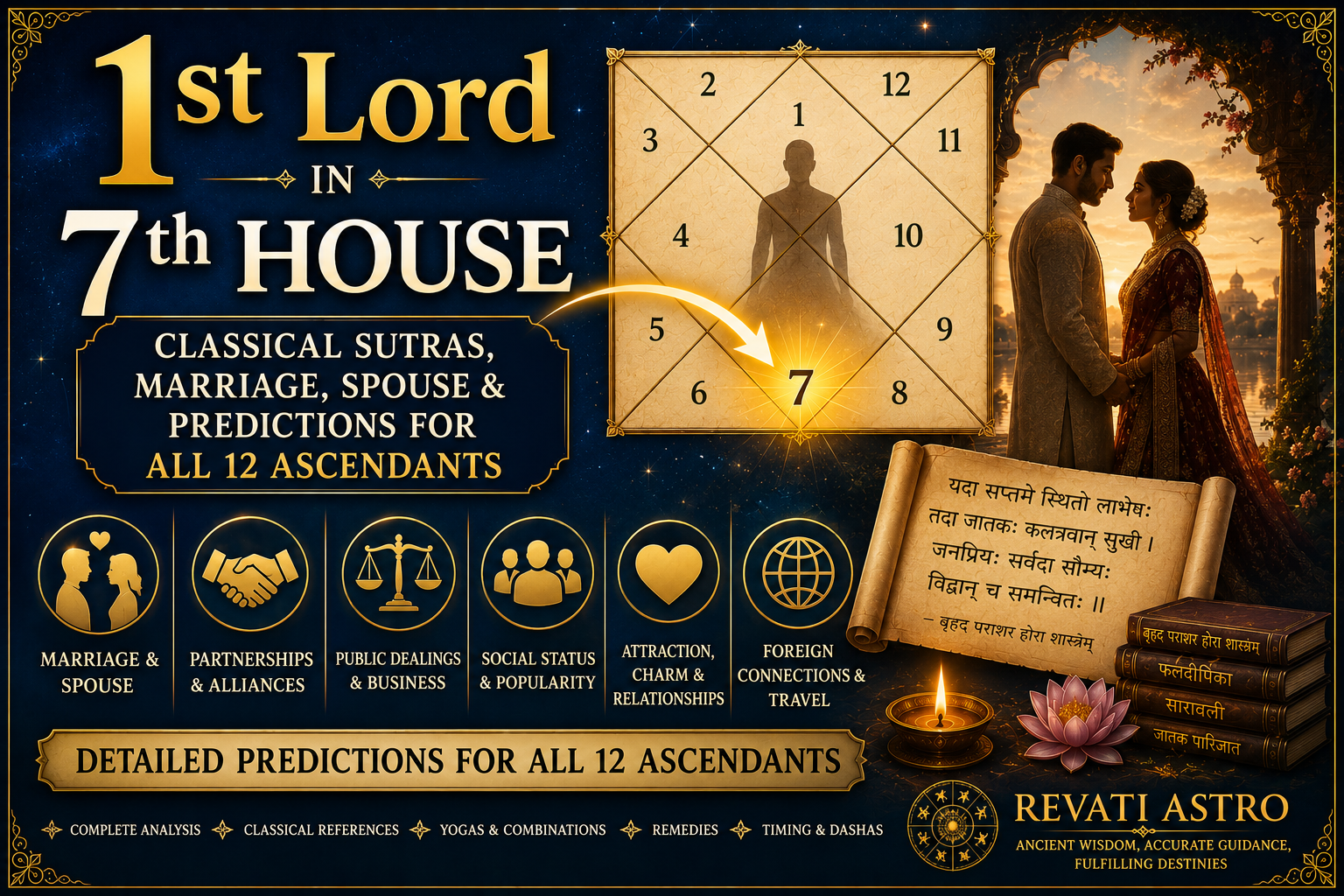
The self goes in search of its other half. In the horoscope, no axis is more fundamental than the 1st-7th axis — the axis of self and other, of identity and relationship, of the self one is and the self one becomes through union with another. When the Lagna Lord — the planet that carries your identity, your body, and your will to live — crosses the entire chart and descends into the 7th house, the house of marriage, partnership, public life, and the “not-self,” it makes a cosmic declaration: I find myself most fully in relationship.
The 7th house is called Kalatra Bhava (house of the spouse), Yuvati Bhava (house of youthful partnership), Jaya Bhava (house of victory through others), and Dvara Bhava (the gateway house — the door through which the outer world enters). It sits exactly opposite the Ascendant — the most philosophically charged position in the chart, because it is the point at which self meets not-self, at which identity confronts its own reflection in another person’s eyes.
This is also a placement of remarkable complexity. The 7th house is simultaneously a Kendra (creating a Rajyoga when the Lagna Lord enters it), a Maraka Sthana (a death-inflicting house that creates timing considerations around the Lagna Lord’s Mahadasha), and the primary house of fame, public life, and foreign travel. No competitor’s article addresses all three of these dimensions — and the failure to address them leaves the reader without the complete picture that this placement demands.
This is the guide that does justice to every dimension of the 1st lord in the 7th house — with the original Sanskrit BPHS sutra, the Self-Other Mirror philosophy, the Kendra Rajyoga decoded, the Maraka risk explained accurately (not alarmingly), the Kalatra Parivartana Yoga, detailed predictions for all 12 ascendants, spouse appearance by sign, multiple marriage indicators properly contextualised, D-9 and D-7 divisional analysis, Mahadasha timing, and classical remedies that address every dimension of this complex and ultimately beautiful placement.
📜 Table of Contents
- The 1st & 7th Houses: The Axis of Self and Other
- Classical Sutras — Original Sanskrit with Transliteration
- The 1st-7th Opposition: The Self-Other Mirror Decoded
- Kendra Rajyoga: The Partnership Path to Success
- The Maraka Dimension: What the Classics Really Say
- Kalatra Parivartana Yoga: The Most Powerful Marriage Yoga
- General Effects & Core Life Themes
- All 12 Ascendants — Detailed Predictions
- Spouse Prediction: Appearance, Character & Background
- Marriage: Timing, Quality & Multiple Partner Indicators
- Business, Fame & Public Life
- Foreign Travel, Residence & the 7th-9th Connection
- Health & the Maraka Timing Consideration
- Strong vs. Afflicted — The Complete Picture
- Navamsha D-9, D-7 Saptamsha & Divisional Analysis
- Mahadasha & Timing of Results
- Remedies: Classical, Mantra & Relational
- FAQ — 7 Questions Google Wants Answered
1. The 1st & 7th Houses: The Axis of Self and Other
1st House — Lagna / Tanu Bhava
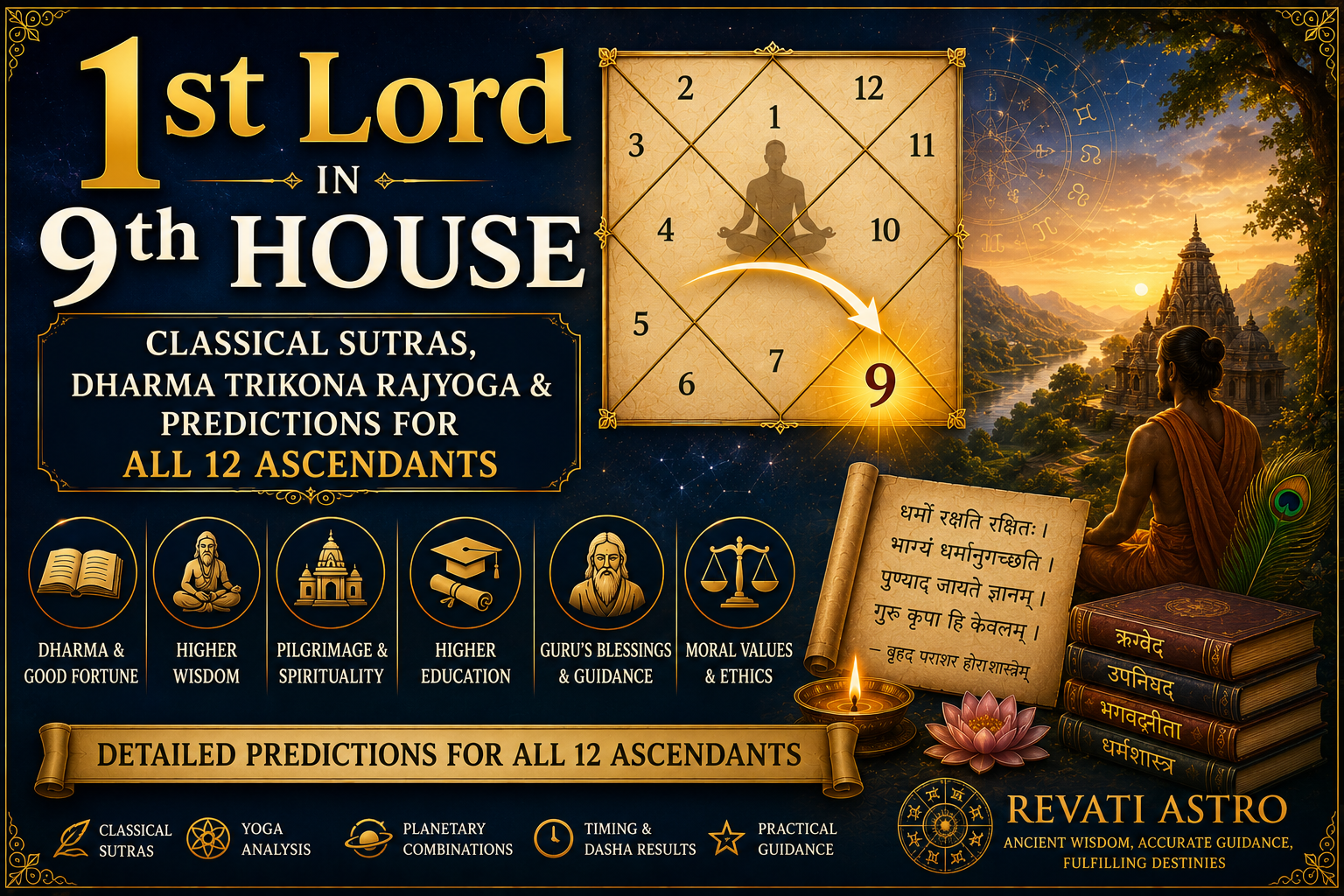
The 1st house is the eastern horizon at the moment of birth — the most personal and powerful coordinate in the horoscope. It governs the physical body, personality, self-concept, temperament, vitality, and life direction. Its lord is simultaneously a Kendra lord (structural pillar) and a Trikona lord (graceful trine) — the only planet with both designations, making it the most personally significant planet in the nativity. Wherever the Lagna Lord travels in the chart, the native’s life force, identity, and will travel with it.
7th House — Kalatra / Yuvati / Jaya / Dvara Bhava
The 7th house’s Sanskrit names reveal the full richness of its domain:
- Kalatra Bhava — house of the spouse, marriage, and marital bond
- Yuvati Bhava — house of youthful love, romantic partnership, and attraction
- Jaya Bhava — house of victory through others, triumph through partnership
- Dvara Bhava — the gateway house; the door through which others formally enter one’s life
- Vyavahara Bhava — house of public dealings, negotiations, contracts, and trade
- Dara Sthana — the place of the spouse (Dara = wife/husband in classical usage)
- Marga Bhava — house of the path ahead; foreign travel, pilgrimages, long journeys
The 7th house’s natural Karakas (significators) are Venus (for marriage in a man’s chart) and Jupiter (for marriage in a woman’s chart). Both planets represent the spouse’s qualities, and their strength in the chart directly determines the quality of the native’s marital experience. The 7th house also governs open enemies (as distinct from the 6th house’s hidden enemies) — people who oppose the native directly, publicly, and in formal or legal settings.
Structural Connections When the Lagna Lord Enters the 7th
When the Lagna Lord crosses to the 7th house, five critical structural connections activate:
- Kendra-Kendra Connection: The 1st and 7th are both Kendras — the Lagna Lord in the 7th Kendra creates the Kendra Rajyoga factor of sustained success and royal favour
- Exact Opposition (7th = 180° from 1st): No other house placement creates this degree of polarity — the native’s self (1st) is in direct, complete, face-to-face confrontation with the “other” (7th)
- Maraka Activation: The 7th is one of two Maraka houses — the Lagna Lord (planet of vitality) placed here creates specific longevity considerations that require careful Mahadasha analysis
- 1st House Aspect: The Lagna Lord in the 7th casts its 7th aspect directly back on the 1st house (its own house) — the planet continuously reflects its energy back to the Lagna, creating a self-reinforcing loop between identity and partnership
- Public Life Activation: The 7th house governs the public, the masses, and open social engagement — the Lagna Lord here makes the native naturally oriented toward and recognised by the public
The most philosophically significant structural feature: The Lagna Lord in the 7th house is the only placement where the planet aspects its own house directly (7th aspect from the 7th = back to the 1st). This creates a planetary feedback loop: the native’s identity constantly seeks itself through others, and the relationships it enters consistently mirror and reveal the native’s own deepest nature back to them. The 7th house placement of the Lagna Lord is, in the most literal astrological sense, a karmic looking-glass.
2. Classical Sutras — Original Sanskrit with Transliteration
लग्नेशे युवतिस्थाने देशान्तरगमी भवेत् ।
कामसक्तो महाभागो द्विभार्यः स्त्रीप्रियः सदा ॥
Transliteration: “Lagneśe yuvatisthāne deśāntaragamī bhavet | Kāmāsakto mahābhāgo dvibhāryaḥ strīpriyaḥ sadā ||”
Translation: “When the Lord of the Ascendant is placed in the 7th house (Yuvati Sthana), the native will travel to foreign lands (Desantara-gami), will be devoted to sensual pleasures (Kama-sakta), will be greatly fortunate (Maha-bhaga), may have two wives (Dvibharyah), and will always be fond of and devoted to women/spouse (Stri-priyah).”
Interpretation: Parasara presents four primary gifts of this placement: foreign travel (the 7th is the gateway to the outer world), passionate desire, great fortune, and devotion to spouse. The word “Maha-bhaga” (greatly fortunate) is especially significant — Parasara considers this placement fundamentally fortunate, not merely complicated. The “Dvibharyah” (two wives/two significant relationships) is a consistent classical pattern for this placement, discussed in full in Section 10.
“When the Lagna Lord is in the 7th house, the native will be valorous (Vikranta), passionate and sensually inclined (Kama-pravritti), will travel abroad (Para-desha-gami), and will be deeply devoted to the spouse (Bharya-bhakta). He will be known in society for his personality and will achieve success through partnerships and alliances.”
Interpretation: Mantreswara adds two distinctive elements: “valorous” (physical courage and strength) and “known in society” — the 7th house’s fame and public recognition dimension. Success through partnerships and alliances directly echoes the Kendra Rajyoga’s promise of institutional and relational success.
“If the Lagna Lord occupies the 7th house, the native will travel to foreign countries and will settle there for extended periods. He will be wealthy and respected. He will have a beautiful spouse and will derive great happiness from the marital relationship. He will be known for his diplomatic ability and social grace.”
Interpretation: Kalyana Varma’s unique additions: “beautiful spouse” (connecting the 7th house sign’s aesthetic qualities to the spouse’s appearance), “diplomatic ability” (the 7th house governs negotiations and social dealings), and “settle abroad for extended periods” — not just travel but foreign residence. This is a specific and practically significant prediction that distinguishes this placement from all others.
“When the Lagna Lord is in the 7th with Shubha yoga, the native achieves great success through marriage and business partnerships. The spouse is noble and the marriage brings prosperity. The native travels abroad and gains from foreign lands. With Ashubha yoga, the marriage is troubled and foreign journeys bring difficulty.”
Interpretation: Satya Jatakam’s Shubha/Ashubha conditional framework is especially revealing for this placement — the entire quality of marriage, foreign gain, and partnership success hinges on the strength of the Lagna Lord and its benefic or malefic associations.
“The native whose Lagna Lord is in the Kalatra Bhava will be greatly devoted to the spouse and will achieve success through partnership with others. He will be handsome, socially polished, and naturally attractive to others. He will travel to foreign lands and will achieve recognition through public dealings.”
Interpretation: “Handsome and socially polished” is a distinctive physical prediction — the Lagna Lord in the 7th often bestows personal attractiveness, social grace, and the kind of polished personality that creates natural magnetism in public settings. The connection between appearance and the 7th house sign is strong.
“When the lord of the ascendant is in the house of the spouse, the native is fortunate in marriage, acquires wealth through the spouse, and gains fame through public dealings. He is born with a disposition oriented toward others — his life’s meaning is found in the quality of his relationships.”
Interpretation: Varahamihira’s final phrase is philosophically the most profound: “his life’s meaning is found in the quality of his relationships.” For the 1st lord in the 7th house native, relationship is not a compartment of life — it is life. The spouse, the partners, the public — these are the mirrors through which the native’s identity finds its fullest, most authentic expression.
3. The 1st-7th Opposition: The Self-Other Mirror Decoded
🪞 Why the 7th House is the Most Profound Placement for the Lagna Lord
In Vedic astrology, the 7th house sits at exactly 180° from the Ascendant — a perfect opposition, the only exact angular relationship in the chart. In Vedic philosophy, the 7th house represents what Sanskrit calls the Anya (the other) — the not-self. The 1st house is the self you were born as; the 7th house is the self you discover through encounter with another person.
When the Lagna Lord — the planet of self — travels to the 7th house, it undertakes the most profound possible journey in the horoscope: it goes in search of itself in another. This creates the defining psychological pattern of the 1st lord in the 7th house native:
- Identity-through-relationship: The native does not know who they fully are outside of significant partnerships. Their most authentic self emerges in relationship with a worthy “other”
- The other as mirror: Partners, spouses, and even adversaries function as karmic mirrors — reflecting back to the native the aspects of themselves they most need to see, develop, or heal
- Magnetic social presence: Because their identity energy (Lagna Lord) is placed in the house of “how others see you” (7th house), these natives have a naturally magnetic, outwardly-oriented personality that others find compelling
- The paradox of self-loss: Precisely because the self (1st) is in the house of the other (7th), there is a subtle tendency toward losing oneself in relationships — the native must consciously maintain individual identity within partnership
The Lagna Lord in the 7th is also unique in that it continuously aspects back its own house (1st) through the 7th aspect — creating a feedback loop between identity and partnership that is unlike any other house placement. The native’s partnerships continuously reshape their identity, and their identity continuously reshapes the quality of their partnerships. This is the deepest meaning of the karmic looking-glass.
4. Kendra Rajyoga: The Partnership Path to Success
🏛️ The 7th House Kendra Rajyoga — Sustained Success Through Relationships
The 7th house is the Kendra opposite the Lagna — one of the four Vishnu Sthanas (abodes of the sustaining god). When the Lagna Lord, itself the lord of the most powerful Kendra, occupies the 7th Kendra, a Kendra-Kendra Rajyoga is formed — just as we have seen with the 1st lord in the 4th and 10th houses. The specific character of this Rajyoga is that success and recognition come through the vehicle of relationships, partnerships, public dealings, and the native’s capacity to work effectively with others.
Unlike the 4th house Rajyoga (success through domestic stability) or the 10th house Rajyoga (success through career achievement), the 7th house Rajyoga produces success through union — through business partnerships, marriage, client relationships, public recognition, diplomatic alliances, and any form of formal one-on-one engagement. These natives rise not alone but in tandem with a significant other — a business partner, a spouse, a key mentor, or a broad public constituency.
The royal favour dimension: Multiple classical texts note that the native with this placement achieves recognition from kings, government, and authority figures — which in the modern context means institutional recognition, public reputation, and the kind of social standing that comes from being genuinely valued by the people one serves through partnership and public dealings.
Key amplifiers of this Rajyoga: Lagna Lord in own sign or exaltation in the 7th; Venus (karaka of 7th house) strong and unafflicted; 7th lord also strong and connected to Kendra or Trikona; Jupiter’s aspect on the 7th house or Lagna Lord; Navamsha confirmation through strong 7th house in D-9.
5. The Maraka Dimension: What the Classics Really Say
⚠️ Understanding the Maraka (Death-Inflicting) Dimension — Accurately, Not Alarmingly
This is the most important technical dimension of this placement that every competitor’s article entirely omits — and its omission creates an incomplete and potentially misleading picture for the reader.
In classical Vedic astrology, the 2nd and 7th houses are designated as Maraka Sthanas (death-inflicting stations). The word “Maraka” comes from the root “Mar” (to kill/die) and refers to the houses whose lords can, under specific timing conditions, act as agents of the native’s mortality. The 7th house is a Maraka because it is the 8th house from the 12th (counting from the house of loss), and more importantly because it is the Kendra directly opposite life — the house that formally completes the arc from self to other, which at its furthest extreme becomes the transition from living to dying.
What this means for the 1st lord in 7th house native:
- The Lagna Lord — the planet of physical vitality, the body, and the life force itself — is placed in a Maraka house
- During the Mahadasha of the Lagna Lord, especially in its later years, and during specific Antardashas when multiple mortality indicators converge, health crises and mortality risks require careful attention
- The classical texts direct astrologers to look for “Maraka periods” — the Mahadasha/Antardasha of Maraka planets — as potential timing windows for significant health events
The critical context that prevents misreading this as doom:
- The Maraka effect activates ONLY when multiple simultaneous indicators in the chart support it — the 8th house (longevity house) must be afflicted, the native’s overall vitality must be weak, and the Maraka must be running in both major and minor periods
- A strong, well-aspected Lagna Lord in the 7th — especially with Jupiter’s aspect — is significantly protected from the Maraka’s negative expression and the same Mahadasha produces success, foreign travel, and marital prosperity instead
- The classical astrologers (including Parasara) describe the Lagna Lord in the 7th as “Maha-bhaga” (greatly fortunate) — so the primary narrative is prosperity and fortune, not mortality
- Every individual’s chart must be assessed holistically; the Maraka consideration is a reminder for careful timing analysis, not a death sentence
Practical guidance: If you have this placement, be especially attentive to health during the Lagna Lord’s Mahadasha — schedule regular medical check-ups, avoid major physical risks, and strengthen protective factors (Jupiter’s influence, good diet, regular exercise). The Maraka is manageable; it is not inevitable.
6. Kalatra Parivartana Yoga: The Most Powerful Marriage Yoga
💍 The 1st-7th Rasi Parivartana — When Self and Partnership Become One
The Kalatra Parivartana Yoga — also called the 1st-7th Rasi Parivartana or mutual exchange between the Lagna Lord and the 7th lord — occurs when the Lagna Lord is in the 7th house AND the 7th lord is simultaneously in the 1st house. This creates a complete, mutual exchange of energies between the house of self and the house of partnership — one of the most powerful relationship yogas in classical Vedic astrology.
When this yoga operates (both lords in each other’s houses):
- The native’s entire identity is fused with partnership — the self cannot be fully understood without the “other,” and the “other” cannot be understood without the self
- Marriage tends to be early, deeply meaningful, and central to every aspect of the native’s life — professionally, emotionally, and spiritually
- The spouse becomes the native’s most important professional and personal ally — they build life’s major achievements together
- The native is known to the world primarily through the lens of their partnerships — “the one who is with X” is how they are recognised
- Financial prosperity and social recognition arrive together with and through the marriage
- The yoga effectively combines the strength of both Kendra lords in each other’s houses, creating sustained success across all partnership domains
Examples by ascendant: Aries ascendant with Mars in Libra (7th) AND Venus in Aries (1st) — Mars and Venus exchange signs, creating this yoga. Cancer ascendant with Moon in Capricorn (7th) AND Saturn in Cancer (1st). Libra ascendant with Venus in Aries (7th) AND Mars in Libra (1st).
When only the Lagna Lord is in the 7th (without the 7th lord in the 1st): The yoga described throughout this article — powerful, relationship-oriented, and marriage-defining — operates in its partial but still very significant form.
7. General Effects & Core Life Themes
💑 Partnership-Centric Identity
The most fundamental truth of this placement is that the native’s sense of who they are is deeply and inseparably linked to their significant partnerships. They are not the solitary hero of their story — they are the one whose story becomes complete in union with another. This is not weakness; it is the natural expression of a cosmos in which the self and the other are, at the deepest level, one. These individuals are at their most powerful, most creative, and most themselves when they have a committed, worthy partner by their side.
This partnership orientation expresses itself across all life domains. In business, they prefer partnership structures over solo ventures — and their partnerships tend to be extraordinarily productive. In marriage, they are devoted, attentive, and genuinely invested in their partner’s happiness as a prerequisite for their own. In public life, they are at home in collaborative and diplomatic roles — positions that require working with others and serving a broader constituency.
🌍 Foreign Travel, Foreign Residence & International Orientation
Every classical source agrees on one practical prediction above all others for this placement: the native travels to foreign lands. The BPHS uses the specific word “Desantara-gami” — one who goes to foreign countries. Saravali adds “settles there for extended periods.” In the modern context, this manifests as extensive international travel for business, study abroad, international career placements, marriage to a person of foreign origin, or permanent relocation to a foreign country. The 7th house’s Marga Bhava (path/journey) dimension is activated by the Lagna Lord’s presence, making international movement a consistent and often defining feature of the native’s biography.
🌟 Public Life, Social Magnetism & Fame
The 7th house governs public dealings and the “public” as a collective entity — the masses who form the audience for the native’s life. With the Lagna Lord here, the native’s identity naturally orients toward and is recognised by the public. They carry a social magnetism that draws others — a quality that manifests in everything from large-scale public recognition (fame) to a simply compelling presence in social gatherings. Many prominent public figures — actors, politicians, business moguls, spiritual leaders with large followings — carry a strong 7th house Lagna Lord signature.
💰 Wealth Through Trade, Business & Partnership
The 7th house is the house of Vyavahara (trade and commerce) and of formal business contracts. The Lagna Lord placed here creates a native with natural commercial instincts and a talent for trade, negotiation, and deal-making. They understand the dynamics of exchange — what the other party needs, what they have to offer, and where the agreement that serves both sides lies. This commercial intelligence, combined with the Kendra Rajyoga’s promise of sustained success, makes this one of the stronger placements for wealth through business and partnership.
8. All 12 Ascendants — Detailed Predictions
| Ascendant | Lagna Lord in 7th | Sign in 7th House | Condition |
|---|---|---|---|
| Aries | Mars | Libra | Neutral (Venus’s sign) |
| Taurus | Venus | Scorpio | Neutral-Challenging |
| Gemini | Mercury | Sagittarius | Friendly (Jupiter’s sign) |
| Cancer | Moon | Capricorn | Debilitated |
| Leo | Sun | Aquarius | Neutral (Saturn’s sign) |
| Virgo | Mercury | Pisces | Debilitated (slightly) |
| Libra | Venus | Aries | Neutral (Mars’s sign) |
| Scorpio | Mars | Taurus | Friendly (Venus’s sign) |
| Sagittarius | Jupiter | Gemini | Neutral |
| Capricorn | Saturn | Cancer | Debilitated |
| Aquarius | Saturn | Leo | Neutral (Sun’s sign) |
| Pisces | Jupiter | Virgo | Debilitated |
♂ MarsAries Ascendant — Mars in Libra
The Diplomatic Warrior — Partnerships Built on Balance
Mars, Aries’ Lagna Lord, enters Venus-ruled Libra in the 7th house — the sign of its natural debilitation. However, this debilitation is not as severe as it seems, because Libra is the sign of relationships and Mars here is directed precisely toward the domain it needs to grow in — partnership. Mars in Libra in the 7th gives the native tremendous drive in relationship contexts, but with a learning curve: they must balance their natural assertiveness (Mars) with the diplomatic finesse (Libra) that the 7th house demands. The spouse is typically refined, aesthetically oriented, socially graceful, and intellectually balanced — a Venusian type who complements Mars’s directness with Libra’s harmony. These natives excel in business partnerships in legal, financial, design, or diplomatic fields. Foreign travel is strongly indicated, often through business deals or legal proceedings in international contexts. Mars also rules the 8th house (Scorpio) for Aries — making the marriage potentially transformative in nature, and introducing joint assets and inheritance dynamics. Watch for: Impulsive marriage decisions, power struggles within partnership, demanding too much of the spouse’s emotional bandwidth. Neecha Bhanga when Saturn is strong or Venus is strongly placed.
♀ VenusTaurus Ascendant — Venus in Scorpio
Deep Partnership & Transformative Love
Venus, Taurus’ Lagna Lord, is in Scorpio in the 7th house — a sign associated with depth, intensity, and transformation. Venus is technically debilitated in Scorpio by some classical schools, though others consider only specific degrees debilitated. Regardless, Venus in Scorpio in the 7th gives partnerships of extraordinary intensity, psychological depth, and transformative power. The native does not fall in love lightly — when they commit, they commit completely. The spouse tends to be psychologically complex, strategically minded, research-oriented, and intensely loyal once committed. Business partnerships tend to involve shared resources, insurance, research, or transformative financial instruments. Venus also rules the 12th house (Libra) for Taurus ascendant — connecting marriage and partnerships to foreign lands, spiritual life, and the possibility of a spouse from abroad. Watch for: Possessiveness, jealousy, and intensity that can suffocate partners who need more personal space; the transformative nature of this Venus means the native’s life genuinely changes — sometimes dramatically — through marriage.
☿ MercuryGemini Ascendant — Mercury in Sagittarius
Intellectual Partnership & Philosophical Union
Mercury, Gemini’s Lagna Lord, enters the expansive Jupiter-ruled Sagittarius in the 7th house. This gives a marriage built on intellectual companionship, philosophical alignment, and shared learning. The native is drawn to partners who are educated, well-traveled, philosophically oriented, and communicatively stimulating — the marriage is genuinely a meeting of minds as much as a union of hearts. Business partnerships tend to be in publishing, education, legal practice, travel, or international communication. Foreign travel and international experience are virtually guaranteed, often connected to educational or philosophical pursuits. Mercury also rules the 4th house (Virgo) for Gemini — connecting foreign adventure to eventual return to home roots. Watch for: Mercury in Sagittarius can over-promise in relationship contexts — the native may commit to more than they can deliver in marriage; the spouse’s philosophical or religious beliefs may occasionally conflict with the native’s more pragmatic communication style.
☽ MoonCancer Ascendant — Moon in Capricorn Debilitated
Emotionally Complex Partnership — Neecha Bhanga Through Saturn
The Moon, Cancer’s Lagna Lord, is debilitated in Capricorn in the 7th house — one of the more nuanced configurations for this placement. Moon in Capricorn loses its natural emotional fluidity, becoming rigid, emotionally reserved, and structured in relationship contexts. The native may struggle to express emotional vulnerability in marriage, or may experience a spouse who is emotionally cool, disciplined, or overly practical rather than warm and nurturing. Marriage may be delayed or approached with excessive caution. However, the Neecha Bhanga for Moon in Capricorn is powerful when Saturn (Capricorn’s lord) is strong, well-placed, or exalted — when this activates, the Moon in Capricorn in the 7th produces remarkably reliable, disciplined, and ultimately deeply loyal partnerships. The spouse, though reserved, is a pillar of practical support. Foreign residence is frequently connected to career-driven relocation. Watch for: Emotional distance in marriage, the native suppressing emotional needs to maintain appearances; the Moon’s Maraka potential in the 7th is amplified by its debilitation — the Lagna Lord Mahadasha requires careful health monitoring.
☀ SunLeo Ascendant — Sun in Aquarius
The Socially Visionary Partner — Community Through Marriage
The Sun, Leo’s Lagna Lord, enters Saturn-ruled Aquarius in the 7th house. The Sun in Aquarius loses some of its personal authority but gains a collective, humanitarian, and progressive orientation. The native’s identity in partnership contexts is social and community-minded — they are drawn to partners who serve large communities, who are innovators in their field, or who carry an independent, progressive vision. Marriage tends to be with someone of a different social background, ahead of their time in thinking, or involved in technology, social reform, or collective causes. Business partnerships thrive in technology, social enterprise, or community-oriented sectors. Foreign travel connects to social causes or international community work. The Sun in Aquarius in the 7th also creates a natural tension between the native’s Leo ego (individual recognition) and the spouse’s Aquarian need for collective identity. Watch for: Ego vs. equality tension in marriage; the spouse may resist the native’s need for personal recognition in the partnership; the Sun’s Maraka quality in the 7th house requires health vigilance during its Mahadasha.
☿ MercuryVirgo Ascendant — Mercury in Pisces Debilitated
Intuitive Union — Neecha Bhanga Through Jupiter & Venus
Mercury, Virgo’s Lagna Lord, is in Jupiter-ruled Pisces in the 7th house — debilitated, as Mercury is at its analytical nadir in the sign of spiritual dissolution. Mercury in Pisces in the 7th gives the native a dreamy, intuitive, and sometimes impractical approach to partnership. They may idealise partners and be slow to recognise practical incompatibilities. The spouse may be spiritually inclined, artistic, compassionate, or involved in healing — a Piscean type who values transcendence over practicality. However, the Neecha Bhanga for Mercury in Pisces is triggered when Jupiter (Pisces’ lord) is strong or in a Kendra — and given that Jupiter also rules the 4th and 7th houses for Virgo ascendant, there is significant structural support for this cancellation. When activated, Mercury in Pisces in the 7th gives an extraordinarily empathetic, creative, and spiritually oriented partnership. Mercury also rules the 10th house (Gemini) for Virgo ascendant — the native’s career is deeply connected to their marriage. Watch for: Illusions about partners, boundary dissolution in marriage, difficulty addressing practical relationship matters analytically.
♀ VenusLibra Ascendant — Venus in Aries
Passionate Pursuit & Courageous Love
Venus, Libra’s Lagna Lord, is in Mars-ruled Aries in the 7th house. Venus in Aries is enthusiastic, bold, and direct in love — a striking contrast to Libra’s natural diplomatic refinement. The native pursues partnership with Mars-like courage and initiative — they do not wait to be chosen; they choose. The spouse tends to be energetic, courageous, pioneering, and independently minded — someone who acts decisively and inspires the native with their vitality. Business partnerships thrive in entrepreneurial, competitive, or action-oriented fields. Venus also rules the 8th house (Taurus) for Libra ascendant — adding transformative financial depth to partnerships and the possibility of gaining through the spouse’s resources or inheritance. The Kalatra Parivartana Yoga is possible here when Mars is simultaneously in Libra in the 1st house. Watch for: Venus in Aries can rush into partnerships without adequate reflection; impulsive marriage decisions; the spouse’s independence (Aries) may create friction with the native’s need for relational harmony (Libra).
♂ MarsScorpio Ascendant — Mars in Taurus
Stable, Sensual Partnership & Material Prosperity Through Marriage
Mars, Scorpio’s Lagna Lord, is in Venus-ruled Taurus in the 7th house — a friendly, productive placement. Mars in Taurus in the 7th gives partnerships of remarkable material solidity, sensual warmth, and practical durability. The native invests their considerable energy into building stable, materially secure partnerships. The spouse is typically grounded, aesthetically refined, financially prudent, and physically attractive in a Taurean sense — someone who creates beauty and security. Business partnerships in real estate, agriculture, luxury goods, or finance thrive. Mars in Taurus also gives considerable physical attraction in the native — they carry a magnetic, earthy, confident presence. Mars also rules the 6th house (Aries) for Scorpio ascendant — giving the native excellent capacity to overcome relationship obstacles and service challenges through sustained effort. Watch for: Possessiveness toward the spouse (Mars in fixed Taurus in the 7th can create controlling relationship patterns); stubbornness in partnership disputes; over-investment in material security at the expense of emotional intimacy.
♃ JupiterSagittarius Ascendant — Jupiter in Gemini
The Intellectually Stimulating Marriage & Multi-Dimensional Partnership
Jupiter, Sagittarius’ Lagna Lord, is in Mercury-ruled Gemini in the 7th house. Jupiter in Gemini distributes wisdom across multiple channels simultaneously — the native is drawn to partners who are multi-talented, communicatively gifted, and intellectually versatile. The marriage is intellectually lively and perhaps occasionally scattered — the spouse has many interests and the native must appreciate this diversity rather than expecting singular focus. Business partnerships thrive in communication, media, education, publishing, or technology. Jupiter also rules the 4th house (Pisces) for Sagittarius ascendant — connecting the marriage to home life and creating a domestic happiness that is philosophically and intellectually rich. Foreign travel is strongly indicated, often for educational or spiritual purposes. Watch for: Jupiter in Gemini can be inconsistent — the native may attract partners who are intellectually brilliant but emotionally non-committal; the spouse’s many interests and social connections may require the native to develop genuine security in the relationship.
♄ SaturnCapricorn Ascendant — Saturn in Cancer Debilitated
Emotionally Demanding Partnership — Neecha Bhanga Through Moon
Saturn, Capricorn’s Lagna Lord, is debilitated in Cancer in the 7th house. Saturn in Cancer loses its characteristic structured discipline in the emotionally fluid domain of marriage — the native struggles to be emotionally present and nurturing in partnership contexts. The spouse may be emotionally demanding, overly dependent, or the marriage may feel like an emotional obligation rather than a joyful union. Delays in marriage are frequently observed. However, the Neecha Bhanga for Saturn in Cancer is triggered when the Moon (Cancer’s lord) is strong, exalted, or in a Kendra position — when this activates, Saturn in Cancer in the 7th produces a remarkably emotionally intelligent partner who combines Capricorn’s practical reliability with Cancer’s nurturing depth. The spouse, through their emotional strength, becomes the native’s greatest source of grounding. Watch for: This is the most challenging marriage configuration for this placement; without Neecha Bhanga, the marriage may be marked by emotional distance, separation, or duty-bound rather than love-driven union. Careful D-9 analysis and qualified astrological assessment are essential before marriage decisions.
♄ SaturnAquarius Ascendant — Saturn in Leo
Authority Through Partnership & Structured Public Life
Saturn, Aquarius’ Lagna Lord, is in Sun-ruled Leo in the 7th house. Saturn in Leo creates a notable tension — the planet of structure and discipline in the sign of individual creativity and authority. In the 7th house, this manifests as partnerships with authoritative, creative, or prominent individuals — the native is attracted to and attracts partners who are leaders, performers, or people of established social standing. The marriage may have a formal, structured quality where roles are clearly defined and mutual respect is based on acknowledged competence. Business partnerships with creative leaders or in leadership-oriented industries thrive. Foreign travel may be connected to government or institutional purposes. Watch for: Saturn in Leo can create ego friction in marriage — whose authority takes precedence? The native must consciously cultivate warmth and individual appreciation within the relationship structure they build.
♃ JupiterPisces Ascendant — Jupiter in Virgo Debilitated
Analytical Partnership — Neecha Bhanga Through Mercury
Jupiter, Pisces’ Lagna Lord, is debilitated in Virgo in the 7th house — Jupiter’s philosophical expansiveness is constrained by Virgo’s analytical, detail-oriented precision. The native may approach partnership too analytically — cataloguing the spouse’s flaws with Virgo’s critical eye rather than embracing them with Piscean compassion. The spouse tends to be organised, detail-oriented, health-conscious, and skilled — a Virgo type who grounds the native’s spiritual idealism in practical reality. The Neecha Bhanga for Jupiter in Virgo occurs when Mercury (Virgo’s lord) is strong, exalted, or in a Kendra. When activated, Jupiter in Virgo in the 7th produces partnerships of extraordinary practical and spiritual productivity — the wisdom of Jupiter refined by Virgo’s precision creates a couple that achieves together what neither could achieve alone. Jupiter also rules the 10th house (Sagittarius) for Pisces ascendant — the 1st-7th-10th triad links self, marriage, and career. Watch for: Over-critical assessment of partners, delayed marriage due to perfectionism, difficulty committing until all criteria are analytically satisfied.
9. Spouse Prediction: Appearance, Character & Background
One of the most searched topics related to the 7th house is the physical appearance and personal character of the spouse. The 7th house sign — combined with the Lagna Lord placed in it — gives the most detailed classical portrait of the spouse’s outer and inner qualities. The Lagna Lord placed in the 7th also means the native’s identity (their body, vitality, and personality) is directly entangled with their spouse’s qualities — they often attract someone who reflects or complements their own most prominent personal traits.
💍 Spouse Appearance & Character by 7th House Sign
| 7th House Sign | Ascendant | Spouse Appearance | Spouse Character |
|---|---|---|---|
| Aries | Libra | Athletic build, sharp features, reddish complexion, active energy | Courageous, independent, pioneering, direct, competitive |
| Taurus | Scorpio | Medium build, attractive, sensual presence, well-dressed | Grounded, loyal, artistic, financially stable, pleasure-loving |
| Gemini | Sagittarius | Tall, youthful, expressive face, quick movement | Intellectual, communicative, multi-talented, witty, versatile |
| Cancer | Capricorn | Round face, nurturing presence, emotional eyes, changing moods | Nurturing, home-oriented, emotionally sensitive, intuitive |
| Leo | Aquarius | Strong presence, regal bearing, prominent hair, confident | Authoritative, creative, generous, leadership-oriented, proud |
| Virgo | Pisces | Neat, orderly appearance, discerning eyes, health-conscious | Analytical, service-oriented, detail-focused, intelligent, modest |
| Libra | Aries | Beautiful, symmetrical features, elegant, socially polished | Diplomatic, aesthetic, fair-minded, socially graceful, balanced |
| Scorpio | Taurus | Intense eyes, magnetic presence, deep complexion, powerful | Psychologically deep, strategic, loyal, transformative, private |
| Sagittarius | Gemini | Tall, athletic, open expression, outdoorsy quality | Philosophical, adventurous, educated, optimistic, independent |
| Capricorn | Cancer | Strong bone structure, serious expression, disciplined | Practical, ambitious, responsible, disciplined, career-focused |
| Aquarius | Leo | Unique features, progressive style, intellectual presence | Innovative, community-minded, unconventional, visionary |
| Pisces | Virgo | Soft features, dreamy eyes, spiritual presence, gentle manner | Compassionate, spiritual, artistic, intuitive, emotionally giving |
The Darakarka — The Spouse Significator by Degree
Beyond the 7th house sign, the classical Jaimini system identifies the Darakarka — the planet with the lowest degree (excluding Rahu and Ketu) in the birth chart — as the specific significator of the spouse. When the Lagna Lord in the 7th house is also the Darakarka, the native’s marriage is of particular karmic significance — the spouse represents a soul-level contract rather than merely a social or romantic choice. Always check the Darakarka’s sign and position in D-9 for the most complete spouse prediction.
10. Marriage: Timing, Quality & Multiple Partner Indicators
Marriage Timing
The Lagna Lord in the 7th house generally creates a strong drive toward early marriage — the native feels incomplete without partnership and naturally moves toward formalising significant relationships. Marriage tends to occur during:
- The Mahadasha of the Lagna Lord itself — the most powerful trigger for marriage when the Lagna Lord is in the 7th
- The Mahadasha or Antardasha of the 7th lord — the house host’s period activates marital events
- Jupiter’s transit over the 7th house or natal Lagna Lord in the 7th — Jupiter transiting the 7th or its lord gives specific marriage timing triggers
- The Mahadasha of Venus (natural karaka of marriage for men) or Jupiter (for women) also frequently triggers marriage, especially when Venus or Jupiter is connected to the 7th house
Marriage Quality Indicators
✅ Indicators of a Happy, Prosperous Marriage
- Lagna Lord in own sign or exaltation in 7th (e.g., Venus in Taurus for Scorpio ascendant would be own sign in 7th)
- Jupiter aspects the 7th house or the Lagna Lord — the supreme marriage blessing
- 7th lord is strong and well-placed in a Kendra or Trikona
- Venus (for men) or Jupiter (for women) is strong, unafflicted, and connected to the 7th house
- D-9 (Navamsha) shows the Lagna Lord in a benefic sign with good aspects
- No malefic planets aspect both the 7th lord and Venus simultaneously
⚠️ Indicators of Marital Challenges
- Lagna Lord debilitated in 7th (Moon in Capricorn for Cancer; Saturn in Cancer for Capricorn; Jupiter in Virgo for Pisces)
- Rahu or Ketu conjunct the Lagna Lord in the 7th without benefic mitigation — creates karmic complexity in relationships
- Saturn and Mars simultaneously aspect the 7th house — creates delays and friction
- The 7th lord is in the 6th, 8th, or 12th house (Dusthana) without compensating yogas
- D-9 7th house heavily afflicted
The “Dvibharyah” Dimension — Multiple Relationships Decoded
BPHS uses the word “Dvibharyah” (literally, “two wives”) for this placement — and this prediction requires careful, contextual interpretation rather than literal reading. In the classical tradition, “two wives” is a shorthand for one of three realities:
- Literal second marriage: The first marriage ends through death, divorce, or separation, and the native remarries — this is more likely when the 7th house, 7th lord, and Venus are all simultaneously afflicted, and when the D-9 7th house is damaged
- Simultaneous relationships: In certain historical and cultural contexts, two concurrent relationships — this applies when the Lagna Lord is heavily afflicted and societal context supports it
- Modern interpretation: The most common modern expression is strong romantic desire, a history of significant pre-marital relationships that feel like “primary” partnerships, or a marriage where the spouse plays multiple roles (spouse AND business partner AND best friend) — the native effectively experiences two partnership dimensions in one person
The key principle: “Dvibharyah” in the classical literature is a probabilistic statement, not a certainty. It reflects the native’s powerful, identity-defining relationship drive — which can manifest as complexity or as the richness of a deeply multi-dimensional primary partnership, depending on the overall chart’s support.
11. Business, Fame & Public Life
The 7th house’s Vyavahara Bhava (trade and commerce) and Dvara Bhava (gateway to the outer world) dimensions make business and public life natural domains for the Lagna Lord placed here. Three specific expressions stand out:
🤝 Business Partnership Excellence
The native is a natural business partner — not a solo entrepreneur but someone whose ventures thrive in formal partnership structures. They understand the give-and-take of business relationships, excel in client-facing roles, and build their commercial success through the strength of their professional alliances. The Kendra Rajyoga dimension means these business partnerships tend to be sustained, productive, and mutually beneficial over the long term.
🎭 Fame, Public Recognition & the Social Stage
The 7th house governs “the public” in the broadest sense — the collective of people who formally engage with the native from the “other side” of their life. With the Lagna Lord here, the native naturally gravitates toward and receives recognition from this public. Actors, politicians, public intellectuals, spiritual teachers with large congregations, prominent business executives, and social media personalities with significant public followings often carry a strong 7th house Lagna Lord signature. Their personal identity is both expressed and shaped by public recognition.
⚖️ Legal, Diplomatic & Negotiation Mastery
The 7th house governs legal contracts and formal negotiations. The Lagna Lord here gives the native exceptional natural ability in negotiation, contract management, and diplomatic engagement — they understand how to reach agreements that honour both sides’ interests, making them effective lawyers, diplomats, mediators, and commercial negotiators. This skill is not merely intellectual; it is rooted in their deep, identity-level understanding of what the “other” needs and values.
12. Foreign Travel, Residence & International Life
The BPHS’s “Desantara-gami” (traveller to foreign lands) prediction is one of the most consistent and practically verified predictions for this placement across all 12 ascendants. The 7th house is the Marga Bhava (path/journey house) and the Dvara Bhava (gateway) — when the Lagna Lord activates it, the native’s sense of self expands naturally outward toward foreign lands, international cultures, and the experience of being a stranger in a new world who creates belonging through relationships rather than roots.
The forms this foreign orientation takes depend on the planet and sign:
- Mars (Aries/Scorpio) in 7th: Travel connected to competitive or professional confrontation — business battles in foreign markets, military or legal deployment abroad
- Venus (Taurus/Libra) in 7th: Travel connected to beauty, art, luxury, and romantic relationships — international creative collaborations, meeting a foreign spouse
- Mercury (Gemini/Virgo) in 7th: Travel connected to communication, trade, and education — international publishing, cross-cultural teaching, global business communication
- Moon (Cancer) in 7th: Travel connected to emotional pull and family dynamics — following a spouse abroad, nurturing-based international work
- Sun (Leo) in 7th: Travel connected to government, authority, and public recognition — diplomatic posting, international government service
- Jupiter (Sagittarius/Pisces) in 7th: Travel connected to education, wisdom, and spiritual learning — study abroad, pilgrimage, international teaching
- Saturn (Capricorn/Aquarius) in 7th: Travel connected to career discipline and long-term settlement — systematic emigration for career advancement, slow-building foreign residence
13. Health & the Maraka Timing Consideration
As detailed in Section 5, the 7th house’s Maraka Sthana classification creates specific health considerations. The body parts governed by the 7th house include the lower abdomen, kidneys, urinary tract, reproductive organs, and lumbar region. The Lagna Lord in the 7th may create sensitivity in these areas, particularly when the Lagna Lord is a malefic planet (Mars, Saturn) or is afflicted.
Practical Health Guidance
- Monitor kidney health (7th house’s primary body zone) throughout life
- Reproductive health deserves regular medical attention, especially when the Lagna Lord is a malefic
- During the Lagna Lord’s Mahadasha: schedule comprehensive health evaluations, maintain robust daily health practices, and ensure Jupiter’s protective influence is active through remedies
- Lumbar (lower back) conditions may emerge, particularly if Saturn is the Lagna Lord in the 7th
- The native’s overall health is deeply connected to the quality of their marriage — marital disharmony frequently manifests as physical health challenges in the 7th house body zone
The reassuring classical context: BPHS describes this native as “Maha-bhaga” (greatly fortunate) — the primary promise is prosperity and fortunate life, not health catastrophe. The Maraka consideration is a timing and vigilance factor, not a fate prediction.
14. Strong vs. Afflicted — The Complete Picture
✅ When the Lagna Lord in 7th is Strong
- Planet in own sign, exaltation, Moolatrikona, or strongly friendly sign in 7th
- Jupiter aspects the 7th house or the Lagna Lord — protects from Maraka, blesses marriage
- 7th lord is also strong and well-placed in Kendra or Trikona
- Venus (men) or Jupiter (women) is strong and unafflicted
- D-9 Lagna Lord in own/exaltation/Kendra/Trikona
- No malefic planets in the 7th house without benefic mitigation
Results: Beautiful, devoted, and prosperous spouse; excellent marital happiness; significant success through business partnerships; extensive and enriching foreign travel and residence; fame and public recognition; strong social magnetism; Kendra Rajyoga fully active — sustained success through all partnership domains; Maraka timing managed safely through natural chart strength.
⚠️ When the Lagna Lord in 7th is Weak or Afflicted
- Debilitated in 7th (Moon/Capricorn for Cancer; Saturn/Cancer for Capricorn; Jupiter/Virgo for Pisces)
- Combust within 6° of the Sun — especially significant given the Maraka potential
- Rahu or Ketu conjunct in 7th without benefic mitigation
- Malefic aspects from both Saturn and Mars simultaneously
- 7th lord also weak and in Dusthana
- Venus badly placed and afflicted (for men especially)
Results: Marital challenges, delays, or separation; difficulty in business partnerships; foreign travel that creates difficulties rather than opportunities; public reputation issues; identity lost in relationships to an unhealthy degree; potential health complications during Lagna Lord Mahadasha that require careful medical attention.
15. Navamsha D-9, D-7 Saptamsha & Divisional Analysis
D-9 (Navamsha) — The Marriage Destiny Chart
The Navamsha is the primary divisional chart for marriage analysis — more important for marriage than even the D-1 birth chart, according to many classical practitioners. For the 1st lord in 7th house placement:
- Vargottama Lagna Lord: Same sign in D-1 and D-9 — the marriage promise is doubled in power; the Kendra Rajyoga manifests fully; the spouse relationship is one of the most significant and defining of the life
- Lagna Lord exalted in D-9: Even a challenging D-1 placement (debilitation, malefic aspects) is significantly redeemed — the marriage ultimately proves deeply fulfilling at the soul level
- Lagna Lord in Dusthana in D-9 (6/8/12): The D-1 promise faces significant karmic resistance; the marriage may be more complex and challenging than the surface chart suggests; careful assessment and remedies are required before marriage decisions
- 7th house of D-9 and its lord: Always check the 7th house of D-9 independently from the Lagna Lord — if the D-9 7th house is strong, marriage is ultimately successful regardless of D-1 complications
D-7 (Saptamsha) — Partnership Karma Assessment
The D-7 divisional chart governs the relationship dimension of life partnerships beyond just children (its primary domain) — it reveals the karmic texture of primary partnerships. For the 1st lord in 7th house native, checking the Lagna Lord’s position in D-7 reveals whether the partnership karma is primarily accumulative (building toward something) or dispersive (relationships that teach through loss rather than gain).
Ashtamamsha (D-8) — Maraka Timing Verification
For the Maraka assessment, the D-8 chart (governing longevity and sudden events) is the specific divisional tool. The Lagna Lord’s position in D-8 reveals the extent to which its Maraka potential in the 7th house will activate at any specific timing window. A strong D-8 Lagna Lord position significantly mitigates Maraka risk; a weak D-8 placement warrants extra health vigilance during the Lagna Lord’s Mahadasha.
16. Mahadasha & Timing of Results
Mahadasha of the Lagna Lord in the 7th house — primary activation period. Expect the following in order of typical manifestation:
- Marriage: The most likely Mahadasha for formal marriage when the Lagna Lord is in the 7th; the period brings the “other” into focus as the primary life theme
- Business partnerships formed: Major commercial alliances, joint ventures, and formal business partnerships tend to crystallise during this period
- Foreign travel and potential foreign residence: The “Desantara-gami” promise activates — significant international experience clusters in this Mahadasha
- Public recognition: The native’s social reputation and public standing peak during this period when the Lagna Lord is strong
- Health awareness: Particularly in the second half of the Mahadasha, health vigilance is classical wisdom — schedule regular check-ups, strengthen Jupiter’s protective energy through remedies
Other Key Activation Periods
- Mahadasha of 7th lord: Deeply activates all 7th house themes — marriage events, partnership formations, foreign travel, and public dealings
- Venus Mahadasha (men): Venus as natural karaka of marriage activates all partnership themes; if Venus connects to the 7th house in any way, marriage almost certainly occurs during this period
- Jupiter Mahadasha (women): Same principle — Jupiter’s natural karaka role for female marriage makes this Mahadasha a primary marriage window
- Jupiter’s transit over the 7th house or natal Lagna Lord: The single strongest annual/biennial trigger for marriage, business partnership formation, and foreign opportunities
- Rahu/Ketu transit through the 1st-7th axis: Creates significant relational transformation — either bringing a major partnership event or transforming an existing relationship fundamentally
- Saturn’s transit through the 7th house: A period of relationship restructuring — delays or solidification of existing partnerships; sometimes brings important karmic relationship encounters
17. Remedies: Classical, Mantra & Relational
Universal Remedies for 1st Lord in 7th House
- Worship Lord Vishnu on Ekadashi (11th lunar day): The 7th house is a Kendra — a Vishnu Sthana. Lord Vishnu governs the sustaining energy of partnerships and the sustaining quality of the 7th house’s promise. Ekadashi fasting and Vishnu worship is the single most classical remedy for strengthening 7th house energy
- Chant the Vivaha Panchami mantra or any Lakshmi mantra: Partnership prosperity is a Lakshmi blessing — regular Lakshmi worship strengthens the 7th house’s material and relational abundance
- Honour the spouse: For those already married, conscious acts of appreciation, gratitude, and service toward the spouse directly strengthen the 7th house in the chart — the spouse is the living representative of the Lagna Lord’s 7th house energy
- Wear the gemstone of Venus (Diamond or White Sapphire): Venus is the natural karaka of marriage and the 7th house. Strengthening Venus through gemstone therapy supports the 7th house’s full promise — but ONLY after qualified chart assessment, as Venus rules different houses for different ascendants
- Keep the marriage space sacred: The bedroom and the home’s relationship spaces should be kept clean, beautiful, and energetically clear — as physical representations of the 7th house’s domestic expression
- Avoid confrontational open enemies: The 7th house governs open enemies alongside spouse — maintaining diplomatic, fair engagement with adversaries rather than escalating conflict honours the 7th house’s Jaya Bhava (victory through partnership, not confrontation) energy
Planet-Specific Remedies
| Lagna Lord | Ascendant | Key Remedy | Mantra | Day |
|---|---|---|---|---|
| Sun | Leo | Offer Arghya at sunrise; donate wheat & copper on Sundays; Aditya Hridayam recitation | Om Hraam Hreem Hraum Sah Suryaya Namah | Sunday |
| Moon | Cancer | Fast Mondays; offer milk to Shiva; silver ornaments; donate white rice on Mondays | Om Shraam Shreem Shraum Sah Chandraya Namah | Monday |
| Mars | Aries, Scorpio | Hanuman temple Tuesdays; donate red lentils; recite Mangal Stotram for partnership harmony | Om Kraam Kreem Kraum Sah Bhaumaya Namah | Tuesday |
| Mercury | Gemini, Virgo | Feed cows on Wednesdays; donate books; practice conscious, truthful communication with partner | Om Braam Breem Braum Sah Budhaya Namah | Wednesday |
| Jupiter | Sagittarius, Pisces | Donate to marriages of underprivileged couples; touch feet of elders; chant Guru Stotram | Om Graam Greem Graum Sah Guruve Namah | Thursday |
| Venus | Taurus, Libra | Worship Lakshmi with white flowers on Fridays; donate sweets to young women; keep rose quartz at home | Om Draam Dreem Draum Sah Shukraya Namah | Friday |
| Saturn | Capricorn, Aquarius | Serve elderly couples on Saturdays; donate sesame oil; light sesame oil lamp at Shani temple | Om Praam Preem Praum Sah Shanaischaraya Namah | Saturday |
The Vivah Panchami Mantra — Partnership & Marriage Strengthening
ॐ श्री राम जानकी वल्लभाय स्वाहा ।
“Om Shri Rama Janaki Vallabhaya Svaha ||”This mantra, chanted on the anniversary of Rama and Sita’s divine marriage (Vivah Panchami — Margashirsha Shukla Panchami), invokes the blessing of the most celebrated divine union in Vedic tradition. Chanting 108 times during the Mahadasha of the Lagna Lord strengthens the 7th house’s marriage energy and protects the partnership from adversarial influences. Regular chanting — even daily — is considered a powerful strengthener of existing marriages and an attractor of the right partner for those unmarried.
Maraka Protection — Specific Remedy for the Longevity Dimension
For the health and longevity protection specific to the Maraka dimension of this placement:
- Chant the Maha Mrityunjaya Mantra (108 times daily during the Lagna Lord’s Mahadasha)
- Strengthen Jupiter through weekly Thursday fasting and Jupiter mantra — Jupiter’s aspect on the 7th house or Lagna Lord is the single most powerful natural protection against Maraka activation
- Wear a Rudraksha (specifically the 5-mukhi/five-faced Rudraksha, sacred to Lord Shiva as the Mrityunjaya — conqueror of death) during the Lagna Lord’s Mahadasha
- Regular health check-ups — the classical tradition recognises that knowledge and prevention are as valid as mantra and gemstone in managing Maraka timing
18. FAQ — 7 Questions Google Wants Answered
Q1: Is 1st lord in 7th house good or bad in Vedic astrology?
Overall, this is a positive and fortunate placement. BPHS describes the native as “Maha-bhaga” (greatly fortunate). The 7th is a Kendra, and the Lagna Lord in a Kendra creates a Rajyoga factor of sustained success. The native is naturally oriented toward and benefits from partnership, public life, business alliances, marriage, and foreign experience. The primary nuance is the Maraka dimension — the 7th is a Maraka house, requiring health vigilance during the Lagna Lord’s Mahadasha. With a strong placement and Jupiter’s protective aspect, this is one of the most relationship-rich, internationally active, and publicly recognised of all Lagna Lord positions.
Q2: What is the BPHS sutra for Lagna Lord in 7th house?
The original Sanskrit: “Lagneśe yuvatisthāne deśāntaragamī bhavet | Kāmāsakto mahābhāgo dvibhāryaḥ strīpriyaḥ sadā ||” — When the Lagna Lord is in the 7th house, the native will travel to foreign lands, will be devoted to sensual pleasures, will be greatly fortunate, may have two wives/strong romantic inclinations, and will always be devoted to and fond of the spouse. This sutra presents four primary themes: foreign travel, passionate desire, great fortune, and spouse-devotion — all fundamentally positive.
Q3: Does 1st lord in 7th house indicate multiple marriages?
BPHS uses “Dvibharyah” (two wives) — indicating strong romantic inclinations and the possibility of multiple significant relationships. This manifests as actual second marriage only when the 7th house and 7th lord are afflicted, Venus (for men) is weak and troubled, and the D-9 confirms marital instability. The most common modern expression is a deeply passionate, identity-defining relationship drive — the native may have significant pre-marital relationships, or may experience one marriage that is multi-dimensional enough to feel like two (spouse AND best friend AND business partner). Literal multiple marriages require multiple simultaneous malefic indicators in the chart.
Q4: Does 1st lord in 7th house give a good spouse?
Yes, when well-placed. Saravali specifically states “beautiful spouse” and Jataka Parijata says the native will be “greatly devoted to the spouse.” The spouse’s appearance and character are described by the 7th house sign (see the spouse prediction table in Section 9). A strong Lagna Lord in the 7th with Jupiter’s aspect gives a spouse who is attractive, noble, prosperous, and deeply aligned with the native’s values. The D-9 (Navamsha) is the definitive chart for spouse quality assessment — check the 7th house of D-9 and the Darakarka planet for the most complete portrait.
Q5: What is the Maraka effect of 1st lord in 7th house?
The 7th is a Maraka Sthana (death-inflicting house). The Lagna Lord here means the planet of vitality is placed in a Maraka house — creating timing considerations during the Lagna Lord’s Mahadasha. The Maraka activates ONLY when multiple chart indicators support it (weak 8th house, afflicted Lagna, Maraka running in both Maha and Antardasha). A strong Lagna Lord with Jupiter’s aspect is significantly protected. The practical guidance is health vigilance during the Lagna Lord’s Mahadasha — regular check-ups, protective mantras (Maha Mrityunjaya), and strengthening Jupiter. The primary BPHS narrative remains “Maha-bhaga” (greatly fortunate) — not health catastrophe.
Q6: What is the Kalatra Parivartana Yoga?
Kalatra Parivartana Yoga occurs when the Lagna Lord is in the 7th house AND the 7th lord is simultaneously in the 1st house — a mutual exchange creating a complete merger of self and partnership energy. It produces natives who are defined by their relationships, who tend to marry early and well, whose spouse becomes their primary life partner in every dimension, and who achieve major life success through the vehicle of their primary partnership. This is one of the most powerful marriage yogas in Vedic astrology, and it specifically requires both lords to be in each other’s houses simultaneously.
Q7: Which ascendants get the best results with 1st lord in 7th house?
Scorpio ascendant (Mars in friendly Taurus in 7th — material prosperity through partnership), Gemini ascendant (Mercury in friendly Sagittarius in 7th — intellectual and philosophical marriage), and Aries ascendant (Mars in Libra in 7th — diplomatic refinement through partnership) tend to show the most balanced positive results. Libra ascendant (Venus in Aries in 7th — courageous love with own-sign Kendra Rajyoga energy) and Aquarius ascendant (Saturn in Leo in 7th — authority through public partnership) also produce strong outcomes. The most challenging configurations are Cancer (Moon debilitated in Capricorn), Capricorn (Saturn debilitated in Cancer), and Pisces (Jupiter debilitated in Virgo) ascendants, all requiring Neecha Bhanga activation to realise the full promise.
Conclusion: The Self Completed Through the Other
The 1st lord in the 7th house is the chart of a soul whose journey toward self-knowledge runs through the gateway of the other. It is the placement of the deeply relational being — one who finds themselves most fully in committed partnership, who builds their public legacy through alliance and collaboration, who travels the world not as a solitary explorer but as someone who creates belonging in every foreign land they enter through the force of their personality and the quality of their relationships.
Every classical author — from Parasara to Mantreswara, Kalyana Varma to Vaidyanatha Dikshita, and Varahamihira himself — presents the same fundamental verdict: this native is greatly fortunate (Maha-bhaga), devoted to the spouse, oriented toward the outer world, and destined to achieve success through the vehicle of formal partnerships and public life. The Kendra Rajyoga confirms the structural promise. The “Dvibharyah” nuance reminds us of the passionate, relationship-defining nature of this placement’s desire. The Maraka consideration calls us toward health vigilance rather than health fear. And the Self-Other Mirror — the 1st-7th opposition — invites the deepest philosophical contemplation: you discover who you are by encountering who the other is.
If you have this placement and want to understand exactly how it operates in your specific Kundli — which Mahadasha brings your marriage, whether Kalatra Parivartana Yoga operates in your chart, how your D-9 confirms or modifies the D-1 promise, and which precise remedies align best with your unique nativity — a personalised consultation with Daksh Maheshwari at Revati Astro offers the classical depth and modern clarity you deserve.
Your partner is your mirror. Your marriage is your method. Your relationships are your most authentic form of self-knowledge. 🙏
Disclaimer: Astrology is an ancient science of self-understanding and timing. All predictions are generalised classical interpretations for educational purposes. Individual chart analysis by a qualified astrologer is always recommended before major life decisions. © 2025–26 Revati Astro. All rights reserved.